
Lori A. Leslie, MD, discusses the efficacy and safety of second-line axicabtagene ciloleucel in elderly patients with high-risk, relapsed/refractory large B-cell lymphoma.
Lori A. Leslie, MD, discusses the efficacy and safety of second-line axicabtagene ciloleucel in elderly patients with high-risk, relapsed/refractory large B-cell lymphoma.
Andre Goy, MD, discusses the prevalence of high-risk clinical features in patients with mantle cell lymphoma and their influence on treatment approaches.
Adnan F. Danish, MD, discusses findings from a study evaluating the prevalence of patients with high-risk non-Hodgkin lymphoma who were eligible for bridging radiation therapy prior to receiving CAR T-cell therapy, as well as the outcomes of these patients following CAR T-cell therapy.

Lori A. Leslie, MD, discusses the benefits of implementing CAR T-cell therapy programs for patients with hematologic malignancies and highlights the successes with administering CAR T-cell therapy that JTCC has experienced.
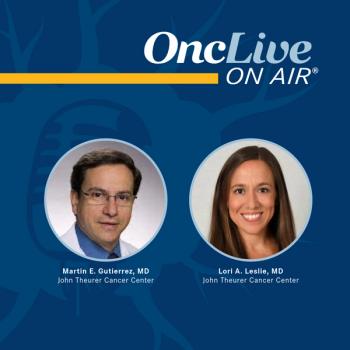
Drs Gutierrez and Leslie discuss common barriers that institutions face when implementing CAR T-cell therapy programs, the early success story of outpatient administration of this modality at John Theurer Cancer Center, and future considerations for using this treatment approach in solid tumors.
Closing out their discussion on myelofibrosis management, experts from the John Theurer Cancer Center consider novel therapies under investigation and the future treatment paradigm.
Broader perspectives on the optimal selection and sequencing of systemic therapy in patients diagnosed with myelofibrosis.
After reviewing the second patient scenario of myelofibrosis, experts from the John Theurer Cancer Center discuss the use of JAK inhibitors, specifically ruxolitinib, to manage patients in the frontline setting.
Key opinion leaders on myelofibrosis management consider the potential role of momelotinib within the current treatment paradigm.
Surgeons affiliated with Hackensack Meridian JFK University Medical Center’s Advanced Lung and Airway Center successfully performed the first robotic resection of malignant thymoma, a cancer of the thymus gland, followed by installation of heated chemotherapy into the chest.
Adnan F. Danish, MD, discusses the potential for SCINTIX radiation technology to open new treatment opportunities for patients with cancer, including those with lung and bone cancers, whose disease has metastasized to more than 5 sites.
Shared insight on the safety profile of pacritinib and how best to mitigate or manage adverse events when they occur in patients with myelofibrosis.
Experts continue their conversation on pacritinib in myelofibrosis by reviewing its potential impact on anemia and ACVR1.
Dr Danish discusses barriers to using radiotherapy for the treatment of patients with metastatic lung and bone cancers; the novel capabilities of SCINTIX biology-guided technology; and how John Theurer Cancer Center plans to use this technology and help advance its role in the field of radiation oncology.
Adnan F. Danish, MD, discusses the methodologies behind the use of SCINTIX radiation technology in metastatic bone and lung tumors, detailing how this technology differs from computed tomography or magnetic resonance imaging scans prior to treatment.
Centering discussion on the JAK inhibitor pacritinib, expert panelists review data from recent clinical trials and consider how they inform real-world use of this agent.
Key opinion leaders provide a broad perspective on the current treatment armamentarium available to patients diagnosed with myelofibrosis.
A comprehensive discussion on the members of a healthcare team who might help to diagnose and manage a patient with myelofibrosis.
Expert panelists consider key molecular markers that guide the classification and management of myelofibrosis, along with other important subsets of disease.
Adnan F. Danish, MD, discusses the use of SCINTIX radiation technology in metastatic bone and lung tumors.
Adnan F. Danish, MD, discusses unmet needs in the treatment of patients with lung and bone cancers, and how unmet needs within this patient population are being addressed with the utilization of SCINTIX radiation technology.
Adnan F. Danish, MD, discusses the use of novel radiotherapy approaches in cancer care.
Adnan F. Danish, MD, discusses current unmet needs in the treatment of patients with stage IV lung and bone cancers, the benefits SCINTIX technology can provide for these patients, and how John Theurer Cancer Center plans to use this technology to improve patient outcomes and support further radiation therapy research.
Press Release
Jersey Shore University Medical Center is among the first hospitals in New Jersey to provide the HAI pump, which is offered at few hospitals in the country, enabling the N.J. community to stay close to home for care.
After reviewing the first patient scenario of myelofibrosis, experts from the John Theurer Cancer Center reflect on best practices in diagnosing and risk stratifying patients.
Andre Goy, MD, discusses advances in the field of oncology that prompted the development of the Hennessy Institute, how early cancer detection can improve patient outcomes, and the importance of employing accessible cancer prevention strategies.
Andre H. Goy, MD, discusses the appropriate monitoring and management of patients with mantle cell lymphoma who display genetic abnormalities but are not considered to be high risk.
Andre H. Goy, MD, discusses differentiating between disease presentations in mantle cell lymphoma.

The family of Mike and Patti Hennessy made a transformational gift in their memory to establish the Hennessy Institute for Cancer Prevention and Applied Molecular Medicine.
As artificial intelligence in cancer care continues to be better understood and refined, the number of potential clinical applications is rapidly expanding.