
Opinion|Videos|September 25, 2026
Approaches to Second-Line Therapy After Checkpoint Inhibitor Failure
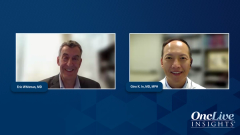
Author(s)Eric Whitman, MD, Gino Kim In, MD
The faculty address management after progression on checkpoint inhibitor monotherapy in patients who are not candidates for further surgery or radiation.
Advertisement
The faculty address management after progression on checkpoint inhibitor monotherapy in patients who are not candidates for further surgery or radiation. Dr In outlines his approach to second-line therapy, including EGFR-directed treatment with cetuximab, which retains activity in cutaneous squamous cell carcinoma, and the alternative option of panitumumab. The faculty discuss dosing and scheduling considerations, including weekly and every 2 week EGFR-directed regimens compared with the every 3 week schedule used for immunotherapy, and how those logistics affect older patients traveling for infusions. Dr Whitman raises combination approaches under investigation, referencing a randomized phase 2 study evaluating avelumab with cetuximab compared with avelumab alone in advanced disease. Both faculty encourage clinical trial enrollment where available and note that cytotoxic chemotherapy remains a consideration in selected patients, though with limited durability compared with checkpoint blockade in the frontline setting.
Advertisement
Related to this article
Read a refresh of GI cancer FDA news from August 2026, including the approval of a RAS(ON) inhibitor in metastatic pancreatic cancer.

The FDA has approved belzutifan (Welireg) plus lenvatinib (Lenvima) for use in patients with advanced renal cell carcinoma with a clear cell component after PD-1 or PD-L1 inhibition.
R. Lor Randall, MD, FACS, discusses AI in musculoskeletal tumor diagnosis, surgical planning and robotics, and validation of AI tools.

MAPK drugs restore TSHR in aggressive thyroid tumors, helping CAR-T cell therapy see and control solid tumors again.
An FDA advisory committee voted in favor of the benefits of the Galleri MCED test outweighing its risks in patients 50 years of age and older.
Novel approaches to the use of AI in oncology may require discussion and ultimately modification of existing proprietary and regulatory barriers.
Extended follow-up from the phase 1b CAMMA 1 trial showed durable responses across two cevostamab dose levels, supporting selection of a recommended phase 3 regimen.

A MAIC found anito-cel produced response rates similar to those of cilta-cel, with fewer high-grade toxicities, in relapsed/refractory multiple myeloma.
Advertisement
Advertisement
Trending on OncLive
1
FDA Approves Belzutifan Plus Lenvatinib for Advanced ccRCC
2
Study Shows Reprogramming Thyroid Tumors May Improve CAR-T Cell Therapy
3
AI Enables Enhanced Decision Making and New Opportunities in Orthopedic Oncology
4
Breaking Down the FDA Approval of Zanidatamab-Based Regimens in HER2+ Gastric Cancer
5