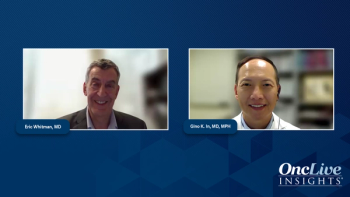
Dr Whitman closes the discussion by asking Dr In where he sees treatment of advanced cutaneous squamous cell carcinoma evolving and what developments he most hopes to see.
Gino Kim In, MD, is a medical oncologist, Medical Oncology, Melanoma Surgery, Sarcoma and Melanoma Surgery and associate professor of clinical medicine at USC's Keck School of Medicine.
Dr Whitman closes the discussion by asking Dr In where he sees treatment of advanced cutaneous squamous cell carcinoma evolving and what developments he most hopes to see.
The faculty address management after progression on checkpoint inhibitor monotherapy in patients who are not candidates for further surgery or radiation.
Dr Whitman poses a variation on the second case, asking how management would change if the patient were a kidney transplant recipient rather than a patient with chronic kidney disease alone.
The faculty consider whether neoadjuvant checkpoint inhibitor therapy has a role in cutaneous squamous cell carcinoma, particularly for tumors that are borderline resectable or would require morbid surgery.
Dr Whitman describes what stands out clinically about the 79-year-old patient, beginning with the interaction between advanced age, accumulated chronic disease, and the clinical impression formed at the bedside.
Dr Whitman presents the second clinical scenario, a 79-year-old woman with a large ulcerated cutaneous squamous cell carcinoma of the right lower leg measuring 6.8 cm and progressively enlarging over roughly 8 months.
The faculty examine how comorbidities factor into the adjuvant treatment decision for the 68-year-old patient, who carries a cardiac history and diabetes.
Dr Whitman presents the first clinical scenario, a 68-year-old man with a cutaneous squamous cell carcinoma of the temple who has undergone resection.
Dr Whitman raises a further structural distinction, noting that cosibelimab retains an active Fc domain capable of mediating antibody-dependent cellular cytotoxicity.
With efficacy across the approved checkpoint inhibitors largely comparable, the faculty turn to tolerability as a differentiating factor and examine cosibelimab in detail.
Dr Whitman introduces cosibelimab, the third checkpoint inhibitor approved in advanced cutaneous squamous cell carcinoma, and the faculty examine what distinguishes it mechanistically from cemiplimab and pembrolizumab.
The faculty examine KEYNOTE-630, the adjuvant trial of pembrolizumab in cutaneous squamous cell carcinoma, and why it produced a different result than C-POST.
Dr Whitman and Dr In discuss the FDA approval of adjuvant cemiplimab for patients with high-risk cutaneous squamous cell carcinoma who have completed surgery and adjuvant radiation yet remain at elevated risk for recurrence.
Eric Whitman, MD, of Atlantic Health, and Gino K. In, MD, MPH, of USC Norris Comprehensive Cancer Center, open this OncLive My Treatment Approach program on matching immunotherapy to the patient in advanced cutaneous squamous cell carcinoma.
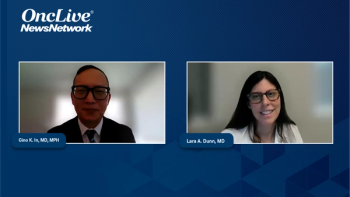
Dr Dunn delivers key takeaways for community oncologists and dermatologists managing advanced cutaneous squamous cell carcinoma.
Dr In and Dr Dunn turn to remaining unmet needs in advanced cutaneous squamous cell carcinoma, focusing on high-risk populations routinely excluded from pivotal trials, including solid organ transplant recipients, patients with hematologic malignancies, and those with autoimmune disease.
Dr In reviews the safety and tolerability profile of cosibelimab in the updated locally advanced cohort, an older patient population in which tolerability carries particular weight.
Dr Dunn interprets the efficacy and durability findings from the updated cosibelimab locally advanced cohort, characterizing the overall response rate exceeding 50% and the unreached median duration of response at 31 months of follow-up as impressive.
Dr In walks through the updated locally advanced disease cohort data from the CK-301-101 study of cosibelimab, presented at the 2026 ASCO Annual Meeting.
Dr. Dunn describes how she uses immune checkpoint inhibitors in locally advanced cutaneous squamous cell carcinoma, distinguishing neoadjuvant therapy from checkpoint blockade given as a replacement for curative therapy.
Gino K. In, MD, MPH, of the USC Norris Comprehensive Cancer Center, and Lara A. Dunn, MD, of Memorial Sloan Kettering Cancer Center, open a discussion of newly reported long-term follow-up data on cosibelimab in locally advanced cutaneous squamous cell carcinoma.
Gino Kim In, MD, shares findings from a subgroup analysis of RP1 efficacy in injected and non-injected melanoma lesions after PD-1 inhibitor progression.