
Opinion|Videos|July 1, 2026
Communicating with patients and families about investigational EZH2 inhibition
Explore where EZH2 inhibitors pair with enzalutamide in mCRPC, offering an early, oral option with broad eligibility and fewer therapy restrictions.
Advertisement
Episodes in this series
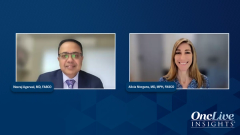
Dr. Morgans asks Dr. Agarwal how he communicates the goals, benefits, and uncertainties of EZH2 inhibition plus enzalutamide to patients and families. Dr. Agarwal describes a structured approach to these nuanced conversations.
He starts with the why: enzalutamide targets the androgen receptor (AR), but cancers can become resistant. EZH2 is part of an epigenetic pathway that helps tumors adapt, so the combination aims to block both the primary driver and a resistance mechanism. He sets expectations honestly: early data are encouraging—citing the 6-month versus 14.3-month progression-free survival difference seen in the dose-expansion data—but the approach remains investigational, and the phase 3 trials are designed to confirm whether the combination is better than standard treatments.
Dr. Agarwal keeps the trial design simple, explaining that some studies compare the combination to physician (or patient) choice while others compare it directly to enzalutamide alone, and that randomization is how the field determines what works. He notes that the control arms include very appropriate therapies, removing the discomfort of offering an unacceptable option. He reviews practical realities: more visits, closer monitoring, and possible dose adjustments. He reassures patients that dose reductions are common and not a sign of failure.
Finally, he places the trial within the full set of treatment options—chemotherapy, PARP inhibitors, and radioligand therapy—and emphasizes shared decision-making that balances optimism with realism. Dr. Morgans adds that the attention patients receive from research teams during clinical trial participation is itself therapeutic.
In the next episode, "Explaining EZH2 mechanism and epigenetic regulation to non-specialists and patients," Dr. Morgans describes how she breaks down epigenetic therapy concepts in clear, accessible language.
Advertisement
Related to this article
A pilot study represents a milestone toward testing a faster, more powerful, and potentially less-toxic form of radiation therapy for cancer treatment.
Oral azacitidine and cedazuridine met the end point of total cycle azacitidine exposure vs subcutaneous azacitidine in MDS or CMML.
UTRxMYCN M1-14 received orphan drug status for soft tissue sarcoma and RPDD for rhabdomyosarcoma.
Interim data showed that the BCMA-directed CAR T-cell therapy NXC-201 generated complete responses in relapsed/refractory AL amyloidosis.

Estelamari Rodriguez, MD, MPH, discusses the rationale, design, and practice implications of the phase 3 RELATIVITY-1093 trial in nonsquamous NSCLC.
Experts spotlight the variety of breast cancer research being presented at the 2026 ESMO Congress.

The third BLA submission for tabelecleucel follows 2 CRLs and includes updated ALLELE data with additional patients and longer follow-up.
A New England Journal of Medicine report describes complete hepatoblastoma regression in a 3-year-old treated with a novel immunotherapy.
Advertisement
Advertisement
Trending on OncLive
1
FDA Grants Fast Track Designation to Plinabulin Plus Docetaxel in Post-ICI Non-Squamous NSCLC
2
Breast Cancer Experts Highlight Abstracts to Watch at ESMO 2026
3
Navigating DLL3-Targeting T-Cell Engagers and the Evolving Small Cell Lung Cancer Treatment Landscape
4
FDA Approves Denosumab Biosimilar for Skeletal-Related Events, GCTB, and Hypercalcemia of Malignancy
5