
Opinion|Videos|June 4, 2025
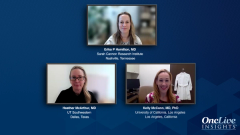
Looking to the Future: Emerging Therapeutic Approaches in HER2+ Breast Cancer
Panelists discuss how emerging developments in HER2-positive (HER2+) breast cancer treatment, including novel antibody-drug conjugates, bispecific antibodies, and cytotoxic-sparing regimens for hormone receptor+ (HR+)/HER2+ disease, are creating exciting new options for patients.
Advertisement
Episodes in this series
Clinical Brief: Future Directions in HER2+ Breast Cancer
Key Themes:
- Novel Therapeutic Approaches: Development of new antibody-drug conjugates, bispecific antibodies, and HER3-targeted agents
- Cytotoxic-Sparing Regimens: Potential for chemotherapy-free approaches for HR+, HER2+ disease
- Treatment Individualization: Increasing ability to tailor treatment based on disease characteristics and patient preferences
Key Points for Physicians:
- HER2 gene amplification provides a stable therapeutic target compared with more heterogeneous cancers
- For HR+/HER2+ disease, combinations of endocrine therapy with HER2-targeted agents may offer quality-of-life benefits
- The growing treatment armamentarium allows for more personalized approaches considering efficacy, toxicity, and quality of life
Notable Insights:
- The transformation of HER2+ breast cancer from a poor prognosis to having multiple effective treatment options is remarkable
- Innovations in brain metastases management have been particularly transformative
- The evolution of treatment options allows physicians to consider both treatment efficacy and impact on quality of life
Clinical Significance:
The treatment landscape for HER2+ breast cancer continues to evolve rapidly, with emerging therapies and strategies focused on improving efficacy and maintaining quality of life. This represents a paradigm shift in the management of what was once considered a highly aggressive disease with limited options.
Advertisement
Related to this article
Novel approaches to the use of AI in oncology may require discussion and ultimately modification of existing proprietary and regulatory barriers.
Extended follow-up from the phase 1b CAMMA 1 trial showed durable responses across two cevostamab dose levels, supporting selection of a recommended phase 3 regimen.

A MAIC found anito-cel produced response rates similar to those of cilta-cel, with fewer high-grade toxicities, in relapsed/refractory multiple myeloma.
Updated phase 2 LINKER-SMM1 data show single-agent, fixed-duration linvoseltamab produced deep, durable, and MRD-negative responses in high-risk smoldering multiple myeloma.
The FDA has approved lirafugratinib (Lyrfigtu) for the treatment of adult patients with previously treated unresectable, locally advanced or metastatic cholangiocarcinoma harboring an FGFR2 gene fusion or other rearrangement.

An IDMC recommended continuing a phase 2 minimal residual disease study of IMNN-001 without modification following a favorable safety review.

Shailender Bhatia, MD, discusses next steps for adjuvant therapy research in light of the phase 3 ADAM trial data and broader implications for Merkel cell carcinoma.

Clinicians and researchers are set to gather for the UCSF-cosponsored International Invasive Lobular Carcinoma Symposium.
Advertisement
Advertisement
Trending on OncLive
1
FDA Approves Lirafugratinib for Pretreated, Locally Advanced or Metastatic Cholangiocarcinoma
2
iMMagine-1 vs CARTITUDE-1 MAIC Shows Comparable Efficacy, Improved Safety With Anito-Cel in Relapsed/Refractory Multiple Myeloma
3
Linvoseltamab Yields Deep, MRD-Negative Responses With Manageable Safety in High-Risk Smoldering Myeloma
4
Dr Kahl on Frontline Strategies for Avoiding Autologous Transplant in MCL
5