
Erika P. Hamilton, MD, discusses data from HER2CLIMB-05 evaluating tucatinib plus trastuzumab/pertuzumab first-line maintenance in HER2-positive breast cancer.

Erika P. Hamilton, MD, is the director of Breast Cancer and Gynecologic Cancer Research at Sarah Cannon Research Institute.
Erika P. Hamilton, MD, discusses data from HER2CLIMB-05 evaluating tucatinib plus trastuzumab/pertuzumab first-line maintenance in HER2-positive breast cancer.

Erika P. Hamilton, MD, highlights the unmet needs regarding treatment for brain metastases in HER2-positive metastatic breast cancer.

Panelists discuss how emerging developments in HER2-positive (HER2+) breast cancer treatment, including novel antibody-drug conjugates, bispecific antibodies, and cytotoxic-sparing regimens for hormone receptor+ (HR+)/HER2+ disease, are creating exciting new options for patients.

Erika Hamilton, MD, discusses data for vepdegestrant vs fulvestrant in ER-positive, HER2-negative advanced breast cancer.
Panelists discuss how they approach treatment beyond third-line therapy for HER2-positive (HER2+) metastatic breast cancer, considering factors such as prior therapies, residual toxicities, and patient preferences when selecting from multiple options.
Panelists discuss how they manage adverse effects of tucatinib-based therapy, particularly focusing on diarrhea and palmar-plantar erythrodysesthesia from capecitabine, with practical dosing strategies to improve tolerability.
Panelists discuss how the HER2CLIMB-02 and HER2CLIMB-05 trials might impact treatment sequencing, with particular interest in using tucatinib earlier in treatment to potentially prevent brain metastases.
Panelists discuss how National Comprehensive Cancer Network (NCCN) guidelines inform third-line treatment options for HER2-positive (HER2+) metastatic breast cancer, with particular focus on the HER2CLIMB regimen (tucatinib, capecitabine, and trastuzumab) for patients with brain metastases.
Panelists discuss how they would approach multiple brain metastases at initial metastatic diagnosis, debating the use of stereotactic radiosurgery vs systemic therapy with agents that cross the blood-brain barrier.
Panelists discuss how they approach the case of a 47-year-old marketing executive with initially low-risk HER2-positive (HER2+) breast cancer who developed brain, liver, lung, and bone metastases shortly after completing adjuvant therapy.
Panelists discuss how the presence of brain metastases influences treatment decisions in HER2-positive (HER2+) breast cancer, highlighting the DESTINY-Breast12 trial demonstrating trastuzumab deruxtecan’s (T-DXd) efficacy in patients with brain metastases.
Panelists discuss how they manage adverse effects of trastuzumab deruxtecan (T-DXd), particularly focusing on nausea, fatigue, and the critical monitoring needed for interstitial lung disease (ILD), with recommendations for prophylactic antiemetics and frequent imaging.
Panelists discuss how they approach treatment sequencing for HER2-positive (HER2+) metastatic breast cancer (mBC) after progression on first-line therapy, including considerations for trastuzumab deruxtecan and the impressive results from the PATINA trial adding CDK4/6 inhibitors to maintenance therapy.
Panelists discuss how a 52-year-old elementary school teacher diagnosed with HER2-positive (HER2+) breast cancer achieved pathologic complete response with neoadjuvant therapy but experienced metastasis 18 months after completing treatment, requiring first-line metastatic therapy.

Erika P. Hamilton, MD, discusses how mutational profiles inform the management of HR-positive breast cancer after progression on a prior CDK4/6 inhibitor.

Erika P. Hamilton, MD, discusses the safety profile of ADCs in patients with hormone receptor–positive, HER2-low and -ultralow breast cancer.

Erika P. Hamilton, MD, discusses the efficacy of trastuzumab deruxtecan in patients with HER2-low breast cancer.

Adam M. Brufsky, MD, PhD, and Erika P. Hamilton, MD, share their perspectives on the future landscape of HR+/HER2- locally advanced or metastatic breast cancer treatment and provide essential insights to summarize the key points of their discussion.
Medical experts address the challenges of managing adverse events in the treatment of HR+/HER2- locally advanced or metastatic breast cancer.
Key opinion leaders discuss other clinical trials, including the EMERALD study, and targeted therapies for the treatment of HR+/HER2- locally advanced or metastatic breast cancer in later lines of therapy.
Erika P. Hamilton, MD, discusses the CAPItello-291 trial, which investigated the combination of capivasertib and fulvestrant in advanced HR+, HER2- locally advanced or metastatic breast cancer and led to its FDA approval, emphasizing the improved progression-free survival observed in patients with PIK3CA, AKT1, and PTEN alterations.
The panel examines how resistance mutations influence the efficacy of subsequent treatment lines and delves into the process of selecting later-line therapies based on next-generation sequencing results.
Key opinion leaders explore the mechanisms of resistance that can develop after endocrine therapy and CDK4/6 inhibitor treatment in HR+/HER2- locally advanced or metastatic breast cancer, emphasizing the uncertain etiology of resistance and current hypotheses, while also examining biomarkers that may predict resistance to CDK4/6 inhibitors and endocrine therapy.
Adam M. Brufsky, MD, PhD, and Erika P. Hamilton, MD, delve into the most clinically significant genomic tests and biomarker assays employed in HR+/HER2- breast cancer, focusing on BRCA mutations, PIK3CA alterations, AKT1 alterations, and PTEN alterations, which play crucial roles in determining prognosis and guiding treatment decisions.
Medical experts share their strategies for choosing initial treatment options for HR+/HER2- locally advanced or metastatic breast cancer, debating the most effective frontline therapies based on clinical trial evidence, while also discussing their aspirations for a new standard of care, and the challenges of managing disease progression.
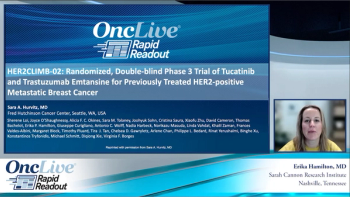
Erika Hamilton, MD, presents data from the phase 3 HER2CLIMB-02 study investigating tucatinib and trastuzumab emtansine in patients with previously treated HER2+ metastatic breast cancer.

Erika P. Hamilton, MD, discusses the benefit seen with adjuvant ribociclib in patients with hormone receptor-positive,HER2-negative breast cancer.

Erika P. Hamilton, MD, discusses the use and sequencing of antibody-drug conjugates in patients with hormone receptor-positive/HER2-negative and HER2-low breast cancer.

Erika P. Hamilton, MD, discusses the investigation of patritumab deruxtecan in heavily pretreated patients with metastatic estrogen receptor-positive or triple-negative breast cancer with varying levels of HER3 expression in a phase 2 trial.

Erika P. Hamilton, MD, discusses the efficacy and safety of adjuvant abemaciclib plus endocrine therapy in patients with hormone receptor–positive, HER2-negative, high-risk early breast cancer according to age.