
Opinion|Videos|September 30, 2026
Positioning Bispecific Antibodies and Combinations in DLBCL Treatment
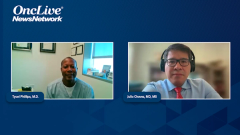
Author(s)Julio Chavez, MD, Tycel Phillips, MD
Dr. Chavez explains that for most patients with relapsed/refractory DLBCL in the third-line setting, including those who are not CAR T candidates, decline CAR T, or progress after CAR T, bispecific antibodies are his preferred option.
Advertisement
Episodes in this series
Dr. Chavez explains that for most patients with relapsed/refractory DLBCL in the third-line setting, including those who are not CAR T candidates, decline CAR T, or progress after CAR T, bispecific antibodies are his preferred option. He notes that institutional experience managing CRS in the CAR T era supports broader use, including in the community. The physicians discuss emerging combinations, including glofitamab or epcoritamab with gemcitabine and oxaliplatin, mosunetuzumab with polatuzumab vedotin, and loncastuximab tesirine-based regimens, which may improve efficacy and reduce CRS, though cytopenias can require growth factor support. Dr. Chavez notes that some combinations are used in the second line based on STARGLO and SUNMO data and NCCN compendium listings, despite lacking FDA approval in that setting. Dr. Phillips describes monitoring immunoglobulin levels, including IgG subtypes, and CMV. The physicians close with key takeaways for community oncologists.
Advertisement
Related to this article

FDA Approves Denosumab Biosimilar for Skeletal-Related Events, GCTB, and Hypercalcemia of Malignancy
Denosumab-adet (Degevma) is FDA approved as an Xgeva biosimilar for SRE prevention in myeloma and bone metastases, giant cell tumor of bone, and HCM.

Faculty convened at an OncLive Scientific Interchange and Workshop to discuss individualized treatment and strategic sequencing in HER2-mutated NSCLC.

Researchers at Wake Forest University School of Medicine identified a protein that may help breast cancer spread to the brain and evade immune defenses.

Benjamin Weinberg, MD, discusses the FDA approval of daraxonrasib, RASolute 302 survival data, safety considerations, and future RAS-targeted therapies in pancreatic cancer.

Half of lenalidomide-refractory patients with 1 to 3 prior lines remained alive and progression free at least 5 years after a single cilta-cel infusion.

Andrew Kuykendall, MD, discusses the FDA approval of rusfertide and how to apply it in clinical practice for polycythemia vera management.

An NDA seeks FDA approval of savolitinib plus osimertinib for EGFR-mutated NSCLC with MET overexpression or amplification after EGFR TKI therapy.
Jason Hafron, MD, discusses the emotional, clinical, and financial burden of false positive cancer screening results and improved risk stratification.
Advertisement
Advertisement
Trending on OncLive
1
Savolitinib Plus Osimertinib NDA Submitted to FDA for MET-Driven, EGFR-Mutated NSCLC After EGFR TKI
2
Daraxonrasib Approval Signals a New Era for RAS-Targeted Therapy in Pancreatic Cancer
3
Cilta-Cel Shows Long-Term Treatment-Free Remissions in Lenalidomide-Refractory Myeloma
4
Researchers Uncover How Aggressive Breast Cancer May Spread to the Brain
5