
Rami Komrokji, MD, summarizes data presented at ASCO 2023 from the COMMANDS trial on the role of luspatercept in lower-risk MDS.
Rami Komrokji, MD, summarizes data presented at ASCO 2023 from the COMMANDS trial on the role of luspatercept in lower-risk MDS.
Dr Madanat reviews data from an abstract presented at ASCO 2023 on the outcomes of ESA therapy in patients with SF3B1-mutated lower-risk MDS.
The panel discusses the patient profile of a man with lower-risk MDS and how they would have approached treatment in their practice.
Yazan Madanat, MD, presents the patient profile of a transfusion-dependent 79-year-old man with lower-risk MDS and a KRAS mutation.
Panelists review the presented patient profile and shares how they would have approached treatment.
Dr Brunner presents the patient profile of a 75-year-old man with transfusion-dependent, lower-risk MDS and symptomatic anemia.
Andrew Brunner, MD, reviews the available second-line treatment options for lower-risk MDS with symptomatic anemia.
Dr Madanat defines erythropoiesis-stimulating agent (ESA) treatment failure in lower-risk MDS with symptomatic anemia and describes his approach to monitoring patients.
The panel shares at what point they decide to start treatment for patients with lower-risk MDS and symptomatic anemia.
Yazan Madanat, MD, details the available options for first-line treatment of patients with lower-risk MDS and symptomatic anemia.
Amer Zeidan, MBBS, MHS, explains risk stratification in MDS, how the process has evolved over time, and the guidelines he typically follows.
Hetty Carraway, MD, reviews how MDS is diagnosed and the common symptoms that patients who have MDS may present with.
Expert hematologic oncologists discuss updates from the ASH 2022 Annual Meeting on emerging therapies for lower-risk MDS.
Following the ASH 2022 Annual Meeting, experts in hematologic oncology review updated data for luspatercept in lower-risk MDS.
Hematologic oncology experts give an overview of first- and second-line treatment options for lower-risk myelodysplastic syndromes.
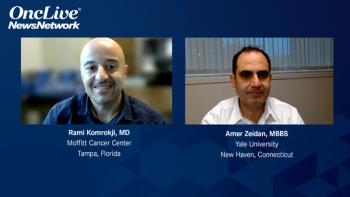
Amer Zeidan, MBBS, and Rami Komrokji, MD, offer closing remarks on recent advances in MF and MDS, and look towards the future of treatment.
Dr Komrokji summarizes the remaining unmet needs in the treatment of MF, including suboptimal responses to JAK2 inhibitors, and comments on data from ongoing trials that may address these needs.
A comprehensive review of the treatment landscape for myelofibrosis (MF) and recent ASCO and ASH data updates on JAK2 inhibitors.
Experts in hematology take a detailed look at new data on investigational therapies for higher-risk MDS, including the STIMULUS-MDS1 trial on sabatolimab.
Amer Zeidan, MBBS, and Rami Komrokji, MD, discuss trial updates on oral hypomethylating agents, including data on dosing, for treatment of lower-risk MDS.
An overview of updates from the Sintra-REV trial of low-dose lenalidomide, and data from COMMANDS, MEDALIST, and real-world studies on luspatercept.
Hematology experts highlight recent data updates from the IMerge trial on the telomerase inhibitor imetelstat, which is being studied for lower-risk MDS.
Amer Zeidan, MBBS, and Rami Komrokji, MD, compare the available IPSS-M and IPSS-R tools for stratifying risk and assessing prognosis in MDS.
Distinguished experts in hematology discuss the WHO and ICC classification systems for myelodysplastic syndromes (MDS), including recent WHO updates.
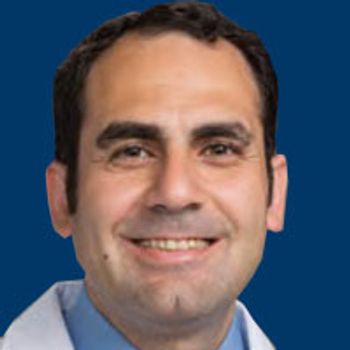
Amer Zeidan, MBBS, MHS, an assistant professor of medicine (hematology) at Yale University, shares his story about his journey through training with Oncology Fellows, and talks about landing his dream career.
Choosing a research mentor is one of the most important steps when beginning a successful academic research career.
Amer Zeidan, MBBS, MHS, assistant professor of Medicine, Hematology, Yale Cancer Center, discusses a population-based study of subsequent myelodysplastic syndromes (MDS) in prostate cancer patients after radiotherapy.
The big moment has arrived. After many years of medical school, residency, and fellowship training, you have finally been invited to interview for your first academic faculty job at your top-choice institution.