Articles by Andrew J. Armstrong, MD
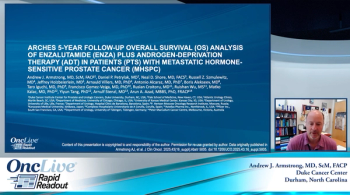
Andrew J. Armstrong, MD, ScM, FACP, presented 5-year follow-up data from the ARCHES trial showing that enzalutamide plus androgen-deprivation therapy significantly prolonged overall survival versus placebo plus ADT in patients with metastatic hormone-sensitive prostate cancer, with consistent benefit across subgroups and no new safety signals.

Andrew J. Armstrong, MD, MSc, discusses the significance of the FDA approval of olaparib plus abiraterone acetate and prednisone or prednisolone in patients with BRCA-mutated metastatic castration-resistant prostate cancer.

Drs Manning and Armstrong discuss the impact of lesion size and symptomatic status of bone metastases on radiotherapy selection in mCRPC, highlighting ongoing trials and emerging data.
Matthew Manning, MD, and Andrew Armstrong, MD, discuss the remaining unmet needs in mCRPC, clinical trials and novel agents to look out for, and share practical advice for other clinicians treating patients with the disease.
Centering discussion on a patient profile of mCRPC with asymptomatic bone metastases, experts share best approaches to treating and optimizing outcomes for such patients, including supplement recommendations to prevent bone fractures.
Drs Armstrong and Manning review the safety and efficacy data from the ALSYMPCA trial of radium-223 in patients with mCRPC.
A medical oncologist and radiation oncologist share clinical insight on how they might approach subsequent treatment selection in patients with mCRPC who have disease progression on or after radium-223.

Radiation oncologist Matthew Manning, MD, shares the patient profile of a 72-year-old man with mCRPC receiving palliative treatment with radium-223.
Drs Manning and Armstrong discuss the best treatment approaches for a patient with mCRPC and disease progression in the bone after initial radiotherapy for metastatic disease.

Dr Andrew Armstrong presents a profile of a 78-year-old man with mCRPC with a single PSMA-avid bone metastasis and asks Dr Manning how he would treat the patient in question.
Medical oncologist Andrew Armstrong, MD, details the available treatment options for patients with mCRPC, and how recommendations vary by prior therapy and mutation status.
Andrew Armstrong, MD, and Matthew Manning, MD, explain how the treatment options and typical patient outcomes in mCRPC have changed over history.

Practical Considerations in Selecting Therapy for Metastatic CRPC
ByEvan Y. Yu, MD,Andrew J. Armstrong, MD,Pedro Barata, MD, MSc,Tanya B. Dorff, MD,Mary-Ellen Taplin, MD Closing out their discussion on prostate cancer, expert panelists highlight which factors best inform selection of therapy for patients with mCRPC.

What is the Role of 177Lu-PSMA-617 in Metastatic CRPC?
ByEvan Y. Yu, MD,Andrew J. Armstrong, MD,Pedro Barata, MD, MSc,Tanya B. Dorff, MD,Mary-Ellen Taplin, MD Panelists share insight on 177Lu-PSMA-617 and consider where it might fit into the treatment paradigm for metastatic castration-resistant prostate cancer.

Metastatic CRPC: Practical Selection and Use of PARP Inhibitors
ByEvan Y. Yu, MD,Andrew J. Armstrong, MD,Pedro Barata, MD, MSc,Tanya B. Dorff, MD,Mary-Ellen Taplin, MD Expert perspectives on how PARP inhibition will fit into the real-world management of patients with metastatic castration-resistant prostate cancer.
An Overview of PARP Inhibition in Metastatic CRPC
ByEvan Y. Yu, MD,Andrew J. Armstrong, MD,Pedro Barata, MD, MSc,Tanya B. Dorff, MD,Mary-Ellen Taplin, MD Focusing on the advent of PARP inhibitors in metastatic castration-resistant prostate cancer, genitourinary cancer specialists provide an overview of clinical trials and agents in this setting.
PTEN Loss in mCRPC: Caution Surrounding mTOR, PI3K, and AKT Inhibition
ByEvan Y. Yu, MD,Andrew J. Armstrong, MD,Pedro Barata, MD, MSc,Tanya B. Dorff, MD,Mary-Ellen Taplin, MD Panelists share caution toward use of mTOR-, PI3K-, and AKT-targeted therapies in the setting of PTEN loss in metastatic CRPC.
Therapy Overview: Sequencing Agents in Patients With Metastatic CRPC
ByEvan Y. Yu, MD,Andrew J. Armstrong, MD,Pedro Barata, MD, MSc,Tanya B. Dorff, MD,Mary-Ellen Taplin, MD A comprehensive review of available agents in the setting of metastatic CRPC, with discussion of optimal sequencing in later lines of therapy.
Metastatic Castration-Resistant Prostate Cancer: Optimal Imaging Strategies
ByEvan Y. Yu, MD,Andrew J. Armstrong, MD,Pedro Barata, MD, MSc,Tanya B. Dorff, MD,Mary-Ellen Taplin, MD Expert oncologists define appropriate imaging strategies, conventional and novel, in patients with metastatic castration-resistant prostate cancer.
Clinical Scenario 3: A 76-Year-Old With Metastatic CRPC
ByEvan Y. Yu, MD,Andrew J. Armstrong, MD,Pedro Barata, MD, MSc,Tanya B. Dorff, MD,Mary-Ellen Taplin, MD Shared insight on a clinical scenario of metastatic castration-resistant prostate cancer managed with androgen-deprivation therapy and docetaxel.
Addressing Unmet Needs in Nonmetastatic CRPC
ByEvan Y. Yu, MD,Andrew J. Armstrong, MD,Pedro Barata, MD, MSc,Tanya B. Dorff, MD,Mary-Ellen Taplin, MD Before closing out their second module, panelists highlight remaining unmet needs in the setting of nonmetastatic castration-resistant prostate cancer.
Selecting Among Available AR Inhibitors in Nonmetastatic CPRC
ByEvan Y. Yu, MD,Andrew J. Armstrong, MD,Pedro Barata, MD, MSc,Tanya B. Dorff, MD,Mary-Ellen Taplin, MD A comprehensive discussion on factors that inform treatment selection of available AR-targeted therapy for patients with nonmetastatic CRPC.
Optimizing Management of nmCRPC: Patient Monitoring and Initiating Therapy
ByEvan Y. Yu, MD,Andrew J. Armstrong, MD,Pedro Barata, MD, MSc,Tanya B. Dorff, MD,Mary-Ellen Taplin, MD Expert perspectives on monitoring patients with nonmetastatic castration-resistant prostate cancer and deciding when to initiate systemic therapy.
Clinical Scenario 2: A 64-Year-Old Man With nmCRPC
ByEvan Y. Yu, MD,Andrew J. Armstrong, MD,Pedro Barata, MD, MSc,Tanya B. Dorff, MD,Mary-Ellen Taplin, MD Shared insight on a clinical scenario of a patient with nonmetastatic castration-resistant prostate cancer who was treated with prostatectomy and adjuvant therapy.
Improving Patient Monitoring in the Setting of Metastatic HSPC
ByEvan Y. Yu, MD,Andrew J. Armstrong, MD,Pedro Barata, MD, MSc,Tanya B. Dorff, MD,Mary-Ellen Taplin, MD Closing out their discussion on a clinical scenario of metastatic HSPC, expert panelists consider optimal patient monitoring strategies and novel imaging.
Clinical Trial Data in Metastatic HSPC From the ASCO 2022 Annual Meeting
ByEvan Y. Yu, MD,Andrew J. Armstrong, MD,Pedro Barata, MD, MSc,Tanya B. Dorff, MD,Mary-Ellen Taplin, MD Expert panelists briefly share their excitement for trial data readouts in metastatic hormone-sensitive prostate cancer from the annual ASCO 2022 Annual meeting.
Establishing Eligibility for Frontline AR-Targeted Therapy in mHSPC
ByEvan Y. Yu, MD,Andrew J. Armstrong, MD,Pedro Barata, MD, MSc,Tanya B. Dorff, MD,Mary-Ellen Taplin, MD Continuing their discussion on frontline AR-targeted therapy in mHSPC, experts define how accessibility and patient eligibility impact treatment selection.
Factors in Selecting AR-Targeted Therapy for Patients With Metastatic HSPC
ByEvan Y. Yu, MD,Andrew J. Armstrong, MD,Pedro Barata, MD, MSc,Tanya B. Dorff, MD,Mary-Ellen Taplin, MD Expert perspectives on frontline AR-targeted therapy in metastatic hormone-sensitive prostate cancer, with deference to recent clinical trial data on triplet therapy.
Optimizing Management of mHSPC: Multimodality Care and Genetic Testing
ByEvan Y. Yu, MD,Andrew J. Armstrong, MD,Pedro Barata, MD, MSc,Tanya B. Dorff, MD,Mary-Ellen Taplin, MD A brief review of the respective roles of multidisciplinary care and genetic testing in patients diagnosed with metastatic hormone-sensitive prostate cancer.
Clinical Scenario 1: A 67-Year-Old With Metastatic HSPC
ByEvan Y. Yu, MD,Andrew J. Armstrong, MD,Pedro Barata, MD, MSc,Tanya B. Dorff, MD,Mary-Ellen Taplin, MD Centering discussion on a clinical scenario of metastatic hormone-sensitive prostate cancer, expert panelists consider how they might approach frontline therapy in this setting.