

Charu Aggarwal, MD, MPH, and Geoffrey Liu, MSc, MD, on novel approaches being investigated in ROS1-positive non–small cell lung cancer.

Charu Aggarwal, MD, MPH, is a physician leader in Airways Malignancies Research, director of Precision Oncology Innovation at Penn Center for Cancer Care Innovation, section chief of Head & Neck and Thoracic Cancers, Hematology-Oncology, and the Leslye M. Heisler Professor for Lung Cancer Excellence at Penn Medicine in Philadelphia, Pennsylvania.
Charu Aggarwal, MD, MPH, and Geoffrey Liu, MSc, MD, on novel approaches being investigated in ROS1-positive non–small cell lung cancer.
Charu Aggarwal, MD, MPH, and Geoffrey Liu, MSc, MD, on how FDA approval of taletrectinib would affect ROS1-positive non–small cell lung cancer management.
Charu Aggarwal, MD, MPH, and Geoffrey Liu, MSc, MD, discuss data for taletrectinib in ROS1-positive non–small cell lung cancer.
Charu Aggarwal, MD, MPH, and Geoffrey Liu, MSc, MD, discuss CNS involvement in ROS1-positive non–small cell lung cancer.
Charu Aggarwal, MD, MPH, and Geoffrey Liu, MSc, MD, discuss TKI selection in ROS1-positive non–small cell lung cancer.
Charu Aggarwal, MD, MPH, and Geoffrey Liu, MSc, MD, discuss treatment sequencing in ROS1-positive non–small cell lung cancer.
Charu Aggarwal, MD, MPH, and Geoffrey Liu, MSc, MD, discuss the prevalence of ROS1 fusions in non–small cell lung cancer.

Charu Aggarwal, MD, MPH, FASCO, on data for CAN-2409 plus valacyclovir with continued immune checkpoint inhibitors in advanced non–small cell lung cancer.

Charu Aggarwal, MD, MPH, FASCO, discusses the evaluation of CAN-2409, valacyclovir, and continued immune checkpoint inhibitors in NSCLC.
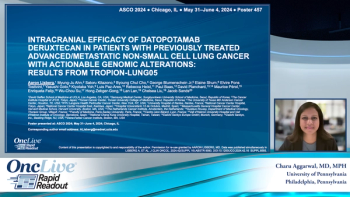
Tropion-Lung05 (NCT04484142) is a phase 2, multicenter, single-arm, open-label study evaluating Dato-DXd in patients with advanced/metastatic NSCLC with actionable genomic alterations who have progressed on or after targeted therapy and platinum-based CT.
Discover the latest insights on treating uncommon EGFR mutations, emphasizing the importance of NGS, personalized therapy, and ongoing advancements in TKIs and ADCs.
Experts share treatment experiences with osimertinib and afatinib, the potential role of immunotherapy, and ongoing investigations with ADCs and emerging TKIs for patients with uncommon EGFR mutations.
Insights into how the UNICORN study, which assessed osimertinib, is impacting treatment decisions for uncommon EGFR mutations, and other ongoing trials shedding light on effective treatments for this patient population.
Expert insights on sequencing treatment options for patients with uncommon EGFR mutations who have progressed on afatinib, emphasizing clinical trial considerations, biomarker testing, and emerging therapeutic approaches.
Explore dosing nuances and adverse event management strategies for afatinib in treating EGFR mutant non-small cell lung cancer, reflecting real-world practices and clinical insights.
Panelists discuss the intricacies of treating uncommon EGFR mutations, dissecting approved treatment options, considerations for specific mutations, and insights into the evolving drug landscape.
Explore the complexity of uncommon EGFR mutations in lung cancer with experts discussing classifications, testing methodologies, and the necessity of comprehensive panels for accurate identification.

Shared insight into the transformative impact of targeted therapies in lung cancer treatment, from adjuvant therapy breakthroughs to emerging trials, emphasizing the critical role of comprehensive molecular testing.
Explore the complexities of limited molecular genotyping availability, the importance of comprehensive testing, and challenges in accessing target therapies, including cost considerations, in real-world clinical practice.
Delve into the evolving landscape of treating EGFR mutations in lung cancer, exploring emerging therapies, structural classifications, and the complexity of individual mutation responses.
The impact of and strategies for addressing less frequent mutations in NSCLC treatment decisions, emphasizing actionable alterations and timely interventions in challenging scenarios.
Experts reflect on the mixed enthusiasm for concurrent liquid and tissue testing, addressing insurance coverage concerns and the importance of shortening turnaround time, while highlighting efforts to make comprehensive testing the default in the community.
A comprehensive study on the association between the availability of molecular genotyping results and overall survival in advanced non-squamous, non-small cell lung cancer patients, shedding light on the importance of timely and concurrent testing.
Expert perspectives on improving turnaround times in genomic testing for lung cancer, covering strategies, challenges, and the significance of liquid biopsy in optimizing patient care.
Shared insight into strategies in genomic testing for lung cancer, emphasizing the importance of comprehensive next-generation sequencing, DNA vs. RNA sequencing, and the evolving role of liquid biopsy.
Key opinion leaders Charu Aggarwal, MD, MPH, and Melina E. Marmarelis, MD, reflect on their institution’s practices with regard to molecular profiling and its impact on treatment pathways in the setting of metastatic NSCLC.
Shared insight into the comprehensive list of molecular targets in metastatic NSCLC, from point mutations like EGFR and KRAS to fusions such as ALK and ROS1, understanding the challenges of comprehensive testing and treatment implications.
Experts review a patient scenario of metastatic non-squamous NSCLC and discuss complexities and challenges of initiating timely molecular testing, examining its impact on treatment decisions and patient outcomes.
Explore the dynamic landscape of metastatic non-squamous non-small cell lung cancer treatment, focusing on molecular genotyping, targeted therapies, and the evolving standard of care.

The panel shares clinical pearls for community oncologists treating small cell lung cancer.