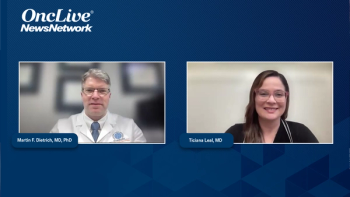
Martin F. Dietrich, MD, PhD, and Ticiana Leal, MD, discuss other potential treatment avenues to explore in HER2-mutant non–small cell lung cancer.

Martin Dietrich, MD, PhD, is a medical oncologist with The US Oncology Network Cancer Care Centers of Brevard and an assistant professor of internal medicine at the University of Central Florida College of Medicine in Orlando, Florida.
Martin F. Dietrich, MD, PhD, and Ticiana Leal, MD, discuss other potential treatment avenues to explore in HER2-mutant non–small cell lung cancer.
Martin F. Dietrich, MD, PhD, and Ticiana Leal, MD, discuss how the NCCN Guidelines can help supplement HER2-mutant non–small cell lung cancer management decisions.
Martin F. Dietrich, MD, PhD, and Ticiana Leal, MD, examine sequencing considerations between tyrosine kinase inhibitors and antibody-drug conjugates in HER2-mutant non–small cell lung cancer.
Martin F. Dietrich, MD, PhD, and Ticiana Leal, MD, discuss toxicity management with TKIs in HER2-mutant non–small cell lung cancer.
Martin F. Dietrich, MD, PhD, and Ticiana Leal, MD, discuss factors that inform sevabertinib and zongertinib treatment selection in HER2-mutant NSCLC.
Martin F. Dietrich, MD, PhD, and Ticiana Leal, MD, discuss frontline therapy approaches in HER2-mutant non–small cell lung cancer and the evolving role of chemoimmunotherapy.
Martin F. Dietrich, MD, PhD, and Ticiana Leal, MD, discuss the importance of biomarker testing in non–small cell lung cancer and tools for detecting HER2-mutant disease.
Drs Rotow and Dietrich discuss the significance of the accelerated FDA approval of zongertinib (Hernexeos) for patients with HER2 TKD–mutated NSCLC.

In their concluding remarks, the experts highlight critical future directions and unmet needs in non-small cell lung cancer (NSCLC). A major focus is on improving lung cancer screening. They note that current screening rates are unacceptably low (~20%) and emphasize the need to better integrate it into primary care. Furthermore, they call for expanded screening criteria to include populations not currently eligible, such as never-smokers and light smokers, especially women, who are increasingly being diagnosed.
Experts discuss the critical factors for recommending adjuvant chemotherapy after surgery for early-stage non-small cell lung cancer (NSCLC). They confirm that lymph node involvement (N1 disease) is a clear indicator for offering platinum-based chemotherapy due to the higher risk of recurrence.
Experts emphasize the indispensable role of a multidisciplinary team (MDT) in managing non-small cell lung cancer (NSCLC). They highlight that complex cases, like the one discussed, demonstrate how knowledge evolves and how critical collaborative decision-making is for optimal patient outcomes.
Experts address the critical differences between pre-operative biopsies and post-operative surgical specimens for biomarker testing. They confirm that a surgical specimen is far more reliable, as it provides a larger, higher-quality sample, allowing a pathologist to select a more tumor-rich area for analysis. This was key in finally identifying the patient's RET fusion.
Experts discuss how the final pathology report, which included an RNA-based NGS test, definitively resolved the case by identifying a RET fusion. They highlight this finding as a critical justification for comprehensive biomarker testing, especially in never-smoker patients where initial results are negative.
Experts discuss how to manage a complex non-small cell lung cancer (NSCLC) case with ambiguous neuroendocrine markers and initially negative biomarker testing. They note that mixed biphenotypic tumors are not uncommon but present a diagnostic challenge.
Experts address a complex case of a never-smoker with early-stage non-small cell lung cancer (NSCLC). The diagnosis is complicated by ambiguous neuroendocrine markers on the biopsy, a PD-L1 score of 0%, and a negative NGS panel for common drivers, which is unusual for a never-smoker.
Experts discuss the critical importance of including RNA sequencing in comprehensive biomarker testing for non-small cell lung cancer (NSCLC). They highlight that while DNA-based NGS is foundational, it is insufficient for reliably detecting key gene fusions like RET and ROS1
Experts address managing recurrent non-small cell lung cancer (NSCLC) after definitive treatment with surgery and immunotherapy (IO). The experts outline a strategy based on the timing of recurrence.
Experts discuss treatment options for stage III non-small cell lung cancer (NSCLC) without actionable driver mutations and with a PD-L1 expression of 30%. The experts emphasize a multidisciplinary evaluation to decide between a surgical or non-surgical approach.
The oncologists delve into the specifics of which non-small cell lung cancer (NSCLC) patients to test. They recommend testing all non-squamous cases and, increasingly, squamous cases as well, especially those with a light smoking history, to ensure no actionable biomarker is missed.
The oncologists delve into the specifics of which non-small cell lung cancer (NSCLC) patients to test. They recommend testing all non-squamous cases and, increasingly, squamous cases as well, especially those with a light smoking history, to ensure no actionable biomarker is missed.
The oncologists delve into the specifics of which non-small cell lung cancer (NSCLC) patients to test. They recommend testing all non-squamous cases and, increasingly, squamous cases as well, especially those with a light smoking history, to ensure no actionable biomarker is missed.
Two expert oncologists discuss the critical role of comprehensive biomarker testing in non-small cell lung cancer (NSCLC). They emphasize that molecular testing is an essential part of the initial diagnosis, not an optional add-on, as it identifies specific mutations and fusions that dictate the most effective first-line treatment.
Panelists discuss clinical pearls for community oncologists, emphasizing that comprehensive testing is essential since zongertinib offers dramatic improvements with 75% response rates and progression-free survival exceeding 12 months in HER2 exon 20 mutations, while noting that HER2 immunohistochemistry testing shouldn’t be neglected for identifying patients who may benefit from trastuzumab deruxtecan, requiring a multilayered molecular profiling approach encompassing DNA, RNA, and protein analysis to provide new hope for patients with HER2-mutant disease.
Panelists discuss how combination therapies represent the future of HER2 mutation treatment, drawing parallels to successful EGFR combination strategies, with particular interest in anti-VEGF agents and potentially anti-PD-1/PD-L1 therapies, while noting that zongertinib’s favorable tolerability profile makes it an ideal candidate for combination approaches compared with more toxic agents like trastuzumab deruxtecan or sevabertinib, though current trial designs should incorporate 3-armed studies to evaluate up-front combination strategies rather than sequential monotherapy comparisons.
Panelists discuss how shared decision-making between zongertinib and trastuzumab deruxtecan (T-DXd) in second-line treatment involves presenting key differences to patients, including that T-DXd requires intravenous (IV) infusion with chemotherapy-like toxicities and closer monitoring (including cardiac function), while zongertinib is an oral, once-daily targeted therapy with better patient-reported outcomes and functional status improvements, fewer clinic visits after initial monitoring, and superior tolerability, leading to a preference for zongertinib first followed by T-DXd sequencing.
Panelists discuss how treatment sequencing for HER2-mutation non–small cell lung cancer (NSCLC) prioritizes zongertinib over trastuzumab deruxtecan in the second-line setting due to superior efficacy and tolerability, while noting that special populations like patients with baseline lung dysfunction (favoring zongertinib to avoid interstitial lung disease risk) or CNS (central nervous system) metastases (where zongertinib shows promising brain activity but may require concurrent radiation for larger lesions) require individualized, case-by-case management with close monitoring and early imaging follow-up.
Panelists discuss a clinical scenario involving a 73-year-old Asian woman with stage 4 lung adenocarcinoma harboring a HER2 exon 20 insertion mutation (A775-G776 YVMA) who initially responded to carboplatin, pemetrexed, and pembrolizumab for 4 cycles followed by maintenance therapy, but now presents with progressive cough and shortness of breath suggesting clinical progression, requiring decisions about next-step management in this fit patient with good performance status.
Panelists discuss how emerging second-line treatment options for HER2-mutant non–small cell lung cancer (NSCLC) include sevabertinib (a dual HER2/EGFR exon 20 inhibitor with higher gastrointestinal toxicity but similar efficacy to zongertinib) and other brain-penetrant tyrosine-kinase inhibitors (TKIs) in development, while noting that multiple ongoing phase 3 trials are studying frontline comparisons of these targeted therapies vs chemotherapy plus immunotherapy, creating a complex treatment landscape where the principle of using the best therapy first must consider efficacy, tolerability, and quality-of-life factors.
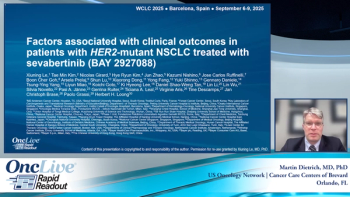
Martin Dietrich, MD, PhD presents insights from an exploratory analysis of the Phase I/II SOHO-01 trial of sevabertinib in HER2-mutant NSCLC, highlighting how clinical and molecular factors, such as prior therapy, HER2 subtype, and TP53 co-alterations, impact treatment outcomes.
Panelists discuss how the Beamion LUNG-1 trial demonstrated zongertinib’s impressive efficacy in second-line treatment of HER2–mutant non–small cell lung cancer (NSCLC)with a 75% response rate and 14.1-month duration of response in previously treated patients, while showing a favorable safety profile as a true targeted therapy with mainly low-grade diarrhea and minimal toxicities compared with chemotherapy-like side effects, and maintaining activity even after prior trastuzumab deruxtecan treatment with a 50% response rate.
Published: October 18th 2024 | Updated: October 21st 2024
January 11th 2024
September 19th 2023