
Lyudmila A. Bazhenova, MD, and D. Ross Camidge, MD, PhD, review the DESTINY-Lung01 and DESTINY-Lung02 trials, and the panel provides its impressions of the data.

Martin Dietrich, MD, PhD, is a medical oncologist with The US Oncology Network Cancer Care Centers of Brevard and an assistant professor of internal medicine at the University of Central Florida College of Medicine in Orlando, Florida.
Lyudmila A. Bazhenova, MD, and D. Ross Camidge, MD, PhD, review the DESTINY-Lung01 and DESTINY-Lung02 trials, and the panel provides its impressions of the data.
The panel discusses the role of antibody-drug conjugates (ADCs) and the treatment of patients with HER2-mutated non–small cell lung cancer.
Experts on HER2-mutated non–small cell lung cancer provide clinical insights on biomarker testing challenges and the role of reflex testing.
A panel of thoracic oncologists introduce themselves and discuss biomarker testing strategies and the diagnosis of HER2-mutated non–small cell lung cancer (NSCLC).
Martin Dietrich, MD, PhD, and Ritu Salani, MD, share their outlook on the future roles of HER2-directed ADCs in gynecological cancers and other solid tumors, highlighting the necessity for additional research to provide further understanding in these areas.
Ritu Salani, MD, provides expert insights regarding HER2 testing in patients with gynecological cancers, emphasizing the need for standardization in testing practices and greater clarity surrounding the incidence of HER2 positivity across gynecological cancers.
Ritu Salani, MD, highlights impactful findings from the DESTINY-PanTumor02 study in patients with cervical cancer, highlighting the promising role of HER2-directed ADCS in this treatment space.
Ritu Salani, MD, discusses impactful efficacy signals from T-DXd in the DESTINY-PanTumor02 study for endometrial cancer, marking a potential breakthrough in this treatment field.
Ritu Salani, MD, presents an outline of the treatment landscape for ovarian cancer and underscores encouraging data from the DESTINY-PanTumor02 study, showcasing promising results in this treatment setting.
Martin Dietrich, MD, PhD, discusses the role of HER2 ADCs in GI cancers, reviewing key data from DESTINY-Gastric and DESTINY-CRC trials.
Martin Dietrich, MD, PhD, examines the safety and efficacy of HER2-directed ADCs in NSCLC, emphasizing significant differences in response associated with HER alterations.
Martin Dietrich, MD, PhD, offers a comprehensive review of the efficacy and safety of HER2 ADCs in breast cancer, underscoring their substantial impact on treatment practices in both HER2+ and HER2-low.
Martin Dietrich, MD, PhD, reflects on the lessons and insights gleaned from HER2 in breast cancer, examining their influence on the development of treatment approaches utilizing HER2-targeted therapies in other solid tumors.
Martin Dietrich, MD, PhD, presents a thorough analysis of HER2 as a pan-tumor biomarker, underscoring its universal importance in the field of oncology.
Discover the latest insights on treating uncommon EGFR mutations, emphasizing the importance of NGS, personalized therapy, and ongoing advancements in TKIs and ADCs.
Experts share treatment experiences with osimertinib and afatinib, the potential role of immunotherapy, and ongoing investigations with ADCs and emerging TKIs for patients with uncommon EGFR mutations.
Insights into how the UNICORN study, which assessed osimertinib, is impacting treatment decisions for uncommon EGFR mutations, and other ongoing trials shedding light on effective treatments for this patient population.
Expert insights on sequencing treatment options for patients with uncommon EGFR mutations who have progressed on afatinib, emphasizing clinical trial considerations, biomarker testing, and emerging therapeutic approaches.
Explore dosing nuances and adverse event management strategies for afatinib in treating EGFR mutant non-small cell lung cancer, reflecting real-world practices and clinical insights.
Panelists discuss the intricacies of treating uncommon EGFR mutations, dissecting approved treatment options, considerations for specific mutations, and insights into the evolving drug landscape.
Explore the complexity of uncommon EGFR mutations in lung cancer with experts discussing classifications, testing methodologies, and the necessity of comprehensive panels for accurate identification.
Delve into the evolving landscape of treating EGFR mutations in lung cancer, exploring emerging therapies, structural classifications, and the complexity of individual mutation responses.
The impact of and strategies for addressing less frequent mutations in NSCLC treatment decisions, emphasizing actionable alterations and timely interventions in challenging scenarios.
Expert perspectives on improving turnaround times in genomic testing for lung cancer, covering strategies, challenges, and the significance of liquid biopsy in optimizing patient care.
Shared insight into strategies in genomic testing for lung cancer, emphasizing the importance of comprehensive next-generation sequencing, DNA vs. RNA sequencing, and the evolving role of liquid biopsy.
Explore the latest breakthroughs in precision medicine with a focus on biomarker testing and emerging targets in patients with non–small cell lung cancer.
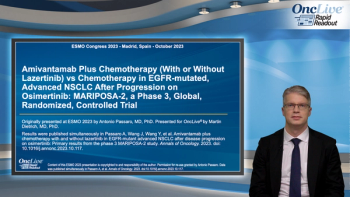
Martin Dietrich, MD, PhD, presents key data from the phase 3 MARIPOSA-2 study, which investigated amivantamab plus chemotherapy, with or without lazertinib, versus chemotherapy in patients with EGFR-mutated advanced NSCLC who experienced disease progression on osimertinib.
Closing out their discussion on biomarker testing and targeted therapies in non–small cell lung cancer, the panel of expert oncologists share clinical pearls and thoughts on the evolving treatment landscape.
Julie R. Brahmer, MD, details emerging targets in non–small cell lung cancer and the outlook for the future of treatment.
The focus turns to therapeutic strategies for treating MET exon 14 non–small cell lung cancer.