Articles by Vivek Subbiah, MD

Panelists discuss how in this discussion the top 3 key points were patient-centric care, enhanced multidisciplinary coordination, and increased access and equity. In the next 3 to 5 years there will be more decentralized testing, potentially more practices participating in genomic profiling, the cost of testing will go down and the turnaround time will be shorter.
Panelists discuss how decentralizing testing can address socioeconomic disparities by improving access to diagnostics for underserved populations. In-house testing reduces barriers like transportation challenges, lack of insurance, and limited availability of specialized tests, ensuring timely, equitable health care for all communities.
Panelists discuss how decentralizing biomarker testing improves access to targeted therapies and clinical trials for underserved populations by reducing geographic and systemic barriers, fostering equity in cutting-edge health care.
Panelists discuss how in-house laboratory testing has demonstrated significant advantages in patient care through rapid turnaround times and immediate decision-making capabilities. Emergency departments have seen notably improved outcomes when critical tests like cardiac markers and blood gases are performed on-site, enabling faster treatment initiation for acute conditions. For example, rapid troponin testing in-house allows for immediate cardiac intervention decisions, while stat electrolyte panels enable quick medication adjustments for critical patients. Additionally, on-site therapeutic drug monitoring helps clinicians make real-time dosing modifications, which is particularly beneficial for antibiotics and anticoagulation therapy.
Panelists discuss how in-house testing facilities significantly enhance multidisciplinary coordination by enabling rapid result turnaround and real-time treatment adjustments. This streamlined process facilitates immediate care planning among specialists, leading to faster clinical decisions and reduced wait times. Studies demonstrate that on-site testing correlates with improved patient outcomes through earlier interventions, decreased length of stay, and enhanced treatment monitoring, ultimately supporting more efficient and responsive patient care delivery.
Panelists discuss how in-house testing significantly reduces turnaround times by eliminating send-out delays and courier dependencies. This enables immediate sample processing, allowing for faster results delivery and prompt clinical decision-making. Health care facilities can optimize workflows through automated systems, clear communication protocols, and standardized testing procedures, minimizing bottlenecks between departments and facilitating quicker diagnosis and treatment initiation.
Panelists discuss how implementing in-house biomarker testing can significantly enhance patient care through faster turnaround times and streamlined decision-making processes. This approach reduces dependence on external laboratories while enabling more immediate clinical interventions. Key implementation considerations include staff expertise, quality control protocols, equipment costs, regulatory compliance, and testing volume to ensure operational efficiency and return on investment
Panelists discuss how in-house comprehensive genomic profiling (CGP) testing offers key benefits like reduced turnaround times, direct control over processes, and immediate access to testing resources. However, significant challenges include substantial initial capital investment, the need for specialized staff recruitment and retention, and ongoing equipment maintenance requirements. Health care facilities must carefully weigh these trade-offs, considering their patient volume, existing infrastructure, and financial capabilities before implementing in-house CGP services.
Panelists discuss how centralized biomarker testing outsources analysis to specialized laboratories while decentralized testing occurs in-house. In-house testing offers tighter workflow control and closer pathology collaboration but requires more resources, whereas send-out testing leverages external expertise.
Panelists discuss how comprehensive genomic testing may not be practical for well-understood tumors with established treatment pathways. Narrow panel testing is preferred when specific mutations guide therapy (like EGFR in lung cancer) or when time/cost constraints exist.
Panelists discuss how comprehensive biomarker testing enables detection of actionable mutations across cancer types, informing targeted therapy selection. This broad molecular profiling approach can reveal treatment opportunities regardless of tumor origin.
Panelists discuss how optimal biomarker testing requires careful balancing of multiple factors. Critical considerations include the turnaround time needed to inform timely treatment decisions, the comprehensiveness of testing panels to identify actionable mutations, and the demonstrated clinical utility of results for guiding therapy selection. Patient-specific factors such as cancer type, stage, prior treatments, and urgency of therapeutic decisions must guide test selection.

In this Oncology Unplugged episode, Dr. Chandler Park and Dr. Vivek Subbiah discuss advancements in precision oncology, next-gen sequencing, and tissue-agnostic therapies.

Vivek Subbiah, MD, discusses data from the VICTORIA trial which evaluated treatment with larotrectinib in patients with TRK fusion–positive solid tumors.
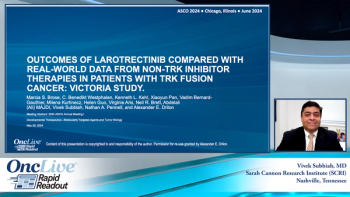
VICTORIA (NCT05192642), is an exact-matching study comparing the outcomes of patients with TRK fusion cancer treated with larotrectinib in 3 clinical trials (NCT02122913, NCT02576431, NCT02637687) to patients treated with non-TRK inhibitor therapies in the real-world (RW) setting.

Vivek Subbiah, MD, discusses the rationale for combining sapanisertib with ziv-aflibercept in recurrent metastatic solid tumors, including kidney cancer.

Clinical Practice Pearls and the Future of SCLC
ByCharu Aggarwal, MD, MPH,Taofeek K. Owonikoko, MD, PhD,Charles M. Rudin, MD,Vivek Subbiah, MD,Jared Weiss, MD The panel shares clinical pearls for community oncologists treating small cell lung cancer.

Investigational Agents in SCLC in the Second Line Setting and Beyond
ByCharu Aggarwal, MD, MPH,Taofeek K. Owonikoko, MD, PhD,Charles M. Rudin, MD,Vivek Subbiah, MD,Jared Weiss, MD Taofeek Owonikoko, MD, PhD, highlights investigational agents and ongoing clinical trials in SCLC he looks forward to.
Choosing the Appropriate Treatment in the Second Line Setting in SCLC
ByCharu Aggarwal, MD, MPH,Taofeek K. Owonikoko, MD, PhD,Charles M. Rudin, MD,Vivek Subbiah, MD,Jared Weiss, MD Experts provide insights on choosing the optimal therapy in patients with small cell lung cancer in the second line and beyond.

Patient Profile 3: A 70-Year-Old Man with SCLC Receiving Chemotherapy in the Second-Line Setting
ByCharu Aggarwal, MD, MPH,Taofeek K. Owonikoko, MD, PhD,Charles M. Rudin, MD,Vivek Subbiah, MD,Jared Weiss, MD Dr Jared Weiss presents the profile of a 70-year-old male patient with SCLC who received chemotherapy in the second line setting for discussion to the panel.
Lurbinectedin for SCLC Treatment in the Second-Line Setting
ByCharu Aggarwal, MD, MPH,Taofeek K. Owonikoko, MD, PhD,Charles M. Rudin, MD,Vivek Subbiah, MD,Jared Weiss, MD Dr Vivek Subbiah explains the clinical trial data that led to the approval of lurbinectedin for SCLC treatment.
Second Line Treatment Options in SCLC and Selecting the Appropriate Therapy
ByCharu Aggarwal, MD, MPH,Taofeek K. Owonikoko, MD, PhD,Charles M. Rudin, MD, PhD,Vivek Subbiah, MD,Jared Weiss, MD The panel discusses the second line treatment options in SCLC and how they choose among the various options based on patient and disease characteristics.
Patient Profile 2: A 60-Year-Old Man with SCLC Progressing on First-Line Therapy
ByCharu Aggarwal, MD, MPH,Taofeek K. Owonikoko, MD, PhD,Charles M. Rudin, MD, PhD,Vivek Subbiah, MD,Jared Weiss, MD Vivek Subbiah, MD, MPH, presents the patient profile of a 60-year-old man with SCLC who progressed on frontline therapy.
Ongoing Trials and Real-World Studies in Frontline SCLC
ByCharu Aggarwal, MD, MPH,Taofeek K. Owonikoko, MD, PhD,Charles M. Rudin, MD, PhD,Vivek Subbiah, MD,Jared Weiss, MD Dr Charles Rudin highlights other notable clinical trials and real-world studies in patients with SCLC in the frontline setting.

IMpower 133 Trial and Patient Selection for Durvalumab + Chemotherapy vs Atezolizumab + Chemotherapy
ByCharu Aggarwal, MD, MPH,Taofeek K. Owonikoko, MD, PhD,Charles M. Rudin, MD, PhD,Vivek Subbiah, MD,Jared Weiss, MD Dr Charu Aggarwal shares data from the IMpower133 trial of atezolizumab plus chemotherapy for SCLC, and how to select the appropriate frontline therapy.
Management of Adverse Events Associated with Durvalumab + Chemotherapy
ByCharu Aggarwal, MD, MPH,Taofeek K. Owonikoko, MD, PhD,Charles M. Rudin, MD,Vivek Subbiah, MD,Jared Weiss, MD Vivek Subbiah, MD, analyzes adverse events observed with durvalumab plus chemotherapy in patients with SCLC and how they can be managed.
Frontline Therapy for SCLC: The CASPIAN Trial of Durvalumab + Chemotherapy
ByTaofeek K. Owonikoko, MD, PhD,Charu Aggarwal, MD, MPH,Charles M. Rudin, MD, PhD,Vivek Subbiah, MD,Jared Weiss, MD Jared Weiss, MD, reviews data from the CASPIAN trial of durvalumab plus chemotherapy in patients with extensive-stage small cell lung cancer.
Patient Profile 1: A 68-Year-Old Male with SCLC and Brain Metastases
ByCharu Aggarwal, MD, MPH,Taofeek K. Owonikoko, MD, PhD,Charles M. Rudin, MD, PhD,Vivek Subbiah, MD,Jared Weiss, MD Charu Aggarwal, MD, MPH, presents the profile of a patient with small cell lung cancer with brain metastases to spark a discussion on treatment approaches in the frontline setting.
Progress in the Treatment and Management of SCLC
ByCharu Aggarwal, MD, MPH,Taofeek K. Owonikoko, MD, PhD,Charles M. Rudin, MD, PhD,Vivek Subbiah, MD,Jared Weiss, MD The panel discusses how the field of small cell lung cancer treatment has changed in recent years.
Use of the TNM Staging System in SCLC
ByCharu Aggarwal, MD, MPH,Taofeek K. Owonikoko, MD, PhD,Charles M. Rudin, MD, PhD,Vivek Subbiah, MD,Jared Weiss, MD Charles Rudin, MD, PhD, explains the prognostic staging systems used for small cell lung cancer.