
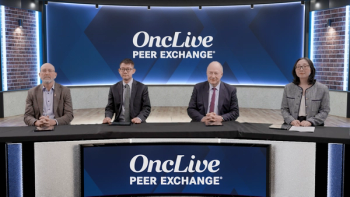
Dr. Hans Lee and the panel discuss emerging combination strategies and treatment sequencing for patients with relapsed/refractory multiple myeloma.
Dr. Hans Lee and the panel discuss emerging combination strategies and treatment sequencing for patients with relapsed/refractory multiple myeloma.
The panel discusses geographic access, community-based treatment, and evolving guideline recommendations for BCMA-directed therapies in relapsed/refractory multiple myeloma.
The panel discusses the practical advantages of off-the-shelf BCMA-directed therapies in relapsed/refractory multiple myeloma, particularly for patients with rapidly progressing disease or high disease burden who may not be able to wait for CAR T-cell manufacturing.
Dr. Hans Lee and Dr. Douglas Sborov discuss how clinical trial subgroup data can inform treatment selection for patients with high-risk relapsed/refractory multiple myeloma.
Dr. Paul Richardson discusses clinical data and practical considerations for belantamab mafodotin as a BCMA-directed antibody-drug conjugate in relapsed/refractory multiple myeloma, highlighting findings from the DREAMM-7 study.
Dr. Hans Lee and Dr. Jing Christine Ye discuss the evolution of clinical data for BCMA-directed bispecific antibodies in relapsed/refractory multiple myeloma, focusing on the increasing understanding of response depth and durability with longer follow-up.
Dr. Hans Lee and Dr. Douglas Sborov discuss how clinicians conceptualize the three major BCMA-directed treatment approaches in relapsed/refractory multiple myeloma: CAR T-cell therapy, bispecific antibodies, and antibody-drug conjugates.
The discussion opens with an overview of the rapidly evolving treatment landscape in relapsed/refractory multiple myeloma, highlighting the expanding range of BCMA-directed therapeutic approaches.
Douglas W. Sborov, MD, MS, discussed the FDA approval of isatuximab for subcutaneous injection in multiple myeloma indications.
Douglas Sborov, MD, discusses a brief overview of key clinical trials, including PERSEUS, IsKia, and GMMG-HD7, highlighting their implications for the treatment of patients with NDMM.
Douglas Sborov, MD, discusses the most reported adverse events in transplant-eligible patients undergoing triplet or quadruplet therapy, as well as significant advancements on the horizon for frontline treatment in NDMM and key takeaways from recent clinical trial data that may impact clinical practice.
Douglas Sborov, MD, discusses how key factors, such as patient eligibility for ASCT, decision-making processes for patients with transplant-eligible NDMM, and the influence of depth of response, including MRD negativity, shape frontline therapy strategies.
Douglas W. Sborov, MD, MS, discusses long-term treatment outcomes for patients with myeloma who received CAR T-cell therapy vs another treatment option.
Douglas W. Sborov, MD, MS, discusses the use of CAR T-cell therapy in patients with relapsed/refractory multiple myeloma.
Douglas W. Sborov, MD, MS, discusses supportive care approaches for selinexor-associated toxicities in multiple myeloma.
Douglas W. Sborov, MD, MS, discusses management strategies for bispecific antibody–related adverse effects in multiple myeloma.
Douglas W. Sborov, MD, MS, discusses mitigating toxicities associated with monoclonal antibodies in multiple myeloma.
Douglas W. Sborov, MD, MS, discusses the toxicities associated with novel therapies in multiple myeloma.

September 13th 2021

