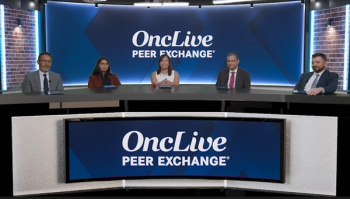
The panel offers closing reflections on the future of neuroendocrine tumor treatment.
The panel offers closing reflections on the future of neuroendocrine tumor treatment.
The panel addresses how academic specialists can support community providers when sharing patients on cabozantinib, and how to manage myelosuppression.
Faculty share practical strategies for dosing cabozantinib and supporting patients through treatment, drawing on experience across neuroendocrine, renal, and thyroid cancers.
The panel discusses where cabozantinib fits within the treatment sequence based on its current second-line label across pancreatic and extra-pancreatic neuroendocrine tumors.
Faculty discuss how future trials should be designed to address unmet needs in lung and thymic neuroendocrine tumors. Several propose randomized studies evaluating cabozantinib before everolimus, with stratification by typical versus atypical histology, and note an ongoing randomized trial comparing a tyrosine kinase inhibitor with everolimus that includes lung patients.
The panel addresses the lung and thymic subgroup analysis from CABINET, a population with historically limited treatment evidence.
Faculty examine the safety considerations most important when treating grade 3 neuroendocrine tumors, beginning with the recently defined and still-evolving nature of this category.
The panel focuses on the use of cabozantinib in grade 3 neuroendocrine tumors, a population increasingly encountered in clinical practice, possibly reflecting more standardized Ki-67 testing across community settings.
Faculty review the key safety findings from CABINET, emphasizing that no unexpected signals emerged relative to prior experience with cabozantinib in other malignancies.
The panel interprets the overall survival data from CABINET and the implications of the trial's early termination. Faculty note that overall survival remains immature and is confounded by permitted placebo crossover, emphasizing that the study was not powered for this endpoint and that progression-free survival was the primary measure.
Faculty present the progression-free survival findings from CABINET across both cohorts, emphasizing the encouraging and practice-changing results in a heavily pretreated population. In the pancreatic neuroendocrine tumor cohort, median progression-free survival exceeded 13 months with cabozantinib versus roughly 4 months with placebo.
The panel reviews the design of the CABINET trial, a large phase 3, randomized, double-blind, placebo-controlled study evaluating cabozantinib in advanced neuroendocrine tumors. Faculty describe the trial's ambitious and inclusive structure, enrolling both pancreatic and extra-pancreatic cohorts, with the extra-pancreatic group encompassing lung, thymic, gastrointestinal, small bowel, and unknown primary tumors. Patients were randomized 2:1 to cabozantinib 60 mg daily versus placebo. The discussion notes that the protocol was modified after launch to require progression on at least one prior approved therapy, reflecting the evolving treatment landscape. Faculty emphasize the broad eligibility, including grades 1 through 3 well-differentiated disease, and compare baseline characteristics with landmark neuroendocrine trials. They highlight that this was a modern-era study, with many patients having received prior radioligand therapy, everolimus, sunitinib, or capecitabine, underscoring how the heavily pretreated population reflects contemporary real-world sequencing and sets the trial apart from earlier studies.
Learn how NET therapy is tailored—surgery when curable, somatostatin analogs first, then PRRT, targeted drugs, and liver-directed options.
The panel examines how treatment is selected across the disease course in neuroendocrine tumors, beginning with the distinction between early-stage and advanced disease.
A multidisciplinary panel of oncologists opens this OncLive Peer Exchange on evolving strategies in neuroendocrine tumor management, introducing the faculty and framing the discussion around CABINET trial data and current clinical practice.

Mohammed Najeeb Al Hallak, MD, MS, discusses treatment considerations for patients with HCC and the associated risks of cirrhosis and portal hypertension.

Mohammed Najeeb Al Hallak, MD, MS, and Sakti Chakrabarti, MD, discuss ongoing research in gastrointestinal cancers.

Mohammed Najeeb Al Hallak, MD, MS, and Sakti Chakrabarti, MD, discuss research building upon approved combinations in unresectable hepatocellular carcinoma.
Mohammed Najeeb Al Hallak, MD, MS, and Sakti Chakrabarti, MD, on trastuzumab deruxtecan–based regimens in advanced HER2-positive GI cancers.

Mohammed Najeeb Al Hallak, MD, MS, and Sakti Chakrabarti, MD, on final overall survival data from the KEYNOTE-811 trial.
Mohammed Najeeb Al Hallak, MD, MS, and Sakti Chakrabarti, MD, on data for neoadjuvant nivolumab plus ipilimumab in dMMR colon cancer.
Mohammed Najeeb Al Hallak, MD, MS, and Sakti Chakrabarti, MD, on tremelimumab/durvalumab vs atezolizumab/bevacizumab in unresectable HCC.
Mohammed Najeeb Al Hallak, MD, MS, and Sakti Chakrabarti, MD, on 5-year data for tremelimumab plus durvalumab in unresectable HCC.
Mohammed Najeeb Al Hallak, MD, MS, shares his experience with making a career decision while trying to meet the challenges of fellowship.

October 28th 2024

October 28th 2024