
Experts weigh switching KIT-mutant GIST patients from sunitinib to a promising combo, balancing PFS gains, exon 9 nuance, sequencing, and pending OS data.

Neeta Somaiah, MD, is a professor and department chair of the Department of Sarcoma Medical Oncology in the Division of Cancer Medicine at The University of Texas MD Anderson Cancer Center.
Experts weigh switching KIT-mutant GIST patients from sunitinib to a promising combo, balancing PFS gains, exon 9 nuance, sequencing, and pending OS data.
Investigational combo TKI for KIT-mutant GIST nears FDA review, upgrading second-line care and stressing mutation and ctDNA testing.
Phase 3 PEAK data show bevacizumab plus sunitinib boosts second-line KIT-mutant GIST PFS and responses with manageable toxicity.
Clinicians explain second-line KIT-mutant GIST, resistance mutations, and why adding besiclastinib to sunitinib may improve outcomes.
Neeta Somaiah, MD, discusses efficacy data for bezuclastinib plus sunitinib from the Peak study in advanced gastrointestinal stromal tumors.
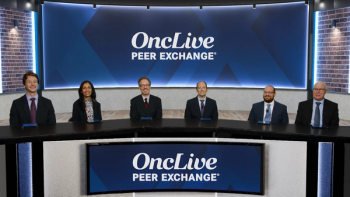
The panel discusses exciting future developments including expanded interest in first-line combination strategies and targeting multiple resistance mechanisms simultaneously. Companies are increasingly developing agents specifically for GIST rather than repurposing drugs designed for other malignancies.
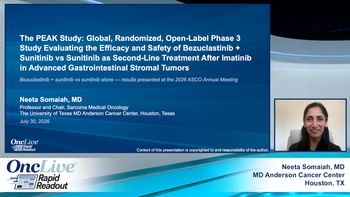
Dr. Neeta Somaiah discusses PEAK trial results showing that adding bezuclastinib to sunitinib nearly doubled median progression-free survival (16.5 vs 9.2 months) and improved overall response rate versus sunitinib alone in second-line, imatinib-resistant gastrointestinal stromal tumors.
Dr. Schulte outlines toxicity management strategies across the GIST treatment sequence, emphasizing proactive patient education and monitoring. Imatinib's 25-year track record provides community comfort with characteristic side effects including edema, myalgias, and gastrointestinal irritation, managed with full stomach dosing and symptomatic measures.
Dr. Pollack emphasizes tissue-based next-generation sequencing as the gold standard for initial diagnosis and primary driver mutation identification. This testing remains absolutely essential at diagnosis to distinguish KIT-mutant from PDGFRA-mutant GIST and identify rare entities like SDH-deficient or NTRK-fusion tumors requiring different treatment approaches.
Dr. Somaiah addresses the critical question of treatment sequencing after combination second-line therapy, acknowledging that all currently approved agents were studied as sequential monotherapies without prospective data on their performance following combination treatment. This represents uncharted territory requiring clinical experience and real-world data collection.
Dr. Schulte addresses the critical question of combination tolerability compared to sunitinib monotherapy, noting that community oncologists' primary concern involves adding a second agent to an already challenging treatment regimen. The PEAK Part 1 safety data provided reassuring evidence that combination therapy doesn't substantially increase toxicity burden.
Dr. Pollack addresses clinicians' desire for mutation-specific response data before adopting combination therapy, emphasizing the transformative insights from the INTRIGUE trial's ctDNA analysis. The INTRIGUE study demonstrated dramatic differences in patients with KIT exon 11 mutations based on secondary resistance patterns: those with exon 13/14 secondary mutations achieved over 12 months progression-free survival with sunitinib versus only months with ripretinib, while the reverse pattern held for exon 17/18 secondary mutations.
Dr. Agulnik outlines bezuclastinib's regulatory trajectory, noting Breakthrough Therapy Designation granted in March 2026 based on PEAK topline results. This designation indicates the drug addresses unmet medical need with substantial improvement over available therapy. The New Drug Application was accepted under Real-Time Oncology Review with submission completed in April 2026.
Dr. Heinrich explains the scientific foundation for combining bezuclastinib with sunitinib, addressing the fundamental problem of polyclonal resistance emerging after imatinib progression.
Dr. Schulte identifies significant knowledge gaps among community oncologists managing GIST, acknowledging that even experienced community practitioners may encounter only 2 to 3 patients annually. This limited exposure creates challenges in maintaining expertise with nuanced treatment decisions and sequencing strategies.
Dr. Pollack characterizes ripretinib as an outstanding fourth-line agent that filled a critical unmet need in post-third-TKI progression settings. Before ripretinib's availability, patients lacked effective treatment options after exhausting the first three lines of therapy.
Dr. Agulnik analyzes the INTRIGUE trial's landmark contributions to GIST management, representing the first head-to-head Phase 3 comparison rather than placebo-controlled study.
Dr. Somaiah outlines the current FDA-approved sequence for advanced KIT-mutant GIST, emphasizing that community oncologists may encounter only handful of patients annually. First-line therapy uses imatinib 400mg daily, escalating to 400mg twice daily for KIT exon 9 mutations based on superior activity data.
Dr. Jason Sicklick from UC San Diego introduces this OncLive Peer Exchange program addressing the evolving post-third-line GIST landscape, joined by sarcoma experts Dr. Mark Agulnik, Dr. Neeta Somaiah, Dr. Michael Heinrich, Dr. Seth Pollack, and Dr. Brian Schulte. The discussion focuses on the first positive Phase 3 second-line trial in over two decades currently under FDA review.
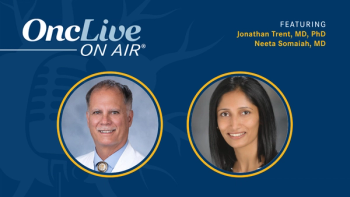
Jonathan Trent, MD, PhD, and Neeta Somaiah, MD, discuss the importance of identifying genomic drivers and resistance patterns for therapy selection in GIST.
Neeta Somaiah, MD, discusses the landscape of mutation-specific therapy for the treatment of patients with a gastrointestinal stromal tumor.

Neeta Somaiah, MD, details challenges that are associated with pathology diagnosis, NGS, and early opinions for patients with sarcomas.
Neeta Somaiah, MD, discusses chemotherapy as the current mainstay of treatment in sarcoma subtypes and the emergence of immunotherapies in the space.
Neeta Somaiah, MD, discusses ongoing research with novel agents that have emerged and those that could soon emerge in the sarcoma treatment paradigm.
Neeta Somaiah, MD, discusses enrollment criteria for the phase 3 Peak trial in patients with gastrointestinal stromal tumor and the advantages of this trial’s design.
Neeta Somaiah, MD, discusses remaining challenges in soft tissue sarcoma.
Neeta Somaiah, MD, assistant professor, Department of Sarcoma Medical Oncology, Division of Cancer Medicine, The University of Texas MD Anderson Cancer Center, discusses the next steps following the phase I findings of the CMB305 trial in patients with NY-ESO-1–positive recurrent soft tissue sarcoma.
Neeta Somaiah, MD, assistant professor, Department of Sarcoma Medical Oncology, Division of Cancer Medicine, The University of Texas MD Anderson Cancer Center, discusses the expression of NY-ESO-1 in patients with soft tissue sarcoma.
Neeta Somaiah, MD, assistant professor, Department of Sarcoma Medical Oncology, Division of Cancer Medicine, The University of Texas MD Anderson Cancer Center, discusses phase I findings of CMB305 in patients with NY-ESO-1–positive recurrent soft tissue sarcoma.
August 20th 2020

June 19th 2017
August 2nd 2017