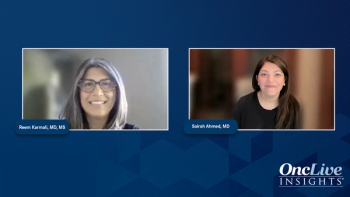
Panelists discuss how CAR T therapy is being positioned within the treatment paradigm for marginal zone lymphoma based on emerging efficacy and safety data.
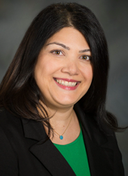
Sairah Ahmed, MD, is an associate professor in the Department of Lymphoma/Myeloma, of the Division of Cancer Medicine, and director of the CAR T Program at The University of Texas MD Anderson Cancer Center.
Panelists discuss how CAR T therapy is being positioned within the treatment paradigm for marginal zone lymphoma based on emerging efficacy and safety data.
Panelists discuss how emerging evidence supports the use of CAR T therapy for patients with relapsed or refractory marginal zone lymphoma.
Panelists discuss how clinicians identify and address ongoing unmet needs in treating relapsed or refractory marginal zone lymphoma.
Panelists discuss how the treatment landscape for relapsed or refractory marginal zone lymphoma continues to evolve with emerging targeted and immune-based therapies.
Panelists discuss how novel CAR T strategies are being studied to further improve outcomes in follicular lymphoma.
Panelists discuss how clinicians compare safety profiles and manage risks between different CAR T therapies for relapsed or refractory follicular lymphoma.
Panelists discuss how safety profiles differ between CAR T therapy and bispecific antibodies for patients with relapsed or refractory follicular lymphoma.
Panelists discuss how clinicians decide between CAR T therapy and bispecific antibodies for patients with relapsed or refractory follicular lymphoma.
Panelists discuss how determining the best timing for CAR T therapy can maximize outcomes in relapsed or refractory follicular lymphoma.
Panelists discuss how individual and disease-specific factors influence the success of CAR T therapy in relapsed or refractory follicular lymphoma.
Panelists discuss how pivotal trials have established the efficacy and safety of CAR T therapies for relapsed or refractory follicular lymphoma.
Panelists discuss how clinicians determine when and how to use CAR T-cell therapy in relapsed or refractory follicular lymphoma.
Panelists discuss how CAR T-cell therapy and bispecific antibodies are being integrated into care for relapsed or refractory follicular lymphoma.
Panelists discuss how clinicians evaluate the advantages and limitations of therapies used in earlier lines of follicular lymphoma treatment.
Panelists discuss how clinicians approach selecting the most appropriate second-line treatments for relapsed or refractory follicular lymphoma.
Panelists discuss how advances in the understanding of follicular lymphoma have shaped evolving treatment strategies for patients with relapsed or refractory disease.
Sairah Ahmed, MD, discusses safety data with NKTR-255 in patients with relapsed/refractory large B-cell lymphoma.
Sairah Ahmed, MD, explains the rationale for evaluating NTKR-255 after CAR T-cell therapy in relapsed/refractory large B-cell lymphoma.
Sairah Ahmed, MD, discusses treatment challenges for patients with relapsed/refractory large B-cell lymphoma following CAR T-cell therapy.
Sairah Ahmed, MD, discusses evaluating NKTR-255 in combination with CD19-directed CAR T-cell therapy in patients with relapsed/refractory large B-cell lymphoma.
Sairah Ahmed, MD, discusses optimizing treatment with axicabtagene ciloleucel in large B-cell lymphoma.
Sairah Ahmed, MD, discusses the efficacy of axicabtagene ciloleucel (axi-cel; Yescarta) in patients with refractory large B-cell lymphoma (LBCL) who achieved complete remission (CR) to any prior treatment versus those who were primary refractory.

For an incoming first-year hematology/oncology fellow, July 1st is when you are once again the new kid on the block.
February 14th 2025

March 7th 2011