
Uwe Platzbecker, MD, discusses efficacy data with the combination of all-trans retinoic acid and arsenic trioxide in high-risk acute promyelocytic leukemia.
Uwe Platzbecker, MD, discusses efficacy data with the combination of all-trans retinoic acid and arsenic trioxide in high-risk acute promyelocytic leukemia.
The panel concludes their discussion with a look toward the future of lower-risk myelodysplastic syndrome treatment and the unmet needs that should be addressed.
Rami Komrokji, MD, provides clinical insights on treatment decision-making, sequencing, and combinations for patients with myelodysplastic syndrome. Please note: Since the filming of this program, luspatercept has been approved by the FDA for the treatment of lower-risk MDS in the first-line setting.
Valeria Santini, MD, reviews data from real-world outcomes in clinical trials investigating luspatercept in patients with lower-risk MDS.
Uwe Platzbecker, MD, discusses key findings from the phase 3 COMMANDS trial with luspatercept in patients with lower-risk myelodysplastic syndrome with anemia, as well as the clinical implications of FDA approval of luspatercept for patients in this population.
Expert perspectives on the clinical implications of recent clinical trial data on new therapies in lower-risk myelodysplastic syndrome.
The panel of experts review recent data updates for new agents being investigated in the second line in patients with lower-risk MDS.
Uwe Platzbecker, MD, reviews data updates from the MEDALIST trial investigating luspatercept in patients with lower-risk myelodysplastic syndrome.
Comprehensive insights on the differences and similarities in treatment algorithms for physicians treating patients with MDS in and outside the United States. Please note: Since the filming of this program, luspatercept has been approved by the FDA for the treatment of lower-risk MDS in the first-line setting.
The expert panel reviews updated data from the COMMANDS trial on luspatercept in patients with lower-risk MDS and discusses their effect on clinical practice. Please note: Since the filming of this program, luspatercept has been approved by the FDA for the treatment of lower-risk MDS in the first-line setting.
A panel of expert hematologists give an overview of myelodysplastic syndrome, focusing on diagnosis, classification, and treatment practices.

Uwe Platzbecker, MD, discusses the significance of the FDA approval of luspatercept for patients with lower-risk myelodysplastic syndrome with anemia.

Experts close by summarizing key advances and remaining unmet needs across all MDS risk groups, and share their hopes for the future.
A brief discussion centered on MDS/MPN-RS-T overlap syndromes, considerations for diagnosis, available treatment options, and updates in the space.

The panelists touch on emerging data in the higher-risk MDS space, including updates presented at ASH 2022.
The panel turns their focus to higher-risk MDS, starting with a discussion of first- and second-line treatment options, followed by a third and final case presentation and discussion led by Dr Platzbecker.
Experts summarize recent updates on other approved or emerging second-line therapies for lower-risk MDS.
Dr Komrokji presents key data updates from the MEDALIST trial on luspatercept in patients with lower-risk MDS that were presented at the 2022 European Hematology Association (EHA) Congress and the 2022 ASH Annual Meeting.
The panelists discuss Dr Cluzeau’s presented case, emphasizing the importance of pathology reporting, and expand upon approaches to second-line treatment selection for patients with MDS-RS.
Dr Cluzeau introduces a second patient case of lower-risk MDS-RS with an SF3B1 mutation and symptomatic anemia, who received a first-line erythropoiesis-stimulating agent (ESA) and second-line luspatercept.
Dr Komrokji leads a discussion on emerging data on how p53 mutations and chromosome 5q deletions may affect prognosis, treatment response, and outcomes for patients with MDS.
Expert panelists reflect on the case presented by Dr Garcia-Manero and share their unique perspectives on how they might have approached treatment and followup for this patient in their own practice.
Guillermo Garcia-Manero, MD presents a case of lower-risk MDS with chromosome 5q and 20q deletions and a p53 mutation, and discusses first- and second-line treatment selection.
Dr Platzbecker outlines available second-line therapies for symptomatic anemia in patients with lower-risk MDS, highlighting differences in availability between the United States and Europe.
Thomas Cluzeau, MD, PhD provides an overview of first-line treatment options for symptomatic anemia in patients with lower-risk MDS, followed by a discussion of panelists’ treatment patterns and dosing strategies across the globe.
A focused discussion on best practices for MDS pathology and risk status reporting in both community and academic center settings.
Uwe Platzbecker, MD introduces models commonly used to determine risk status and prognosis, and inform treatment decisions, for patients with MDS.
Moderator Rami Komrokji, MD, introduces the panel and invites expert pathologist Sanam Loghavi, MD to lead a discussion on the typical patient presentation and diagnostic process in MDS, which was recently renamed as ‘myelodysplastic neoplasms’ in the 2022 5th edition of the World Health Organization (WHO) classification of the disease state.
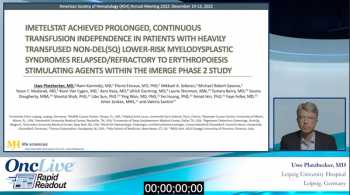
Dr Uwe Platzbecker reviews data on imetelstat in patients with lower-risk myelodysplastic syndromes (MDS) that were recently presented at the 2022 American Society of Hematology (ASH) Annual Meeting.
February 23rd 2023

March 2nd 2023

January 26th 2023
March 9th 2023
January 18th 2023