Articles by Xavier Leleu, MD, PhD
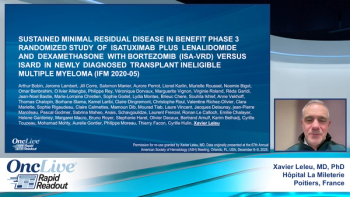
This video presents an updated analysis from the BENEFIT (IFM 20205) study, led by Professor Xavier Leleu, focusing on sustained measurable residual disease (MRD) negativity in patients with newly diagnosed multiple myeloma. Following the primary results published in Nature Medicine in 2024, this update examines MRD negativity over time using next-generation sequencing at 12, 18, and 24 months after treatment initiation. The discussion emphasizes that sustained MRD negativity—rather than a single timepoint or complete response rate—is the most clinically meaningful endpoint. Results show that quadruplet-based regimens achieve higher and more durable MRD negativity compared with triplet-based therapies. The video also explores outcomes in key biological subgroups, including patients with t(11;14) translocation, who demonstrate slower and lower rates of MRD negativity. Overall, the findings support the growing role of sustained MRD negativity as a critical endpoint to guide long-term treatment strategies in multiple myeloma.
Xavier Leleu, MD, PhD, discusses the role of subcutaneous isatuximab delivered via an on-body delivery system in patients with relapsed/refractory multiple myeloma.

Isatuximab-Based Triplet Delivered via On-Body System Shows Promise in RRMM: With Xavier Leleu, MD, PhD; and Beth Faiman, PhD, MSN, APN-BC
ByBeth M. Faiman, PhD, MS, APN-BC, BMTCN, AOCN, FAAN, FAPO,Xavier Leleu, MD, PhD Xavier Leleu, MD, PhD, and Beth Faiman, PhD, MSN, APN-BC, BMTCN, AOCN, FAAN, FAPO, discuss key data from the phase 3 IRAKLIA study.
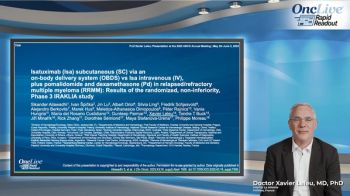
Xavier Leleu, MD, PhD, presents primary results from the Phase 3 IRAKLIA study demonstrating noninferior efficacy and a favorable safety profile of subcutaneous versus intravenous isatuximab, both combined with pomalidomide and dexamethasone, in patients with relapsed/refractory multiple myeloma.
Xavier Leleu, MD, PhD, discusses how the declining prognosis of patients with multiple myeloma correlates with line of therapy and time after diagnosis, highlighting an unmet need for more effective later-line therapies in this population.


