Xiuning Le, MD, PhD, discusses treatment selection among targeted therapies for HER2-mutant NSCLC.

Xiuning Le, MD, PhD, is an associate professor in the Department of Thoracic/Head and Neck Medical Oncology in the Division of Internal Medicine at The University of Texas MD Anderson Cancer Center
Xiuning Le, MD, PhD, discusses treatment selection among targeted therapies for HER2-mutant NSCLC.
Combination therapy with osimertinib and chemotherapy demonstrated substantially improved disease control and response durability compared with osimertinib alone. The benefit was consistent across key subgroups, including patients with brain metastases and different EGFR mutation types. While toxicity was higher with combination therapy, no new safety concerns were identified, supporting its potential role as a preferred first-line option in this high-risk population
Xiuning Le, MD, PhD, discusses the mechanism of action of sevabertinib in HER2-mutated NSCLC.
Xiuning Le, MD, PhD, discusses the significance of the FDA’s approval of sevabertinib for locally advanced/metastatic, nonsquamous HER2-positive NSCLC.
Xiuning Le, MD, PhD, discusses the current landscape of KRAS G12C inhibitors and emerging strategies for optimizing KRAS inhibition in NSCLC.
Xiuning Le, MD, PhD, discusses findings from the phase 1/2 SOHO-01 trial evaluating sevabertinib monotherapy in HER2-mutant advanced NSCLC.
Xiuning Le, MD, PhD, discusses efficacy data with firmonertinib for the treatment of patients with EGFR PACC–mutated NSCLC.
Xiuning Le, MD, PhD, discusses the prevalence of EGFR PACC mutations in NSCLC.

Panelists discussed that despite advances in targeted therapies for EGFR-mutant lung cancer, challenges remain around defining meaningful clinical endpoints, improving access to molecular testing and treatments, expanding trial eligibility for high-risk patients, exploring curative approaches in select cases, and emphasizing personalized strategies with ongoing patient-centered care and education.
Panelists discussed that consolidation osimertinib after chemoradiation significantly improves progression-free survival in unresectable stage III EGFR-mutant NSCLC, neoadjuvant osimertinib plus chemotherapy shows promise in early-stage disease, and new antibody-drug conjugates offer effective, better-tolerated options after progression on osimertinib and chemotherapy.
Panelists discussed that although a HER3-targeted ADC showed limited benefit and lost FDA approval, emerging therapies like new ADCs, bispecific antibodies, and personalized sequencing based on molecular testing are expanding treatment options for EGFR-mutant NSCLC resistant to TKIs.
Panelists discuss that when patients progress after frontline osimertinib without histologic transformation or secondary drivers, treatment options include switching to chemotherapy combined with targeted agents like anti-MET antibodies, considering toxicity and patient tolerance, while molecular testing guides sequencing decisions—especially in cases with MET amplification—and that after newer combination regimens, biopsy and personalized approaches remain essential for optimizing therapy and managing side effects.
Panelists discuss that after progression on frontline therapy, treatment decisions hinge on prior regimens, progression patterns, and detailed molecular profiling—including tissue biopsy to detect transformations and resistance mechanisms like MET or HER2 alterations—with sequencing strategies tailored accordingly and clinical trial enrollment encouraged for patients without clear targets.
Panelists discuss that managing systemic progression in EGFR-mutant lung cancer requires thorough molecular profiling via tissue and liquid biopsies to identify resistance mechanisms like histologic transformation and MET amplification, with comprehensive testing guiding next-line targeted therapies or clinical trial enrollment to optimize patient outcomes.
Panelists discuss that resistance to frontline osimertinib is diverse, involving on-target mutations like C797S, MET amplification, and small cell transformation, highlighting the need for tissue biopsies alongside liquid biopsies to guide treatment, and note that newer combination therapies such as Mariposa may reduce certain resistance mutations and alter tumor evolution, offering hope for improved outcomes.
Panelists discuss that the Cocoon trial’s four-part prophylactic regimen—including oral antibiotics, clindamycin topical treatment, nail toxicity prevention, and ceramide-based lotions—significantly reduces skin toxicities like scalp rashes in EGFR inhibitor therapies, emphasizing the importance of patient and provider education to ensure adherence and improve treatment tolerability.
Panelists discuss that the skipper regimen—a prophylactic dexamethasone schedule started days before infusion—has significantly reduced infusion-related reactions from about 66% to 22%, improving patient comfort and clinic workflow while emphasizing ongoing education and early management to ensure safety.
Panelists discuss that chemotherapy plus osimertinib requires managing early hematologic toxicities and EGFR-related rash and diarrhea with close monitoring, while the bispecific antibody regimen involves proactive prevention of infusion reactions, anticoagulation for VTE risk, and intensive rash management to support treatment adherence and patient quality of life.
Panelists discuss the evolving safety profiles of first-line EGFR-mutated lung cancer treatments, highlighting that chemotherapy combinations cause expected hematologic toxicities and fatigue, while bispecific antibody regimens bring unique challenges such as infusion reactions, more severe rashes and diarrhea, peripheral edema, and a notably increased risk of venous thromboembolism that warrants prophylactic anticoagulation and careful patient monitoring.
Panelists discuss the critical role of regular brain MRI monitoring in EGFR-mutant lung cancer, balancing timely detection of intracranial progression with the risks of early radiation; they emphasize individualized treatment sequencing guided by progression patterns and resistance profiling through biopsies and liquid biopsies to optimize patient outcomes.
Panelists discuss the evolving management of CNS metastases in EGFR-mutant lung cancer, highlighting how third-generation TKIs and combination regimens from the FLORA and Mariposa trials delay CNS progression and reduce new brain metastases, supporting a shift away from upfront radiation in asymptomatic patients.
Panelists discuss how the availability of three frontline options for EGFR-mutant NSCLC has complicated treatment selection, prompting highly individualized, hour-long consultations that balance disease biology, patient values, and the trade-offs between monotherapy and combination regimens.
Panelists discuss the Mariposa trial’s landmark overall survival benefit with amivantamab plus lazertinib over osimertinib monotherapy in EGFR-mutant NSCLC, marking a paradigm shift toward durable survival and reinforcing the value of optimized patient selection and adherence to combination regimens.
Panelists discuss how the FLAURA2 trial has reshaped EGFR-mutant NSCLC treatment by demonstrating meaningful progression-free survival gains with osimertinib plus chemotherapy, while emphasizing the importance of protocol adherence, long-term outcome potential, and the ongoing pursuit of curative strategies.
Panelists discuss evolving first-line strategies for EGFR-mutant NSCLC, highlighting the expanding role of combination regimens, CNS efficacy, and the need for personalized treatment selection and toxicity management, especially in younger, well-informed patients.
Xiuning Le, MD, PhD, discusses the HARMONi-2 trial of ivonescimab in patients with advanced PD-L1–positive non–small cell lung cancer.
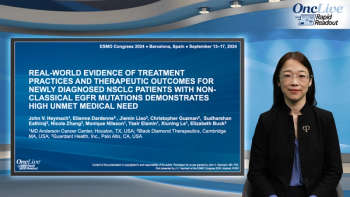
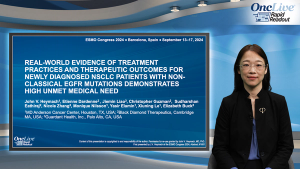
Dr. Xiuning Le highlights real-world data on therapeutic outcomes for newly diagnosed NSCLC patients with non-classical EGFR mutations, emphasizing the need for improved treatments, at ESMO Congress 2024.

Xiuning Le, MD, PhD, discusses updated findings from the phase 1/2 SOHO-01 trial.
Xiuning Le, MD, PhD, discusses findings from the interim analysis of the phase 2 RAMOSE trial in patients with TKI-naïve metastatic non–small cell lung cancer harboring EGFR mutations.
Published: September 27th 2024 | Updated: October 4th 2024
Published: September 27th 2024 | Updated: October 4th 2024

September 10th 2024