






Colorectal Cancer
Latest News
Advertisement
Latest Videos


































































Advertisement
More News

Patrick Boland, MD, discusses the development of therapeutic strategies targeting KRAS G12C mutations in colorectal cancer.

SCO-101 in combination with leucovorin, fluorouracil, and irinotecan (FOLFIRI) prolonged survival in heavily pretreated patients with metastatic colorectal cancer who had no other active treatment options available, according to final data from part 2 of the phase 2 CORIST study.

John Lindsay Marshall, MD, sheds light on the significance of the FDA approval of fruquintinib for patients with heavily pretreated metastatic colorectal cancer and discusses the efficacy and safety data from the FRESCO and FRESCO-2 trials that supported the decision in this population.

The FDA has approved fruquintinib (Fruzaqla) for the treatment of adult patients with metastatic colorectal cancer who have been previously treated with fluoropyrimidine-, oxaliplatin-, and irinotecan-based chemotherapy, an anti-VEGF therapy, and, if RAS wild-type and medically appropriate, an anti-EGFR therapy.
The FDA has approved fruquintinib (Fruzaqla) for the treatment of adult patients with metastatic colorectal cancer who have been previously treated with fluoropyrimidine-, oxaliplatin-, and irinotecan-based chemotherapy, an anti-VEGF therapy, and, if RAS wild-type and medically appropriate, an anti-EGFR therapy.

The addition of panitumumab to FOLFIRINOX or mFOLFOX6 led to comparable overall response rates and complete response rates in patients with RAS or BRAF V600E wild-type, unresectable, metastatic colorectal cancer without liver-limited disease.

The combination of garsorasib and cetuximab elicited responses and was found to be well tolerated in heavily pretreated patients with KRAS G12C–mutated colorectal cancer.

Treatment with combinations using sotorasib at multiple dose levels and panitumumab led to improved progression-free survival vs standard of care in patients with chemorefractory metastatic colorectal cancer harboring KRAS G12C mutations.

Filippo Pietrantonio, MD, discusses the influence of primary results from the phase 3 CodeBreak 300 trial of sotorasib plus panitumumab on KRAS G12C-mutated metastatic colorectal cancer.

David S. Hong, MD, and David Sommerhalder, MD, discuss the unmet needs for patients with KRAS G12C–mutant non–small cell lung cancer (NSCLC) and colorectal cancer (CRC) that prompted the initiation of the RMC-6291-001 trial; the key efficacy and safety findings with RMC-6291 in patients with NSCLC and CRC; and potential next steps for this agent.

David S. Hong, MD, discusses preliminary efficacy data from a phase 1 trial f the KRAS G12C inhibitor RMC-6291 in advanced KRAS G12C–mutant solid tumors.

David Sommerhalder, MD, discusses the potential for RMC-6291 as a single agent in KRAS G12C–mutated advanced colorectal cancer.

The novel mRNA biomarkers in the noninvasive ColoAlert® screening test displayed sensitivity and specificity for detecting colorectal cancer and advanced adenomas that could be precursors to CRC.
The FDA has approved the CRCdx® RAS Mutation Detection Kit as a companion diagnostic for panitumumab in the treatment of patients with metastatic colorectal cancer, according to an announcement from EntroGen.
A new drug application seeking the approval of fruquintinib for the treatment of adult patients with previously treated metastatic colorectal cancer has been submitted to Japan’s Ministry of Health, Labour, and Welfare.

Jeremy C. Jones, MD, discusses the applications of circulating tumor DNA testing in colorectal cancer.
Circulating tumor DNA status at the time of postoperative minimal residual disease is a prognostic factor of recurrence for patients with radically resected stage II to IV colorectal cancer

Although findings from the International Duration Evaluation of Adjuvant Therapy collaboration in 2018 failed to demonstrate the noninferiority of 3 months of adjuvant chemotherapy vs 6 months for patients with stage III colon cancer, clinically relevant data in subgroup analyses have influenced practice prescribing patterns, according to a retrospective analysis.
The integration of novel mRNA biomarkers into the ColoAlert® screening test resulted in high sensitivity and specificity for colorectal cancer.

Marwan G. Fakih, MD, expands on long-term findings from the phase 2/3 PROSPECT trial and how these findings may influence the optimal use of nonoperative management strategies in locally advanced rectal cancer.

Howard S. Hochster, MD, discusses data from the phase 3 FRESCO-2 trial of fruquintinib plus best supportive care in metastatic colorectal cancer.

Daneng Li, MD, discusses the evolution of treating patients with HER2-positive colorectal cancer and highlights the effects of implementing HER2-targeted therapy in this patient population.

The FDA has granted 2 breakthrough therapy designations to trastuzumab deruxtecan for the treatment of patients with unresectable or metastatic HER2-positive solid tumors that have progressed after prior treatment and who have no satisfactory alternative treatment options, and for those with HER2-positive metastatic colorectal cancer who have received at least 2 prior lines of therapy.

Thierry André, MD, discusses the investigation of trifluridine/tipiracil plus bevacizumab in patients with metastatic colorectal cancer, including how its use as a standard of care in the third line supported its investigation in the first-line setting, the regimen’s efficacy and safety in the SOLSTICE trial, and the importance of this combination for patients in this space despite negative trial results.
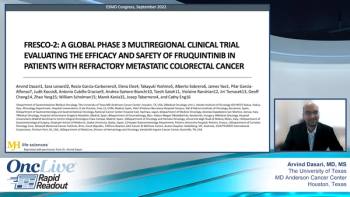
Arvind Dasari, MD, MS, presents data from the FRESCO-2 clinical trial evaluating fruquintinib in patients with refractory metastatic colorectal cancer, and provides insights on the clinical implications of the results.
Advertisement
Advertisement
Trending on OncLive
1
The OncFive: Top Oncology Articles for the Week of 10/4/2026
2
FDA Approves Atezolizumab Plus Chemo for Stage III dMMR Colon Cancer
3
FDA Grants Breakthrough Device Designation to Natera’s Multi-Cancer Early Detection Assay
4
VIR-5500 Receives FDA Fast Track Designation in mCRPC
5