






Colorectal Cancer
Latest News
Advertisement
Latest Videos




































































Advertisement
More News

In this fifth episode of OncChats: Understanding Lynch Syndrome and Cancer Risk, Fay Kastrinos, MD, MPH, highlights progress made with regard to colon cancer treatment and Lynch syndrome, including leveraging immunotherapy.

The FDA has granted priority review to the new drug application seeking the approval of fruquintinib for use in the treatment of adult patients with previously treated metastatic colorectal cancer.

In this fourth episode of OncChats: Understanding Lynch Syndrome and Cancer Risk, Fay Kastrinos, MD, MPH, explains the implications of Lynch syndrome genotype on risk of colorectal cancer.

Amanda Bloomer, PhD, highlights the growing need for more research for this growing patient population and the age-specific findings that were seen in the ColoCare trial.

Brian C. Grieb, MD, PhD, emphasizes the importance of investigating agents that target the MYC oncogene, as well as supportive cofactors, in colorectal cancer and other tumor types.

John L. Hays, MD, PhD, discusses the evolution of the treatment paradigm for patients with metastatic colorectal cancer who experience disease progression following standard chemotherapy regimens.
Brian C. Grieb, MD, PhD, discusses historical barriers to targeting the MYC oncogene in patients with colorectal cancer and the rationale for an ongoing phase 1/2 clinical trial that may demonstrate an effective way to target MYC in CRC and other solid tumors.

Triplet therapy consisting of encorafenib, cetuximab, and binimetinib demonstrated activity and manageable safety as first-line treatment for patients with BRAF V600E–mutated metastatic colorectal cancer.

Alaa Muslimani, MD, discusses unanswered questions in the treatment of patients with metastatic colorectal cancer, highlighting how these unmet needs may be addressed through continued research.

In this third episode of OncChats: Understanding Lynch Syndrome and Cancer Risk, Fay Kastrinos, MD, MPH, discusses testing guidance for identifying Lynch syndrome.

Jayesh Desai, MBBS, FRACP, reports prior phase 1 data on the use of divarasib monotherapy in KRAS G12C–mutated CRC and early efficacy, safety, and presents pharmacokinetic data from the use of divarasib plus cetuximab from a phase 1 trial.

Mariana X. Byndloss, DVM, PhD, discusses the relationship between the gut microbiome and the risk of developing cancers such as colorectal cancer.

China’s National Medical Products Administration has granted a breakthrough therapy designation to the KRAS G12C inhibitor IBI351 as monotherapy for previously treated patients with advanced colorectal carcinoma harboring a KRAS G12C mutation.

In this second episode of OncChats: Understanding Lynch Syndrome and Cancer Risk, Fay Kastrinos, MD, MPH, delves into the epidemiology of Lynch syndrome, the pathogenic variants in the mismatch-repair genes that cause the condition, and criteria utilized to identify it.

John L. Marshall, MD, discusses the identification of targetable subsets of patients with advanced CRC, unmet needs that remain to be addressed for patients with advanced CRC, and the continued need for a multidisciplinary approach in treating patients across the gastrointestinal cancer spectrum.

Yonina R. Murciano-Goroff, MD, MSc, DPhil, discusses the evaluation of LY3537982 in patients with KRAS G12C–mutated non–small cell lung cancer, colorectal cancer, and other solid tumors.

Fielding questions from the audience, expert oncologists discuss clinical trials, molecular testing, and early-stage disease in the context of HER2-amplified colorectal cancer.

Scott Kopetz, MD, PhD, FACP, discusses the rationale for launching the phase 3 BREAKWATER trial in BRAF V600E–mutant metastatic colorectal cancer.

Amanda Bloomer, PhD, discusses the comparison of health-related quality of life outcomes between younger and older adult patients with newly diagnosed colorectal cancer evaluated in the ColoCare study.

Treatment with the combination of IMX-110 and tislelizumab resulted in 100% tumor shrinkage at 2 months in 2 of 2 evaluable patients with advanced metastatic colorectal cancer who received the regimen at the lowest dose level examined in the dose-escalation portion of the ongoing phase 1b/2a IMMINENT-01 trial
John L. Hays, MD, PhD, discusses the significance of the approval for tucatinib and trastuzumab for patients with HER2-expressing metastatic colorectal cancer.

In this first episode of OncChats: Understanding Lynch Syndrome and Cancer Risk, Fay Kastrinos, MD, MPH, provides a brief overview of Lynch syndrome and its prevalence in the United States and beyond.

Yonina R. Murciano-Goroff, MD, MSc, DPhil, discusses the investigation of the novel KRAS G12C inhibitor LY3537982 in patients with non–small cell lung cancer, colorectal cancer, and other solid tumors.
Looking toward the future management of HER2-amplified colorectal cancer, panelists reflect on ongoing clinical trials and evolving treatment strategies.
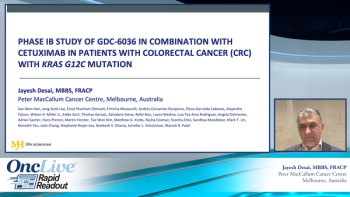
Jayesh Desai, MBBS, FRACP, shares data from a phase IB study investigating KRAS G12C inhibitor GDC-6036, or divarasib, in combination with cetuximab for the treatment of patients with colorectal cancer.
Advertisement
Advertisement
Trending on OncLive
1
The OncFive: Top Oncology Articles for the Week of 10/4/2026
2
FDA Approves Atezolizumab Plus Chemo for Stage III dMMR Colon Cancer
3
FDA Grants Breakthrough Device Designation to Natera’s Multi-Cancer Early Detection Assay
4
FDA Flashback: Hematologic Cancer Decisions and News From September 2026
5