




Colorectal Cancer
Latest News

Advertisement
Latest Videos























































Advertisement
More News

Aasma Shaukat, MD, MPH, discusses the benefit of diverse enrollment in clinical trials in colorectal cancer.

Treatment with either encorafenib plus cetuximab with or without binimetinib or standard chemotherapy each demonstrated comparable progression-free survival and overall survival in pretreated patients with BRAF V600E–mutated metastatic colorectal cancer.

John H. Strickler, MD, discusses the investigation of frontline tucatinib plus trastuzumab in HER2-positive colorectal cancer.
Larotrectinib produced durable responses in patients with NTRK fusion–positive locally advanced or metastatic gastrointestinal cancer, particularly in those with colorectal cancer.
Howard M. Ross, MD, discusses the role of the microbiome colorectal cancer.

Peter Kozuch, MD, discusses the role of circulating tumor DNA in colorectal cancer.

The addition of galunisertib to neoadjuvant chemoradiotherapy improved complete response rates in patients with locally advanced rectal cancer, according to findings from a phase 2 study.

Treatment with frontline panitumumab and mFOLFOX6 led to a significant improvement in overall survival, plus higher response rates and R0 resection rates, compared with bevacizumab and mFOLFOX6 in patients with RAS wild-type metastatic colorectal cancer.
The addition of fruquintinib to best supportive care improved overall survival compared with BSC alone in patients with metastatic colorectal cancer who progressed on standard chemotherapy and relevant biologic agents, and who had progressed on or were intolerant to trifluridine/tipiracil and/or regorafenib.
Experts provide advice for providers treating patients with metastatic colorectal cancer and highlight exciting potential combination treatments on the horizon.
Dr Andrea Cercek reviews key clinical trials in HER2-amplified colorectal cancer treatment and considers how the approval of new therapies will impact the current treatment landscape.
Dr Subbiah discusses research from the 2022 ASCO Annual Meeting, including phase 2 data (NCT04165772) in mismatch repair–deficient, locally advanced rectal cancer; findings from DESTINY-Breast04 (NCT03734029) in HER2-low unresectable and/or metastatic breast cancer; a first-in-human study (NCT04585750) in TP53-mutant advanced solid tumors; and data from LIBRETTO-001 (NCT03157128) in RET fusion–positive solid tumors.
The FDA has lifted a clinical hold on the phase 1b KEYNOTE-B79 trial, which is evaluating the safety and clinical activity of CYAD-101 given concurrently with FOLFOX and followed by pembrolizumab in patients with unresectable metastatic colorectal cancer.
Press Release
Cancer experts at the Sylvester Comprehensive Cancer Center: Annual Oncology Update shared important progress across a wide range of cancers — prostate cancer, breast cancer, colon cancer, and more — that was presented at the American Society of Clinical Oncology 2022 Annual Meeting, the largest gathering of cancer clinicians and scientists in the United States.
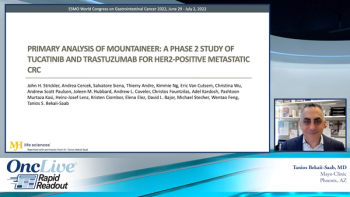
Primary Analysis of MOUNTAINEER: A Phase 2 Study of Tucatinib and Trastuzumab for HER2-positive mCRC
Dr Tanios Bekaii-Saab reviews data from the MOUNTAINEER trial on combination tucatinib/trastuzumab in patients with HER2-positive metastatic colorectal cancer.

John L. Hays, MD, PhD, discusses the importance of clinical trials in colorectal cancer.

John H. Strickler, MD, discusses the rationale of tucatinib plus trastuzumab in HER2-positive colorectal cancer.
Andrea Cercek, MD, explains the potential treatment options for metastatic colorectal cancer after disease progression.
Dr Jaclyn Hechtman presents the profile of a patient with HER2+ metastatic colorectal cancer and has a conversation with Dr Andrea Cercek on how to personalize frontline therapy selection in each patient.
A look at how the molecular testing landscape in colorectal cancer is evolving.
Drs Hechtman and Cercek discuss how practice setting affects molecular testing options and the barriers patients face in receiving testing.
Howard M. Ross, MD, discusses the increase in colon and rectal cancer in young patients.
John L. Hays, MD, PhD, discusses expanding treatment options for HER2-positive colorectal cancer.
A 3-month course of oxaliplatin produced disease-free survival noninferior to a 6-month course in patients with high-risk stage II and III colorectal cancer.

Nivolumab alone or in combination with ipilimumab continued to demonstrate sustained clinical benefit as second- and first-line therapy, respectively, in patients with microsatellite instability–high and mismatch repair deficient metastatic colorectal cancer.
Advertisement
Advertisement
Trending on OncLive
1
FDA Approves Daraxonrasib for Metastatic Pancreatic Ductal Adenocarcinoma
2
Dr Reiss Binder on the FDA Approval of Daraxonrasib for Metastatic PDAC
3
ASCO Issues Warning Regarding Ifosfamide Shortage for Cancer Care
4
Dr Ayanambakkam on the Safety of Darlifarnib Plus Cabozantinib in RCC KD
5