
Patients facing second-line therapy for metastatic pancreatic cancer most often want to know how long they will live.
Patients facing second-line therapy for metastatic pancreatic cancer most often want to know how long they will live.
The phase 3 RASolute 302 trial randomly assigned 500 patients with metastatic pancreatic cancer and progression on 1 prior regimen to oral daraxonrasib 300 mg once daily or investigator's choice of 4 standard chemotherapy regimens.
Before daraxonrasib, second-line therapy for metastatic pancreatic cancer meant more chemotherapy with overlapping toxicities. Jonathan Lee, MD, describes telling patients that response was unlikely and focusing instead on limiting tumor growth and controlling symptoms. Shiraj Sen, MD, PhD, estimates that about half of patients reach second-line therapy and emphasizes offering clinical trials at every step. Tanios S. Bekaii-Saab, MD, notes that the approved indication covers patients with at least 1 prior systemic therapy and patients who are not candidates for multiagent therapy, although every trial participant had progressed on 1 prior line. Anne Noonan, MB BCh, PhD, sees a role for frail patients; however, she urges caution in defining frailty given the side effect profile. Paul E. Oberstein, MD, hopes the drug expands the pool of treated patients and advises giving chemotherapy first when patients can receive it, because the trial sequenced chemotherapy before RAS inhibition. Dr. Lee wants real-world evidence and stresses frank conversations, since first-line data remain limited.
For decades, small molecules could not directly target RAS, the primary oncogenic driver of pancreatic cancer. Tanios S. Bekaii-Saab, MD, opens this discussion on metastatic pancreatic ductal adenocarcinoma by asking what changed. Anne Noonan, MB BCh, PhD, credits the 2013 discovery of a drug-binding pocket on the surface of mutant RAS, known as the switch II pocket, which enabled the first preclinical RAS inhibitors. She explains that RAS proteins cycle between an inactive guanosine diphosphate-bound off state and an active guanosine triphosphate-bound on state, and that oncogenic mutations shift this equilibrium toward the on state. Paul E. Oberstein, MD, describes the tri-complex approach: the oral drug enters the cell, binds the chaperone protein cyclophilin A, and that complex then binds active RAS to block downstream signaling, using the cell's own machinery. Shiraj Sen, MD, PhD, shares how he explains this mechanism to patients, comparing the medicine to a Trojan horse that uses a chaperone protein to reach and block RAS.
Tanios Bekaii-Saab, MD, FACP, discusses the future of treatment within the gastrointestinal cancers armamentarium.
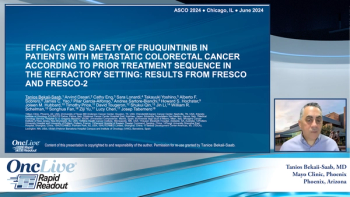
A phase 3, randomized, double-blind, placebo-controlled study to determine if prior TAS-102 and/or regorafenib treatment status and sequence affect the efficacy and safety of fruquintinib in patients with mCRC. This study used data from both FRESCO (NCT02314819) and FRESCO-2 (NCT04322539).
Tanios S. Bekaii-Saab, MD, discusses minimizing the toxicities associates with tyrosine kinase inhibitors (TKIs) through dose optimizations strategies, which are of particular interest at TKIs are combined with immune checkpoint inhibitors that also may impact the liver.
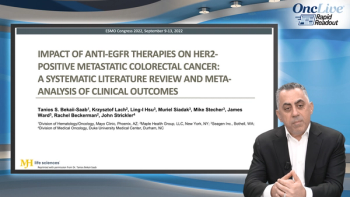
Dr. Tanios Bekaii-Saab discusses the results of a systematic review/meta-analysis intended to assess the impact of EGFR-targeted therapies on clinical outcomes in patients with HER2-positive metastatic colorectal cancer.
Closing out their discussion on hepatocellular carcinoma, expert panelists consider future directions in care.
Comprehensive insight on later-line immunotherapy and combination strategies available for patients with advanced hepatocellular carcinoma.
Expert panelists consider which therapy they would use following failure of atezolizumab + bevacizumab in advanced hepatocellular carcinoma.
Shared insight on which factors help to inform selection of second-line therapy for patients with advanced HCC following lenvatinib failure.
Centering discussion on a patient with advanced HCC, expert oncologists consider which agents they would use in the second line following lenvatinib failure.
Before closing out their discussion on frontline therapy for advanced HCC, expert panelists review other novel combinations under investigation.
Comprehensive insight on the selection and use of frontline tyrosine kinase inhibitors for patients with advanced hepatocellular carcinoma.
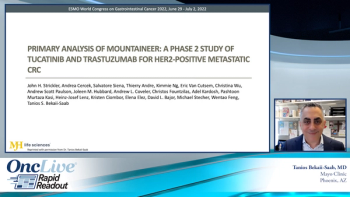
Dr Tanios Bekaii-Saab reviews data from the MOUNTAINEER trial on combination tucatinib/trastuzumab in patients with HER2-positive metastatic colorectal cancer.
Expert panelists briefly review how a patient’s hepatitis status may influence treatment selection for advanced hepatocellular carcinoma.
Taking into account respective data from IMbrave150 and HIMALAYA, experts consider how they might select frontline therapy for advanced HCC.
Shared insight on combination durvalumab + tremelimumab as frontline therapy for advanced HCC in the context of data from the HIMALAYA trial.
A brief review of predictive and prognostic biomarker needs in hepatocellular carcinoma, followed by discussion on screening and detection.
Panelists consider the role of systemic therapy in patients with intermediate-stage HCC who are ineligible for locoregional therapy.
Locoregional Treatment Strategies in Early-/Intermediate-Stage HCC Locoregional Treatment Strategies in Early-/Intermediate-Stage HCC
Expert oncologists consider when it would be appropriate to use neoadjuvant therapy for early-/intermediate-stage hepatocellular carcinoma.
A brief discussion on the risks of neoadjuvant immunotherapy in early-/intermediate-stage HCC with regard for liver transplantation candidacy.
Centering discussion on a patient with early/intermediate-stage HCC, expert panelists consider the roles of transplant, resection, and adjuvant therapy, respectively.
OncLive® will be LIVE with OncLive® News Network: On Location at the 2022 ASCO Annual Meeting. Each day, we will broadcast a series of interviews with top thought leaders, to learn their thoughts and reactions to data presented across oncology during the conference.
Tanios S. Bekaii-Saab, MD, FACP, discusses the uptake of precision medicine in colorectal cancer.

Tanios S. Bekaii-Saab, MD, FACP, discusses improved sequencing strategies in hepatocellular carcinoma.
Tanios S. Bekaii-Saab, MD, FACP, discusses the future of telemedicine in colorectal cancer.
Tanios S. Bekaii-Saab, MD, FACP, discusses the emergence of targeted therapy in colorectal cancer.
August 10th 2022
August 10th 2022
August 3rd 2022
July 27th 2022
