






Colorectal Cancer
Latest News
Advertisement
Latest Videos


























































Advertisement
More News

Paul E. Oberstein, MD, discusses the current treatment landscape of colorectal cancer.

Rohan Jeyarajah, MD, discusses aggressive treatment while preserving quality of life in patients with colorectal cancer.

Scott Kopetz, MD, PhD, FACP, discusses the phase 3 BEACON CRC study and the subsequent efficacy response analysis in patients with BRAF V600E–mutant metastatic colorectal cancer.

Patient Goals and Characteristics Play an Outsized Role in Determining First-Line Treatment for mCRC
Selecting the optimal frontline treatment regimen for patients with unresectable metastatic colorectal cancer requires careful consideration of multiple patient and treatment characteristics.

The expansion of the treatment armamentarium has emphasized the importance of genetic testing in patients with metastatic colorectal cancer, according to Christopher Lieu, MD, who added continued developments in the field have produced additional treatment regimens across patient subsets.

Dr Barzi discusses data from the ACCENT and RESPECT trials evaluating the value of oxaliplatin for patients with colorectal cancer, results from an investigation of nivolumab plus ipilimumab for patients with high tumor mutational burden, and more.

Temozolomide Followed by Low-Dose Ipilimumab/Nivolumab Shows Potential in MSS and MGMT-Silenced mCRC
Temozolomide priming followed by the combination of low-dose ipilimumab and nivolumab may produce durable clinical benefit in microsatellite stable and MGMT-silenced metastatic colorectal cancer.

Afsaneh Barzi, MD, PhD, discusses the safety and efficacy of regorafenib in combination with pembrolizumab in patients with MSS colorectal cancer and describes potential next steps for further exploration of novel combinations in this population.

The Ministry of Health, Labour, and Welfare has approved Guardant360 CDx to perform comprehensive genomic profiling in patients with advanced solid cancers.
Dr Ross shares his advice to health care professionals regarding the detection and treatment of patients with colon cancer, unmet needs for this patient population, the role of minimally invasive surgery, and the need to address and overcome health disparities that affect this population.

Rohan Jeyarajah, MD, discusses the potential role of SIR-Spheres® Y-90 resin microspheres from Sirtex Medical in colorectal cancer with liver metastases.

David S. Hong, MD, discusses the primary objective of the ongoing phase 1/2 CodeBreaK 101 trial in mutated advanced colorectal cancer and other solid tumors harboring KRAS G12C mutations.

The VEGF/Ang2–targeting bispecific nanobody BI 836880, in combination with ezabenlimab, produced antitumor activity found to be comparable to that of available third-line therapy options in patients with advanced microsatellite stable colorectal cancer.

The FDA has placed a clinical hold on the phase 1b CYAD-101-002 trial, which is examining the safety and clinical activity of the investigational CAR T-cell therapy CYAD-101 given concurrently with FOLFOX and followed by pembrolizumab in patients with unresectable metastatic colorectal cancer.

Edmund Scott Kopetz, MD, PhD, FACP, discusses the utilization of circulating tumor DNA in colorectal cancer.

Kanwal P.S. Raghav, MBBS, MD, discusses on the utilization of circulating tumor DNA in metastatic colorectal cancer.

Afsaneh Barzi, MD, PhD, discusses the combination of VEGF inhibitors and immunotherapy in microsatellite stable metastatic colorectal cancer.

Thomas A. Abrams, MD, discusses the next steps for exploration of cabozantinib plus atezolizumab in the treatment of microsatellite stable and mismatch repair proficient colorectal cancer.

Heinz-Josef Lenz, MD, discusses the safety and efficacy of nivolumab plus standard of care in patients with metastatic colorectal cancer, shares additional insight from the CheckMate-9X8 trial, and alludes to next steps with further exploring the regimen in specific subsets who appear to derive benefit from this approach.
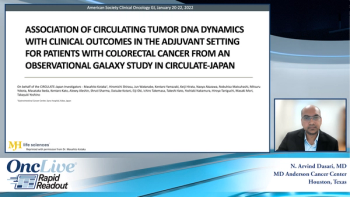
Insight on the observational GALAXY study, which analyzed the relationship between circulating tumor DNA and clinical outcomes in the adjuvant management of colorectal cancer.

Thomas A. Abrams, MD, discusses the ongoing phase 1b COSMIC-021 trial examining cabozantinib/atezolizumab, the efficacy and safety demonstrated with the regimen in those with colorectal cancer, and the next steps for research

Georges Azzi, MD, co-director, Department of Hematology/Oncology, Prostate Cancer, Holy Cross Health, discusses the utilization of the Signatera circulating tumor DNA assay in the ongoing phase 2/3 CIRCULATE-US trial in colorectal cancer.

Howard M. Ross, MD, discusses advances in recognizing, screening, and treating patients with colorectal cancer.

Kanwal P.S. Raghav, MBBS, MD, discusses potential combinations with fam-trastuzumab deruxtecan-nxki in HER2-positive colorectal cancer.

Edmund Scott Kopetz, MD, PhD, FACP, discusses the current state of circulating tumor DNA testing in colorectal cancer.
Advertisement
Advertisement
Trending on OncLive
1
FDA Approves Daraxonrasib for Metastatic Pancreatic Ductal Adenocarcinoma
2
Dr Reiss Binder on the FDA Approval of Daraxonrasib for Metastatic PDAC
3
ASCO Issues Warning Regarding Ifosfamide Shortage for Cancer Care
4
Dr Ayanambakkam on the Safety of Darlifarnib Plus Cabozantinib in RCC KD
5