





Colorectal Cancer
Latest News

TAS-102 Plus Bevacizumab Misses PFS End Point in Frontline Unresectable Metastatic CRC
By Kristi Rosa
Advertisement
Latest Videos





























































Advertisement
More News
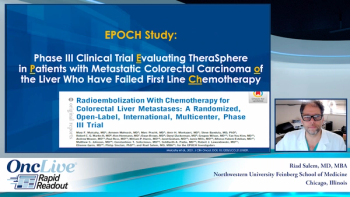
Expert Riad Salem, MD, MBA, highlights key data from the phase 3 EPOCH study, which evaluated TheraSphere in patients with mCRC and liver metastases who failed first line chemotherapy.

Shikha Jain, MD, FACP, and Mario Spaggiari, MD, highlight key advancements made in the treatment of patients with colorectal cancer and liver metastases, patient and disease factors to consider for surgical and systemic treatment, and the importance of multidisciplinary care for this population.

Mario Spaggiari, MD, discusses surgical interventions in colorectal cancer with liver metastases.

Shikha Jain, MD, FACP, discusses advances with surgical interventions and systemic therapies in colorectal cancer with liver metastases.

MSH3 immunohistochemistry and tetranucleotide analysis failed to demonstrate concordance in identifying microsatellite instability in a cohort of colorectal cancer cases at selected tetranucleotide repeats, suggesting that the dual assessment strategy is not ready for routine use in diagnostic workup.

The triplet combination comprised of encorafenib, binimetinib, and cetuximab elicited encouraging responses with a manageable safety profile in patients with previously untreated BRAF V600E–mutant metastatic colorectal cancer, meeting the primary end point of the phase 2 ANCHOR-CRC trial.

Cleveland Clinic has established a center focused on the diagnosis, care, and research of young-onset colorectal cancer.

Kanwal P.S. Raghav, MBBS, MD, discussed nuances to treatment selection in mCRC, the significance of the phase 2 ReDOS trial with regorafenib, and how the paradigms for mCRC, HCC, and gastroesophageal cancers have expanded from areas of unmet need to ones with more robust armamentariums.

Jared Weiss, MD, discusses the efficacy results of the ongoing phase 1/2 KRYSTAL-1 trial in KRAS G12C–mutated colorectal cancer.

The FDA has granted approval of a new indication for cetuximab plus encorafenib for the treatment of adult patients with metastatic colorectal cancer with a BRAF V600E mutation, as detected by a FDA-approved test, after prior therapy.

Stacey A. Cohen, MD, discusses the shortcomings of clinical trials evaluating cytoreductive surgery and hyperthermic intraperitoneal chemotherapy in colorectal cancer.

Joleen M. Hubbard, MD, discusses the barriers of implementing circulating tumor DNA into widespread clinical practice in colorectal cancer.

Fam-trastuzumab deruxtecan-nxki led to improved responses in patients with higher HER2 expression at baseline, whereas responses were seen irrespective of RAS- and PIK3CA mutation status and blood tumor mutational burden levels in patients with HER2-positive, metastatic colorectal cancer.

Harveshp D. Mogal, MD, MS, FACS, DABS, FSSO, discusses the role of cytoreductive surgery in colorectal peritoneal carcinomatosis.

Adavosertib demonstrated a 65% reduction in the risk of disease progression or death compared with active monitoring in patients with TP53-/RAS-mutant metastatic colorectal cancer following first-line chemotherapy.

Kanwal Raghav, MBBS, MD, discusses optimal dosing strategies for regorafenib in patients with colorectal cancer.

Zev A. Wainberg, MD, discusses the importance of enrolling patients with colorectal cancer to clinical trials, despite the difficulties caused by COVID-19.

Adagrasib alone or in combination with cetuximab elicited encouraging antitumor activity and safety in heavily pretreated patients with KRAS G12C–mutant colorectal cancer, according to findings from the phase 1/2 KRYSTAL-1 trial.

John L. Marshall, MD, discusses factors to consider in the third-line treatment setting for patients with colorectal cancer.

Harveshp D. Mogal, MD, MS, FACS, DABS, FSSO, discusses the importance of patient selection for cytoreductive surgery in colorectal cancer with peritoneal involvement.

Stacey A. Cohen, MD, discusses the importance of patient selection for cytoreductive surgery and hyperthermic intraperitoneal chemotherapy in colorectal cancer.

Kanwal Raghav, MBBS, MD, discusses first-line treatment options for patients with colorectal cancer.

Harveshp D. Mogal, MD, MS, FACS, DABS, FSSO, discusses the incidence and prognosis of peritoneal carcinomatosis in colorectal cancer.

Stacey A. Cohen, MD, discusses tailoring treatment approaches to individual subtypes in colorectal cancer.

The Japan Pharmaceuticals and Medical Devices Agency has approved the use of pembrolizumab in the treatment of patients with PD-L1–positive, hormone receptor–negative and HER2-negative, inoperable or recurrent breast cancer, and for single-agent use in patients with unresectable, advanced, or recurrent microsatellite instability–high colorectal cancer.
Advertisement
Advertisement
Trending on OncLive
1
FDA Approves Daraxonrasib for Metastatic Pancreatic Ductal Adenocarcinoma
2
Dr Reiss Binder on the FDA Approval of Daraxonrasib for Metastatic PDAC
3
ASCO Issues Warning Regarding Ifosfamide Shortage for Cancer Care
4
Dr Ayanambakkam on the Safety of Darlifarnib Plus Cabozantinib in RCC KD
5