



Colorectal Cancer
Latest News

Advertisement
Latest Videos






































































Advertisement
More News

Marwan G. Fakih, MD, discusses the main objective and design of the observational BASECAMP-1 study and how it functions alongside the phase 1/2 EVEREST-1 study in patients with solid tumors.

Patients with mismatch repair–deficient and/or microsatellite instability metastatic colorectal cancer experienced a progression-free survival benefit with longer disease control following treatment with avelumab compared with standard second-line chemotherapy.

Scott Kopetz, MD, PhD, FACP, discusses the phase 3 BREAKWATER trial in patients with BRAF V600E–mutant metastatic colorectal cancer.

The FDA has granted a breakthrough device designation to HLA-LOH as a companion diagnostic test, according to an announcement from Tempus.

Isabelle Franklin, discusses strategies healthcare providers can implement to address or ameliorate disparities in place that are affecting screening rates in colorectal cancer.
Isabelle Franklin, discusses future steps to be taken following an investigation into the association between self-reported social needs and colorectal cancer screening rates.

Megan Hitchins, PhD, discusses results from an analysis on the prevalence of high-risk constitutional MLH1 methylation in early-onset colorectal and endometrial cancers displaying mismatch repair deficiency.

The first patients have been dosed in the phase 2 portion of a phase 1/2 trial evaluating BDC-1001 monotherapy in patients with HER2-positive colorectal cancer, endometrial cancer, and gastroesophageal cancer.

John L. Hays, MD, PhD, discusses unmet needs for patients with colorectal cancer and future directions for research in this disease.

Amanda Bloomer, PhD, discusses the rationale for launching the ColoCare study, an investigation into the health-related quality of life outcomes of younger vs older adult patients with newly diagnosed colorectal cancer.

Delays in time to treatment initiation may be associated with demographic and socioeconomic disparities, with care coordination, clinical, and socioeconomic factors representing potential predictors of TTI, according to findings from a retrospective cohort study published in JCO Oncology Practice.


The FDA has approved trifluridine and tipiracil (Lonsurf) plus bevacizumab (Avastin) for patients with metastatic colorectal cancer who were previously treated with fluoropyrimidine-, oxaliplatin-, and irinotecan-based chemotherapy; a VEGF inhibitor; and an EGFR inhibitor, if they have RAS wild-type disease.
Isabelle Franklin, discusses the investigation of the correlation between self-reported social needs and colorectal cancer screening.

The safety and efficacy of adding total ablative therapy of all disease sites to standard systemic treatment is being investigated in patients with limited metastatic colorectal cancer as part of the ongoing phase 3 ERASur study.

Kathryn Hitchcock, MD, PhD, expands on potential clinical implications of the ongoing phase 3 ERAsur trial in metastatic colorectal cancer

Emerging strategies leveraging biomarker data for the treatment of patients with early-stage and metastatic colorectal cancer have made precision medicine a top-of-mind topic for gastrointestinal oncologists.

Tanios S. Bekaii-Saab, MD, offers closing thoughts on the unmet needs and future of HER2+ metastatic colorectal cancer treatment.

Isabelle Franklin discusses the effects of social determinants of health on rates of colorectal cancer screening, expands on how these social determinants of health could affect a patient’s likelihood of adhering to screening guidelines, and highlights ways to potentially address these barriers to screening.

Brian C. Grieb, MD, PhD, discusses unmet needs for patients with colorectal cancer, including the identification of novel pan-CRC biomarkers for drug development.

Closing out their panel on metastatic colorectal cancer, expert oncologists consider ongoing challenges and future evolutions within the treatment landscape.
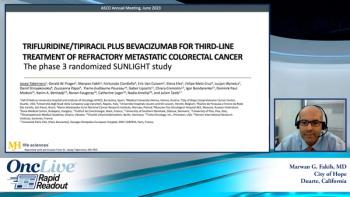
Marwan G. Fakih, MD, reviews data from the phase 3 randomized SUNLIGHT trial investigating trifluridine/tipiracil plus bevacizumab for third-line treatment of refractory metastatic colorectal cancer.
An overview of the DESTINY-CRC02 study, which looked at trastuzumab deruxtecan in patients with HER2+ metastatic colorectal cancer.
Tanios S. Bekaii-Saab, MD, discusses recent clinical trials and provides insights on the evolving metastatic colorectal cancer treatment landscape.

Thierry Andre, MD, discusses the efficacy of trifluridine/tipiracil plus bevacizumab in patients with metastatic colorectal cancer and the safety profiles of the 2 arms of the phase 3 SOLSTICE trial.
Advertisement
Advertisement
Trending on OncLive
1
The OncFive: Top Oncology Articles for the Week of 10/4/2026
2
FDA Approves Atezolizumab Plus Chemo for Stage III dMMR Colon Cancer
3
FDA Grants Breakthrough Device Designation to Natera’s Multi-Cancer Early Detection Assay
4
VIR-5500 Receives FDA Fast Track Designation in mCRPC
5