


Prostate Cancer
Latest News
Advertisement
Latest Videos













































Advertisement
More News
Dan George, MD, reviews new findings in advanced prostate cancer presented at ASCO GU 2021.
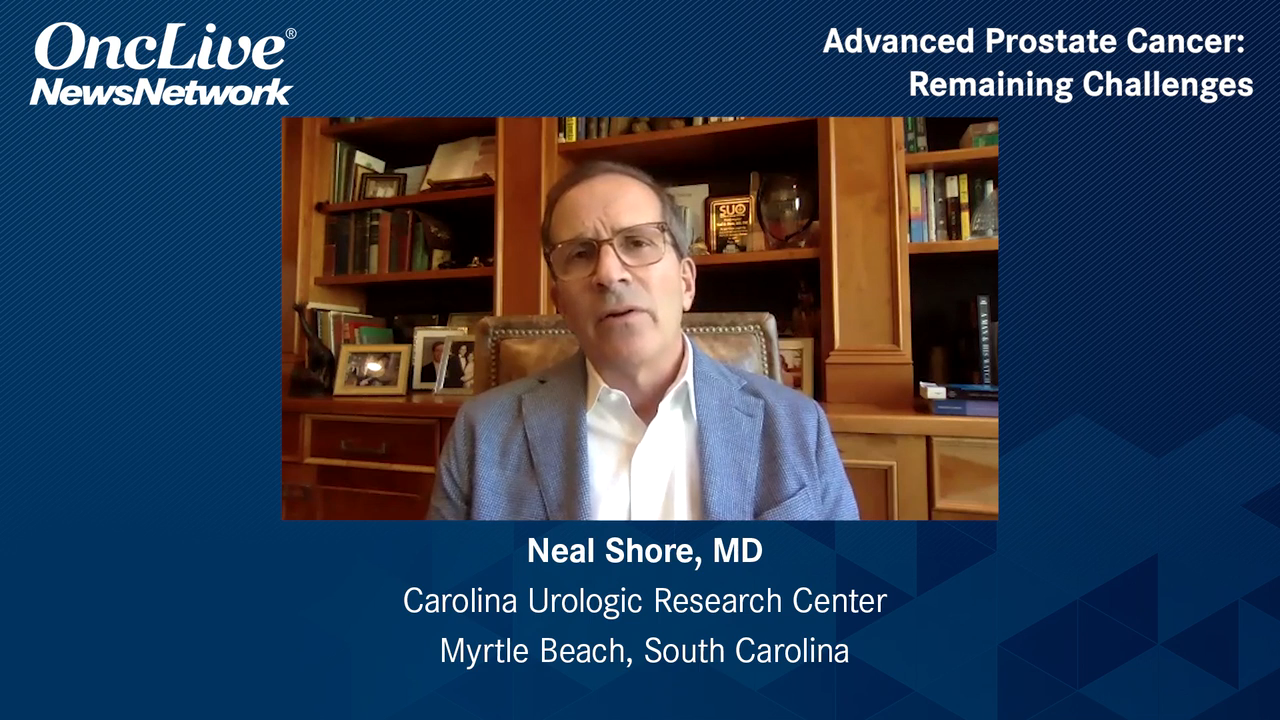
Neal Shore, MD, discusses the recent FDA approval of the first oral GNRH receptor antagonist, relugolix, for men with advanced prostate cancer, along with data from the phase 3 HERO trial.

Darolutamide plus ADT will be evaluated versus ADT alone in patients with metastatic hormone-sensitive prostate cancer in the phase 3 ARANOTE study as part Bayer and Orion Corporation’s growing clinical development program for the oral AR inhibitor in prostate cancer.
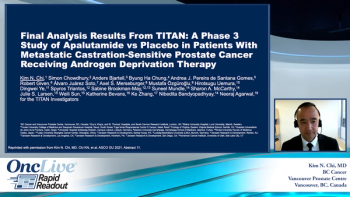
Kim N. Chi, MD, presents slides from the 2021 ASCO Genitourinary Cancers Symposium for the final results from the phase 3 TITAN study of apalutamide versus placebo in patients with metastatic castration-sensitive prostate cancer receiving androgen deprivation therapy.

Eric Klein, MD, discusses safety data with VERU-111 from a phase 2 trial that enrolled patients with metastatic castration-resistant prostate cancer that was presented during the 2021 Genitourinary Cancers Symposium.

February 13, 2021 - Certain molecular signatures at baseline were found to be independently linked with long-term response to apalutamide in patients with nonmetastatic castration-resistant prostate cancer.

February 13, 2021 - Reductions in prostate-specific antigen screening are likely responsible for the recent increase in metastatic prostate cancer cases in the United States.
Patrick Pilie, MD, discusses the impact of adiposity on response to androgen signaling inhibition in patients with metastatic castration-resistant prostate cancer.

Tanya Dorff, MD, discusses the effects of bright white light therapy on obese frailty in older men with prostate cancer.

February 13, 2021 - Treatment with apalutamide plus androgen-deprivation therapy reduced the risk of death by 35% versus ADT alone in patients with metastatic castration-sensitive prostate cancer.
Eleni Efstathiou, MD, discusses the key findings of the placebo-controlled, double-blind phase 3 ACIS study of apalutamide and abiraterone acetate plus prednisone versus prednisone alone in patients with chemotherapy-naïve metastatic castration-resistant prostate cancer.
February 12, 2021 - Crossover from placebo to darolutamide appeared to have minimal impact on the overall survival benefit experienced by patients with nonmetastatic castration-resistant prostate cancer who were enrolled to the pivotal phase 3 ARAMIS trial.

February 12, 2021 - The novel prostate specific membrane antigen–targeted radiopharmaceutical for PET imaging technique, 18F-DCFPyL, demonstrated potential in identifying occult prostate cancer and more accurately characterizing disease burden.

February 12, 2021 - The androgen receptor inhibitor darolutamide continues to show favorable tolerability in patients with nonmetastatic castration-resistant prostate cancer, even when given for a prolonged period of time.

February 11, 2021 - The novel tubulin inhibitor VERU-111 demonstrated early antitumor activity and a well-tolerated safety profile in patients with metastatic castration-resistant prostate cancer who failed a prior androgen receptor–targeting agent.

Atish D. Choudhury, MD, PhD, discusses the rationale behind combining pembrolizumab with radium-223 in patients with metastatic castration-resistant prostate cancer as part of a phase 2 clinical trial.
Neal D. Shore, MD, discusses the FDA approval of relugolix in prostate cancer.

Neeraj Agarwal, MD, discusses the significance of the phase 3 LATITUDE trial, which examined abiraterone acetate in patients with metastatic castration-sensitive prostate cancer.

Data from 3 pivotal trials—PROfound, CARD, and HERO—have served to propel the metastatic prostate cancer treatment paradigm forward.

January 27, 2021 — A shorter course of stereotactic body radiotherapy has been shown to have encouraging efficacy with favorable toxicity when used in patients with high-risk prostate cancer in a multi-institutional, international setting.

Hormonal Agents Improve Survival in mCSPC, but Novel Targets Are Needed For Further Drug Development
Neeraj Agarwal, MD, discusses the role of docetaxel in the frontline setting, the emergence of novel hormonal agents in the paradigm, and efforts being made with combination regimens to potentially treat patients with resistant disease.

Despite the availability of next-generation PET imaging modalities that can detect metastasis earlier, apalutamide, enzalutamide, and darolutamide remain the standard of care for patients with nonmetastatic castration-resistant prostate cancer who have a prostate-specific antigen doubling time of less than 10 months.
In today’s episode, we had the pleasure of speaking with the faculty of a recent Institutional Perspectives in Cancer webinar on prostate cancer hosted by Yale Cancer Center.

New prostate cancer imaging technique is a ‘game changer’ that should become the standard of care, say researchers from UCLA and UCSF who validated its effectiveness.

Michael Schweizer, MD, discusses the results of the HERO trial in prostate cancer.
Advertisement
Advertisement
Trending on OncLive
1
Savolitinib Plus Osimertinib NDA Submitted to FDA for MET-Driven, EGFR-Mutated NSCLC After EGFR TKI
2
Daraxonrasib Approval Signals a New Era for RAS-Targeted Therapy in Pancreatic Cancer
3
Calculating the Real Cost of False Positive Findings in Cancer Screening
4
Cilta-Cel Shows Long-Term Treatment-Free Remissions in Lenalidomide-Refractory Myeloma
5