

Rachna T. Shroff, MD, MS, discusses the importance of molecular profiling upon diagnosis in patients with cholangiocarcinoma.

Your AI-Trained Oncology Knowledge Connection!
Rachna T. Shroff, MD, MS, discusses the importance of molecular profiling upon diagnosis in patients with cholangiocarcinoma.

Marcus Noel, MD, discusses the data of SM-88 and how it will impact the treatment of patients with metastatic pancreatic cancer.

The combination of nivolumab and ramucirumab has activity in patients with previously treated advanced gastric adenocarcinoma, investigators reported at the 2019 Gastrointestinal Cancers Symposium.

Allyson J. Ocean, MD, discusses her experiences with SM-88 in patients with metastatic pancreatic cancer.

Genomic testing to guide treatment decisions for women with ovarian cancer is in its early days. However, as more platforms become commercially available, physicians will need to understand the similarities and differences between tests.

Two-thirds of patients with untreated metastatic HER2-positive esophagogastric adenocarcinoma remained free of disease progression at 6 months with a combination of pembrolizumab, trastuzumab, and chemotherapy.
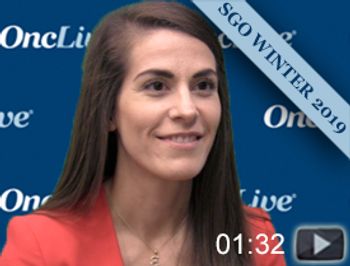
Eleftheria Kalogera, MD, MSc, instructor in Obstetrics and Gynecology, fellow in Gynecologic Oncology, in the department of Obstetrics and Gynecology, at Mayo Clinic College of Medicine, discusses the controversial topic of bowel preparation following minimally invasive or open hysterectomies.

Shannon N. Westin, MD, MPH, associate professor, The University of Texas MD Anderson Cancer Center, discusses advances made with PARP inhibitors in the ovarian cancer treatment paradigm.
Pembrolizumab was found to reduce the risk of death by 31% in patients with PD-L1–positive advanced or metastatic esophageal or esophageal junction carcinoma who progressed on standard therapy.
Several ongoing trials are examining combinations of PARP inhibitors and immunotherapy agents as frontline maintenance for patients with ovarian cancer.

Krish Patel, MD, oncologist, Swedish Cancer Institute, discusses induction therapy with bendamustine and rituximab (Rituxan; BR) in the treatment of patients with mantle cell lymphoma (MCL).

Jordan Gauthier, MD, MSc, senior clinical research fellow, Fred Hutchinson Cancer Research Center, discusses the potential for chimeric antigen receptor T-cell therapy in the treatment of chronic lymphocytic leukemia.

Chemotherapy for breast cancer caused significantly more acute symptoms as compared with endocrine therapy, although the adverse effects of endocrine therapy increased over time.

Chimeric antigen receptor T cells targeting the tyrosine kinase receptor ROR1 can be transferred into patients safely and the cells expand in vivo.

Early-stage breast cancer survivors who completed a telephone-based lifestyle intervention program lost weight and tended to have higher rates of disease-free survival.

The combination of olaparib and durvalumab in patients with HER2-negative metastatic breast cancer with germline BRCA mutations is well tolerated and has promising activity, especially in earlier settings.
Younger patients with breast cancer who underwent lumpectomy had better quality of life than women who had a mastectomy.

Women who took part in a supervised exercise program during adjuvant treatment for breast cancer had better cardiovascular function than women who did not participate in the program.

The combination of palbociclib and trastuzumab demonstrated safety and efficacy in patients with advanced estrogen receptor–positive/HER2-positive breast cancer.
Oxybutynin helped to reduce the frequency and intensity of hot flashes among women who could not take hormone replacement therapy in survivorship.

Combining the BCL-2 inhibitor venetoclax with endocrine therapy elicited notable activity with a tolerable safety profile in patients with estrogen receptor–positive and BCL-2–positive metastatic breast cancer.
Laura Spring, MD, medical oncologist at Massachusetts General Hospital Cancer Center and instructor in medicine at Harvard Medical School, discusses the association between pathologic complete response (pCR) and neoadjuvant chemotherapy in patients with breast cancer at the 2018 San Antonio Breast Cancer Symposium.
Roberto A. Leon Ferre, MD, oncologist, Mayo Clinic, discusses the randomized trial evaluating the effectiveness of oxybutynin chloride in the management of hot flashes in patients with breast cancer at the 2018 San Antonio Breast Cancer Symposium.

Additional analyses from the SOLAR-1 study show that alpelisib, an investigational alpha-specific PI3K inhibitor, combined with fulvestrant extended progression-free survival compared with fulvestrant alone in patients with PIK3CA-mutant advanced breast cancer regardless of line of therapy or prior CDK4/6 inhibitor treatment.
U3-1402, an investigational antibody-drug conjugate targeting HER3, induced objective response in more than 40% of heavily pretreated patients with HER3-expressing breast cancer.

Axillary radiotherapy was associated with locoregional control comparable to that with axillary lymph node dissection in patients with early-stage breast cancer who had a positive sentinel lymph node biopsy.

Accelerated partial breast irradiation following lumpectomy was marginally not found to be equivalent to whole breast irradiation to control ipsilateral breast tumor recurrence.

A longer duration of chemotherapy exposure was possible in patients with metastatic triple-negative breast cancer who received trilaciclib, an investigational CDK4/6 inhibitor, in addition to gemcitabine and carboplatin (GC) compared with GC alone.

The use of low-dose tamoxifen was shown to significantly reduce the risk of new and recurrent disease following surgery in women diagnosed with breast intraepithelial neoplasia but it did not cause more serious adverse events compared with placebo.

The use of circulating tumor-cell counts demonstrated strong value for selecting endocrine therapy versus chemotherapy for patients with estrogen receptor–positive, HER2-negative metastatic breast cancer.