
A matching-adjusted indirect comparison of zanubrutinib and acalabrutinib/venetoclax showed favorability towards zanubrutinib in patients with CLL.

Your AI-Trained Oncology Knowledge Connection!
A matching-adjusted indirect comparison of zanubrutinib and acalabrutinib/venetoclax showed favorability towards zanubrutinib in patients with CLL.

Isa-KRd significantly improved the 1-year MRD negativity rate compared with KRd alone in newly diagnosed patients with multiple myeloma.

Results from dose level G of MagnetisMM-6 found high response rates with an elranatamab triplet in patients with newly diagnosed multiple myeloma.
The majority of transplant-eligible patients with relapsed/refractory DLBCL completed treatment with epcoritamab plus R-ICE and proceeded to ASCT.
Further exploration of epcoritamab plus pola-R-CHP in first-line diffuse large B-cell lymphoma is warranted.
The E1910 trial results showed improved OS and RFS with blinatumomab vs chemotherapy in patients with newly diagnosed BCR::ABL1-negative B ALL.
BGB-16673 showed a favorable safety profile and promising antitumor activity in relapsed/refractory CLL/SLL, with responses seen across baseline mutations.
Lydia Scarfò, MD, discusses long-term data with BGB-16673 in patients with relapsed/refractory chronic lymphocytic leukemia and small lymphocytic lymphoma.
Meletios A. Dimopoulos, MD, discusses efficacy and safety findings with elranatamab plus daratumumab and lenalidomide in newly diagnosed multiple myeloma.

PREDATOR-MRD data can serve as proof of concept for larger trials with novel MRD assessment techniques.
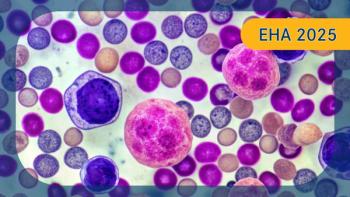
Anitocabtagene autoleucel yielded an overall response rate of 97% in relapsed/refractory multiple myeloma.
The IRAKLIA study examined the use of an innovative on-body injector for isatuximab administration in multiple myeloma.
Dasatinib added to induction and consolidation, then continued as maintenance, did not improve survival in core-binding factor AML.
Talquetamab plus cetrelimab showed safety and efficacy in R/R multiple myeloma, including in patients previously treated with bispecific antibodies.
David Curtis, MBBS, PhD, FRACP, FRCPA, discusses the use of post-transplant cyclophosphamide GVHD prophylaxis in matched donor peripheral blood SCT.

Matthew Ku, MBBS, FRACP, RACP, FRCPA/RCPA, PhD, discusses safety and efficacy findings with JNJ-90014496 in relapsed/refractory large B-cell lymphoma.
Although age did not affect real-world ORR or EFS with axi-cel in LBCL, an age of 65 years or older and cardiac comorbidities correlated with shorter OS.

Bexobrutideg, a novel BTK degrader, has demonstrated preliminary efficacy and a tolerable safety profile in patients with relapsed/refractory CLL.
ASC4START data support potential for asciminib to be standard of care for newly diagnosed chronic myeloid leukemia in chronic phase.
ESAs or danazol in combination with ruxolitinib displayed similar spleen and symptom outcomes in myelofibrosis with anemia.

JNJ’4496 demonstrated an ORR of 100% in patients with relapsed or refractory large B-cell lymphoma who received 1 prior line of treatment.
A post hoc analysis of the PhALLCON study showed response and survival benefits with imatinib in Ph-positive ALL with MRD negativity after induction.
Oral iptacopan monotherapy led to hemoglobin level and transfusion independence benefits vs anti-C5 therapies in paroxysmal nocturnal hemoglobinuria.

Cyclosporin/cyclophosphamide after allogeneic stem cell transplant improved outcomes vs cyclosporin/methotrexate in high-risk hematologic malignancies.

Amir Fathi, MD, discusses findings with ziftomenib in patients with relapsed/refractory, NPM1-mutant acute myeloid leukemia as demonstrated in KOMET-001.

Johannes Schetelig, MD, discusses outcomes with haploidentical related vs mismatched unrelated donor transplantation in high-risk AML, ALL, and MDS.

Saurabh Dahiya, MD, FACP, discusses safety and efficacy data from a study of the CAR T-cell therapy KITE-363 in relapsed/refractory B-cell lymphoma.
Venetoclax and decitabine-cedazuridine demonstrated complete responses and encouraging survival outcomes in newly diagnosed AML.
Revumenib plus azacitidine and venetoclax yielded high CR rates among older patients with NPM1-mutant/KMT2A-rearranged newly diagnosed AML.

Tetiana Skrypets, MD, PhD, discusses next steps for researching the clinical features and treatment outcomes of older patients with PTCL.