

The FDA has approved avapritinib (Ayvakit) for the treatment of adults with indolent systemic mastocytosis.
The FDA has approved avapritinib (Ayvakit) for the treatment of adults with indolent systemic mastocytosis.

Faculty from an OncLive® Institutional Perspectives in Cancer webinar on multiple myeloma summarize the main messages from their presentations.

The FDA has granted an orphan drug designation to mitazalimab for use as a potential therapeutic option in patients with pancreatic cancer.

The combination of GEN-002 and avelumab elicited responses in patients with advanced gastric or gastroesophageal junction adenocarcinoma, according to findings from an interim analysis of an ongoing phase 2 trial.
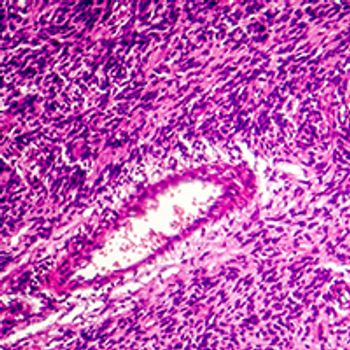
Treatment with milademetan did not lead to a statistically significant improvement in progression-free survival compared with trabectedin in patients with dedifferentiated liposarcoma, failing to reach the primary end point of the phase 3 MANTRA trial.
For the 11th consecutive year, OncLive is honored to recognize oncology leaders whose innovations have contributed to immeasurable improvements in outcomes for countless patients.
Press Release
People living with HIV remain at higher risk than people living without HIV for developing various cancers that can be treated with immune checkpoint inhibitors.

Shahrzad A. Zamani discusses the research on cancer disparities in patients within the LGBTQI+ population, and how these findings could inform further research and decisions in clinical practice.
The addition of cabozantinib to nivolumab and ipilimumab led to improved progression-free survival vs nivolumab and ipilimumab alone in patients with treatment-naïve advanced renal cell carcinoma; however, the rate of grade 3/4 adverse effects with the triplet was 79%.

Polymorphic alleles of ABCB1 or VEGF were predictive of lenalidomide efficacy in patients with mantle cell lymphoma who received lenalidomide maintenance after autologous stem cell transplant.
John V. Heymach, MD, PhD, expands on the efficacy of perioperative durvalumab in the AEGAN trial, the significance of this unique approach for the non–small cell lung cancer treatment paradigm, and future research examining opportunities to build on or intensify the benefit achieved with this regimen.
The FDA has approved the first T-cell–engaging bispecific antibody, epcoritamab-bysp (Epkinly), for the treatment of adult patients with relapsed/refractory diffuse large B-cell lymphoma (DLBCL) not otherwise specified, including DLBCL arising from indolent lymphoma, and high-grade B-cell lymphoma, after 2 or more lines of systemic therapies.
Treatment with ruxolitinib generated superior responses vs treatment with best available therapy in patients with hydroxycarbamide-intolerant or -resistant polycythemia vera, according to findings from the phase 2 MAJIC-PV trial.
Press Release
Acute myeloid leukemia is a cancer that affects blood cells in the bone marrow- the spongy tissue inside certain bones where new blood cells are made.

Mitchell E. Horwitz, MD, expands on key efficacy and safety data supporting the FDA approval of omidubicel, the significance of this decision for the blood cancer treatment paradigm, and the need for continued investigation of the agent in non-malignant disease and other patient subgroups.

The potential effectiveness of employing placebo in cancer clinical investigation is not difficult to appreciate, but the use of this approach has been, and continues to be, controversial.
Morie A. Gertz, MD, discusses the limitations of the current Mayo Stage IV amyloidosis treatment landscape, the rationale for investigating birtamimab in this population, and the importance of raising awareness for the AFFIRM-AL trial.

Roxadustat proved to be noninferior to recombinant erythropoietin alfa with regard to change in hemoglobin level from baseline to an average level during weeks 9 to 13 in patients receiving concurrent chemotherapy for non-myeloid malignancies in China, meeting the primary end point of an ongoing phase 3 trial.
Fred Saad, MD, FRCS, expands on the relationship between PSA responses and survival outcomes in the ARASENS trial, explained the use of 0.2 ng/mL as a standard cut off for undetectable PSA within this exploratory analysis, and discussed how this study elucidates future directions for research with triplet regimens in mHSPC.

Abemaciclib plus endocrine therapy delivered sustained survival benefits with a tolerable safety profile when used as adjuvant treatment in Chinese patients with high-risk, hormone receptor–positive, HER2-negative early breast cancer.

Roger Li, MD, discusses how the synergistic mechanism of pembrolizumab plus CG0070 could address unmet needs in BCG-unresponsive NMIBC, safety and efficacy data for the combination from the CORE-001 trial, and how those data support planned research efforts for CG0070 in this space.
Press Release
Huntsman Cancer Institute at the University of Utah, the only place in the region devoted to developing new treatments for cancer, announced the opening of the Kathryn F. Kirk Center for Comprehensive Cancer Care and Women’s Cancers.
The FDA has granted an orphan drug designation to rucosopasem manganese for the treatment of patients with pancreatic cancer.

Chan Cheah, MBBS, FRACP, FRCPA, DMSc, discusses key safety and efficacy data from the EPCORE NHL-1 trial that may serve to support the approval of epcoritamab in patients with relapsed or refractory large B-cell lymphoma, and highlighted ongoing research efforts seeking to further move the needle forward in this disease.

Antoinette R. Tan, MD, MHSc, discussed the promise of oral SERDs as they continue to be developed for the treatment of patients with ER-positive, HER2-negative breast cancer, factors that inform treatment decisions following disease progression on a CDK4/6 inhibitor, and the growing role of antibody-drug conjugates across the breast cancer spectrum.

Eftilagimod alpha plus pembrolizumab provided an overall survival benefit over what has been reported with historical controls when given as first-line treatment in patients with non–small cell lung cancer and a PD-L1 tumor proportion score of at least 1%.

Triplet therapy consisting of encorafenib, cetuximab, and binimetinib demonstrated activity and manageable safety as first-line treatment for patients with BRAF V600E–mutated metastatic colorectal cancer.

Lida A. Mina, MD, discusses the evolving role of ADCs across breast cancer subtypes, current data on the use of CDK4/6 inhibitors in HR-positive, HER2-negative breast cancer, and the increased use of genomic testing and NGS to improve the sequencing of agents in triple-negative breast cancer.

Press Release
Florida Cancer Specialists & Research Institute, LLC released a case study outlining the evolution of a newly FDA-approved first-line therapy for adult patients with relapsed or refractory diffuse large B-cell lymphoma.

Sunandana Chandra, MD, MS, Anna C. Pavlick, DO, MSc, MBA, BSN, and Nikhil Khushalani, MD, discuss the importance of multidisciplinary care in CSCC and patient counseling regarding available therapies.