
Perioperative pembrolizumab demonstrated improved mPR, pCR, EFS, and OS in patients with early-stage resectable NSCLC and any nodal status.

Your AI-Trained Oncology Knowledge Connection!
Perioperative pembrolizumab demonstrated improved mPR, pCR, EFS, and OS in patients with early-stage resectable NSCLC and any nodal status.

Adjuvant nivolumab plus chemotherapy led to a clinically meaningful reduction in relapse rates vs chemotherapy in resected NSCLC.

D. Ross Camidge, MD, PhD, has spent his career fighting lung cancer. In 2022, that fight turned personal when he received a diagnosis of his own.

Topline results from the BRUIN CLL-313 study show a significant improvement in PFS with pirtobrutinib vs chemoimmunotherapy in treatment-naive CLL/SLL.

A new study suggests that if a tumor shows activity in the TERT gene, it tends to recur more quickly, even if it looks low-grade under the microscope.

Misty D. Shields, MD, PhD, discusses the importance of approving novel treatments for SCLC and developmental drugs that may challenge the current paradigm.

Ifinatamab deruxtecan was efficacious and had a manageable safety profile in patients with previously treated extensive-stage small cell lung cancer.
The brain-penetrant, TRK-sparing, ROS1-selective TKI zidesamtinib was active and safe in patients with advanced ROS1+ non–small cell lung cancer.
Ivonescimab plus chemotherapy showed significant and clinically meaningful PFS in EGFR-mutated NSCLC following progression on a third-generation TKI.

Results from the ALCHEMIST trial show that adjuvant crizotinib did not improve DFS or OS vs observation in resected ALK-positive NSCLC.
Updated FLAURA2 OS data confirm osimertinib plus chemotherapy as a first-line SOC treatment in EGFR-mutated advanced NSCLC.
The addition of aumolertinib to chemotherapy improved PFS vs aumolertinib monotherapy for the treatment of patients with EGFR-mutated NSCLC.

The top 5 OncLive videos of the week cover insights in sarcoma, colorectal cancer, acute lymphoblastic leukemia, renal cell carcinoma.
Perioperative nivolumab maintained HRQOL and decreased the risk of deterioration vs placebo in patients with stage III N2 NSCLC.
COMPEL data support osimertinib plus chemotherapy in EGFR-mutated NSCLC after non-CNS progression on frontline osimertinib.
First-line iza-bren plus osimertinib demonstrated a manageable safety profile with preliminary antitumor activity in EGFR-mutant NSCLC.

A chemotherapy-free regimen of mosunetuzumab and polatuzumab vedotin improved PFS and response rates vs R-GemOx in relapsed/refractory LBCL.
Treatment with mosunetuzumab plus polatuzumab vedotin yielded high response rates and had a manageable safety profile in BTK inhibitor–exposed MCL.
Loncastuximab tesirine plus glofitamab demonstrated early promise in patients with relapsed or refractory large B-cell lymphoma.

FDA grants type A meeting to discuss RP1 BLA in melanoma, CBP/p300 bromodomain inhibitor gets fast track status in NSCLC, and more.

Frontline treatment with mosunetuzumab showed high antitumor activity in patients with marginal zone lymphoma regardless of risk status.

Treatment with an investigational allogeneic T-cell immunotherapy improved outcomes vs conventional transplant in patients with hematologic malignancies

Matching grant from Weill family creates collaborative research hub, uniting scientists from UCSF and Stanford Medicine to transform cancer care within a decade.
CER-1236 has received fast track designation from the FDA for the treatment of patients with acute myeloid leukemia.
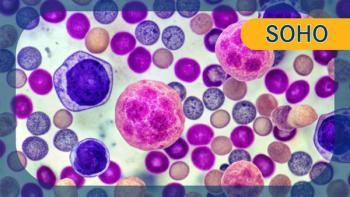
Subcutaneous daratumumab monotherapy demonstrated a 24-month PFS rate of 79.9% in patients with high-risk smoldering multiple myeloma.
The VENTANA HER2 (4B5) test earned CE-IVDR approval in Europe to assess HER2 status in metastatic breast cancer and biliary tract cancer.

Misty D. Shields, MD, PhD, discusses the inefficacy of concurrent immunotherapy and chemoradiation in lung cancer and the debate surrounding PCI in SCLC.
Alison Schram, MD, discusses the potential clinical utility of PKMYT1-targeted agents in gynecologic malignancies.
The combination of ziftomenib and cytarabine/daunorubicin showed a manageable safety profile with early efficacy in NPM1-mutated and KMT2A-rearranged AML.