

Neil Horowitz, MD, discusses surgical options for patients with newly diagnosed ovarian cancer.
Neil Horowitz, MD, discusses surgical options for patients with newly diagnosed ovarian cancer.
Panagiotis A. Konstantinopoulos, MD, director, Translational Research, Gynecologic Oncology, Dana-Farber Cancer Institute, associate professor of medicine, Harvard Medical School, discusses the disappointing results of the JAVELIN 200 trial in ovarian cancer.
Suzanne George, MD, highlights the available therapies for patients with uterine sarcomas and what novel options are on the horizon.
Suzanne George, MD, assistant professor of Medicine, Harvard Medical School, clinical director, Center for Sarcoma and Bone Oncology, Dana-Farber Cancer Institute, discusses the need for biomarkers in the treatment of uterine leiomyosarcoma.
Joyce F. Liu, MD, MPH, highlights the recent changes in the newly diagnosed ovarian cancer space and what the oncology field could see by the end of 2019.
Ursula A. Matulonis, MD, director, Gynecologic Oncology, Dana-Farber Cancer Institute, professor of medicine, Harvard Medical School, discusses the use of immunotherapy in patients with recurrent ovarian cancer.
Suzanne George, MD, assistant professor of Medicine, Harvard Medical School, clinical director, Center for Sarcoma and Bone Oncology, Dana-Farber Cancer Institute, discusses improving methods of diagnosis for women with uterine leiomyosarcoma.
Huma Q. Rana, MD, clinical director, Cancer Genetics and Prevention, instructor of medicine, Harvard Medical School, Dana-Farber Cancer Institute, discusses genetic testing guidelines for patients with ovarian cancer.
Matthew S. Davids, MD, MMSc, associate director, Center for Chronic Lymphocytic Leukemia, Dana-Farber Cancer Institute, discusses updated findings from the DUO study in patients with chronic lymphocytic leukemia.
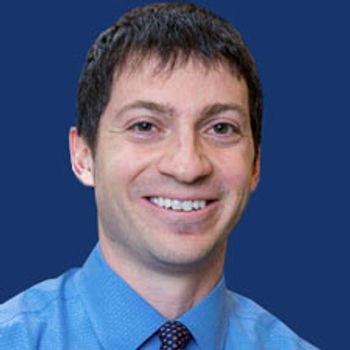
Matthew S. Davids, MD, MMSc, discusses the clinical implications of the DUO trial in patients with chronic lymphocytic leukemia.
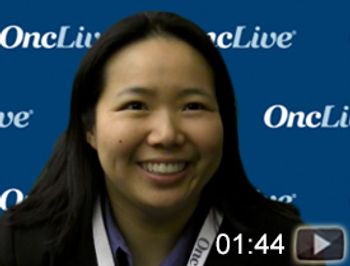
Joyce F. Liu, MD, MPH, assistant professor of medicine and director of clinical research for gynecologic oncology at Dana-Farber Cancer Institute, discusses the use of bevacizumab (Avastin) in the treatment of patients with newly diagnosed advanced ovarian cancer.
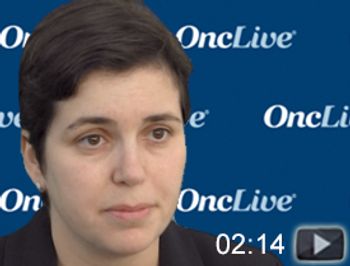
Yana Pikman, MD, a physician in the Cancer and Blood Disorders Center at Dana-Farber Cancer Institute and instructor of pediatrics at Harvard Medical School, discusses a trial attempting to match pediatric patients with more precise therapy for acute leukemia.
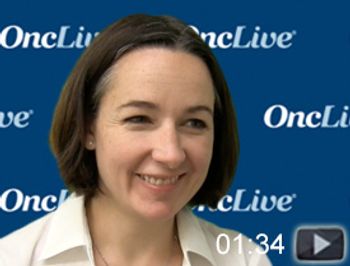
Stephanie K. Dougan, PhD, assistant professor, Microbiology and Immunobiology, Division of Immunology, Harvard Medical School, researcher, Dana-Farber Cancer Institute, discusses ways of augmenting T-cell immunity in pancreatic cancer.
Yana Pikman, MD, discusses the clinical implications of using an approach to match targeted therapy to pediatric patients with leukemia.
Suzanne George, MD, assistant professor of Medicine, Harvard Medical School, clinical director, Center for Sarcoma and Bone Oncology, Dana-Farber Cancer Institute, discusses the current treatment for patients with uterine leiomyosarcoma.
Toni K. Choueiri, MD, discusses recent progress in RCC and where future research is heading in the field.
Panagiotis A. Konstantinopoulos, MD, PhD, director, Translational Research, Gynecologic Oncology, Dana-Farber Cancer Institute, associate professor of medicine, Harvard Medical School, discusses immunotherapy in gynecologic cancers.
Toni Choueiri, MD, director, Lank Center for Genitourinary Oncology, director, Kidney Cancer Center, Jerome and Nancy Kohlberg Associate Professor of Medicine, Harvard Medical School, Dana-Farber Cancer Institute, discusses next steps for treatment in renal cell carcinoma.
Toni Choueiri, MD, director, Lank Center for Genitourinary Oncology, director, Kidney Cancer Center, Jerome and Nancy Kohlberg Associate Professor of Medicine, Harvard Medical School, Dana-Farber Cancer Institute, discusses frontline trials of immunotherapy in renal cell carcinoma.
Susan N. Chi, MD, senior physician, director, Pediatric Brain Tumor Clinical Trials Program, Dana-Farber Cancer Institute, assistant professor of pediatrics, Harvard Medical School, discusses response to tazemetostat in children with INI1-negative tumors.
Toni Choueiri, MD, director, Lank Center for Genitourinary Oncology, director, Kidney Cancer Center, Jerome and Nancy Kohlberg Associate Professor of Medicine, Harvard Medical School, Dana-Farber Cancer Institute, discusses combinations of checkpoint inhibitors and TKIs for the treatment of renal cell carcinoma.
Toni K. Choueiri, MD, discusses the JAVELIN Renal 101 study and where these data fit into the complex treatment paradigm of renal cell carcinoma.

Susan N. Chi, MD, senior physician, director, Pediatric Brain Tumor Clinical Trials Program, Dana-Farber Cancer Institute, assistant professor of pediatrics, Harvard Medical School, discusses the EZH2 inhibitor tazemetostat in pediatric patients with INI1-negative tumors.
David F. McDermott, MD, director of the Biologic Therapy Program at Beth Israel Deaconess Medical Center, discusses an analysis of the CheckMate-214 study in advanced renal cell carcinoma (RCC).
Toni Choueiri, MD, director, Lank Center for Genitourinary Oncology, director, Kidney Cancer Center, Jerome and Nancy Kohlberg Associate Professor of Medicine, Harvard Medical School, Dana-Farber Cancer Institute, discusses biomarkers in renal cell carcinoma.
David M. Jackman, MD, the medical director of Clinical Pathways at Dana-Farber, discusses the benefits of a clinical pathways system.
Harold J. Burstein, MD, PhD, senior physician, associate professor of medicine, Harvard Medical School, Dana-Farber Cancer Institute, discusses the treatment landscape of HER2-positive breast cancer.
Tari King, MD, FACS, chief of Breast Surgery, Dana-Farber Cancer Institute, Brigham Women’s Cancer Center, discusses surgical approaches in breast cancer.
Susana M. Campos, MD, gynecologic oncologist, Dana-Farber Cancer Institute, assistant professor of medicine, Harvard Medical School, discusses next steps with PARP inhibitors in ovarian cancer.
Toni Choueiri, MD, director, Lank Center for Genitourinary Oncology, director, Kidney Cancer Center, Jerome and Nancy Kohlberg Associate Professor of Medicine, Harvard Medical School, Dana-Farber Cancer Institute, discusses the CANTATA trial in renal cell carcinoma.