
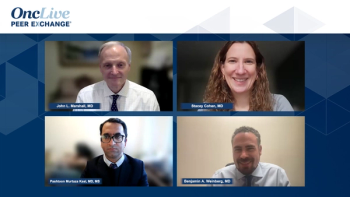
The panel continues its review of data presented on MRD testing in colorectal cancer from the INTERCEPT and COSMOS-CRC-01 studies.
The panel continues its review of data presented on MRD testing in colorectal cancer from the INTERCEPT and COSMOS-CRC-01 studies.
The panel reviews recent data on MRD testing in colorectal cancer, highlighting the INTERCEPT and COSMOS-CRC-01 studies.
Benjamin A. Weinberg, MD, presents the case of a 35-year-old man with oligometastatic disease, and the panel provides insights on treatment decisions.
Pashtoon Murtaza Kasi, MD, MS, emphasizes key aspects of liquid biopsy and ctDNA testing in the MRD treatment landscape.
Pashtoon Murtaza Kasi, MD, MS, reviews data from the BESPOKE CRC study, highlighting overall results and patient-reported outcomes.
Focusing on the GALAXY arm in the CIRCULATE-Japan study, experts on colorectal cancer discuss how recent data are informing the evolving treatment landscape.
John L. Marshall, MD, presents the case of a 52-year-old woman with mid-rectal carcinoma, and the panel offers its initial impressions.
The panel discusses how MRD testing has evolved as a clinical tool in colorectal cancer, highlighting the phase 2/3 COBRA study and its implications.
Experts on colorectal cancer discuss practical considerations related to MRD testing, highlighting strategies to navigate potential challenges.
Pashtoon Murtaza Kasi, MD, MS, discusses MRD testing practices in the community oncology setting and provides recommendations on the integration of MRD testing into clinical practice.
Focusing on the adjuvant setting, the expert panel discusses the timing and frequency of MRD testing in patients with colorectal cancer.
Colorectal cancer specialists discuss MRD testing platforms and how to choose among the available testing assays.
Experts on colorectal cancer discuss the timing of testing for minimal residual disease in the treatment journey.
A panel medical oncologists provide an overview of circulating tumor DNA and its role in MRD (minimal residual disease) testing in the treatment of patients with colorectal cancer.

Chul Kim, MD, MPH, discusses the impact of optimizing rare targets in lung cancer, highlighting the FDA approval of repotrectinib in ROS1-positive disease.

John Lindsay Marshall, MD, sheds light on the significance of the FDA approval of fruquintinib for patients with heavily pretreated metastatic colorectal cancer and discusses the efficacy and safety data from the FRESCO and FRESCO-2 trials that supported the decision in this population.

John Lindsay Marshall, MD, discusses the significance of the FDA approval of fruquintinib (Fruzaqla) in patients with metastatic colorectal cancer.

Stephen V. Liu, MD, discusses the significance of using fam-trastuzumab deruxtecan-nxki in patients with HER2-mutant non–small cell lung cancer and brain metastases according to pooled findings from exploratory analyses of the phase 2 DESTINY-Lung01 and DESTINY-Lung02 trials.
Stephen V. Liu, MD, discusses the interim analysis of the phase 2 TRUST-II trial, which is investigating the use of taletrectinib in patients with ROS1-positive non–small cell lung cancer.
OncLive® and The Ruesch Center for the Cure of Gastrointestinal Cancers at Georgetown Lombardi Comprehensive Cancer Center in Washington, DC, have announced the winners of the 2023 Luminary Award in GI cancers.
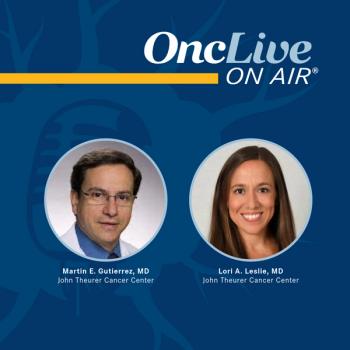
Drs Gutierrez and Leslie discuss common barriers that institutions face when implementing CAR T-cell therapy programs, the early success story of outpatient administration of this modality at John Theurer Cancer Center, and future considerations for using this treatment approach in solid tumors.

Stephen V. Liu, MD, discusses the 5-year overall survival data with atezolizumab and chemotherapy in patients with extensive-stage small cell lung cancer.

Closing out their panel on metastatic colorectal cancer, expert oncologists consider ongoing challenges and future evolutions within the treatment landscape.
Focused discussion on clinical trial data with trastuzumab deruxtecan in the setting of HER2+ metastatic colorectal cancer.
A panel of oncologists shares comprehensive insight to clinical trial data with tucatinib in patients with HER2+ metastatic colorectal cancer.
Switching their focus to HER2+ metastatic colorectal cancer, panelists discuss best practices in testing HER2 to aid in the timely selection of best available therapies.
Expert perspectives on novel combination and immunotherapy strategies within BRAF-mutated metastatic colorectal cancer management.
Shared insight to the importance of tumor sidedness and its impact on the selection of EGFR-targeted therapy in metastatic colorectal cancer.
Key opinion leaders in metastatic colorectal cancer management review data from the BREAKWATER study in BRAF-V600E–mutated disease.
Centering discussion on patients with BRAF-V600E mutations in metastatic colorectal cancer, panelists reflect on the treatment armamentarium in this setting.