Explore oral treatment choices after CDK4/6 progression in ER+ metastatic breast cancer, using ESR1/PIK3CA ctDNA plus scans and markers to track response.

Aditya Bardia, MD, MPH, FASCO, is a professor in the Department of Medicine, Division of Hematology/Oncology and director of Translational Research Integration at UCLA Health Jonsson Comprehensive Cancer Center.
Explore oral treatment choices after CDK4/6 progression in ER+ metastatic breast cancer, using ESR1/PIK3CA ctDNA plus scans and markers to track response.
New data highlight oral SERD combination therapies boosting progression-free survival, while raising toxicity and reshaping when ESR1 mutation testing guides treatment choices.
Experts compare oral SERDs’ side effects, quality-of-life gains, and why brief ESR1 testing delays help choose smarter ER+ breast cancer therapy.
Expert guidance on post-CDK4/6 metastatic breast cancer care, using liquid biopsy mutations to tailor oral SERDs versus targeted doublets for best outcomes.
Oral SERDs transform metastatic breast cancer care, with elacestrant boosting outcomes in ESR1-mutant disease and showing strong real-world progression-free survival.
Why ESR1 mutations rise after CDK4/6 therapy, when to retest via liquid biopsy, and how low VAF still guides SERD choices.
In this segment, Dr. Jason Mouabbi and Dr. Bardia explore the growing importance of ESR1 mutations in the management of ER-positive, HER2-negative metastatic breast cancer, particularly after progression on CDK4/6 inhibitor–based therapy.
Dr. Aditya Bardia provides an overview of the current standard of care in the first-line setting, emphasizing the established role of endocrine therapy combined with CDK4/6 inhibitors.
Dr Bardia discusses key findings from the phase 3 lidERA Breast Cancer study of giredestrant in estrogen receptor–positive, HER2-negative breast cancer.

Aditya Bardia, MD, MPH, FASCO, discusses the design of the ELEGANT study of elacestrant vs endocrine therapy in high-risk, ER-positive early breast cancer.
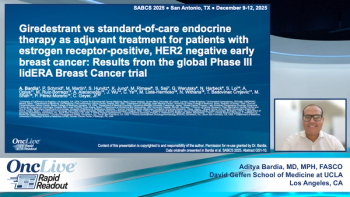
This rapid readout highlights results from a global Phase III trial evaluating giredestrant as adjuvant therapy for estrogen receptor–positive, HER2-negative early breast cancer. The study demonstrated a clinically meaningful improvement in invasive disease-free survival compared with standard endocrine therapy, with a favorable and comparable safety profile.
Dr Bardia discusses the ELEGANT study of elacestrant in estrogen receptor–positive, HER2-negative early breast cancer at high risk of disease recurrence.
Aditya Bardia, MD, MPH, FASCO, discussed data from the lidERA trial of giredestrant vs SOC endocrine therapy in ER-positive, HER2-negative breast cancer.

Aditya Bardia, MD, MPH, FASCO, discusses the efficacy of T-DXd in patients with HER2-low and -ultralow unresectable or metastatic breast cancer.



Aditya Bardia, MD, MPH, discusses the potential impact of novel coronavirus on immunocompromised patients.
Aditya Bardia, MD, MPH, discusses the clinical utility of liquid biopsies in breast cancer.
Aditya Bardia, MD, MPH, director of Precision Medicine at the Center for Breast Cancer, Massachusetts General Hospital Cancer Center, and assistant professor of medicine, Harvard Medical School, discusses the skepticism regarding biosimilars in oncology.
Aditya Bardia, MD, MPH, director of Precision Medicine at the Center for Breast Cancer, Massachusetts General Hospital Cancer Center, and assistant professor of medicine, Harvard Medical School, discusses the potential of sacituzumab govitecan in patients with triple-negative breast cancer (TNBC).
CtDNA will continue to gain importance in precision oncology as physicians continue to uncover the role and interplay of genomic alterations that promote tumor heterogeneity.
Aditya Bardia, MD, MPH, director of Precision Medicine at the Center for Breast Cancer, Massachusetts General Hospital Cancer Center, Harvard Medical School, discusses potential concerns regarding the use of biosimilars in the breast cancer space.
Aditya Bardia, MD, MPH, assistant professor of medicine, Harvard Medical School, attending physician, Medical Oncology, Massachusetts General Hospital, discusses the role of the microenvironment in the treatment of metastatic triple-negative breast cancer (TNBC).

Aditya Bardia, MD, MPH, assistant professor of medicine, Harvard Medical School, attending physician, Medical Oncology, Massachusetts General Hospital, discusses a trial investigating sacituzumab govitecan for patients with triple-negative breast cancer (TNBC).

Aditya Bardia, MD, MPH, assistant professor of Medicine, Harvard Medical School, attending physician, Medical Oncology, Massachusetts General Hospital, discusses RAD1901, a selective estrogen receptor degrader (SERD) for potential use in ER-positive metastatic breast cancer.
January 30th 2018
February 16th 2018
December 10th 2018
March 25th 2019
February 12th 2020