Articles by Barbara Burtness, MD
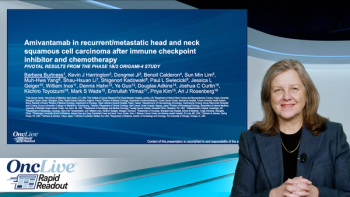
Barbara Burtness, MD, presents OrigAMI-4 cohort 1 data showing that subcutaneous amivantamab produced deep and durable antitumor activity with a manageable safety profile in previously treated recurrent or metastatic head and neck squamous cell carcinoma.

Panelists discuss how PD-1 inhibitors combined with chemotherapy have become the standard for recurrent nasopharyngeal carcinoma (NPC), the importance and challenges of using Epstein-Barr virus (EBV) as a biomarker, emerging therapies such as vaccines and CAR T cells, and the need for novel treatments as more patients receive up-front immunotherapy.
Panelists discuss the cautious use of PD-1 inhibitors in recurrent/metastatic nasopharyngeal carcinoma patients with preexisting autoimmune diseases or organ transplants due to high risks of severe toxicity and graft rejection, emphasizing individualized treatment decisions based on disease burden, symptoms, and patient frailty to balance efficacy and safety.
Panelists discuss the efficacy of multiple PD-1 inhibitors studied in nasopharyngeal cancer (NPC), noting similar overall outcomes despite differences in trial designs and adverse effect profiles, challenges in direct comparisons due to crossover and varying chemotherapy backbones, and how limited US approvals impact clinical choice—yet collectively these data affirm the integral role of PD-1 blockade as a cornerstone of treatment.
Panelists discuss the critical role of patient education and vigilant monitoring to manage immune-related toxicities during treatment, emphasizing the challenges of distinguishing the adverse effects from chemotherapy from immunotherapy, strategies for safely adjusting therapies, and the continued importance of radiation in select cases to enhance outcomes.
Panelists discuss the 4-year JUPITER-02 data confirming that adding PD-1 inhibitors to chemotherapy significantly improves long-term survival with manageable safety in recurrent/metastatic nasopharyngeal carcinoma (R/M NPC), supporting this combination as the new standard of care and highlighting strategies for local consolidation in limited metastatic disease.
Panelists discuss the phase 3 JUPITER-02 trial, which showed that adding PD-1 blockade to chemotherapy significantly improved progression-free survival in recurrent/metastatic (R/M) Epstein-Barr virus (EBV)-positive nasopharyngeal carcinoma (NPC), with biomarker analyses suggesting greater benefit in patients with high EBV DNA levels and PD-L1 expression.
Panelists discuss the biological rationale and consistent clinical data supporting PD-1 checkpoint inhibitors—such as toripalimab, nivolumab, and pembrolizumab—as active and meaningful treatments in recurrent/metastatic nasopharyngeal carcinoma (R/M NPC), particularly given the Epstein-Barr virus (EBV)-driven, immune-infiltrated nature of the disease.
Panelists discuss the standard management of recurrent/metastatic nasopharyngeal carcinoma (NPC), emphasizing surgery or re-irradiation when feasible, and gemcitabine-cisplatin chemotherapy as the systemic backbone, while highlighting the need for more effective therapies to improve long-term outcomes.
Panelists discuss the distinct Epstein-Barr virus (EBV)-driven biology of nasopharyngeal carcinoma (NPC), the role of plasma EBV DNA as a biomarker, and the strong evidence supporting gemcitabine-based induction chemotherapy followed by chemoradiotherapy as standard treatment for locally advanced disease.

The panel provides clinical insights on the treatment of a patient with metastatic EBV-positive nasopharyngeal carcinoma.
Shravan Kandula, MD, presents the case of a patient with locally recurrent nasopharyngeal carcinoma.
Victoria M. Villaflor, MD, discusses the integration of PD-1 inhibitors into standard treatment practices for patients with nasopharyngeal carcinoma.
The panel provides clinical insights on nasopharyngeal carcinoma treatment practices and outlines unmet needs in the current therapeutic landscape.
Victoria M. Villaflor, MD, highlights ways to mitigate adverse events for patients receiving treatment for nasopharyngeal carcinoma.
Experts on nasopharyngeal carcinoma outline the role of immunotherapy and discuss external factors that inform treatment decisions.
Shravan Kandula, MD, reviews findings from the DIPPER trial, which is investigating adjuvant PD-1 blockade with camrelizumab in patients with nasopharyngeal carcinoma.
A medical oncologist discusses the value of PD-L1 as a biomarker in the treatment of patients with nasopharyngeal carcinoma.
Victoria M. Villaflor, MD, provides insights on the role of immune checkpoint inhibitors in treating nasopharyngeal carcinoma, focusing on the JUPITER and POLARIS-2 clinical trials.
Shravan Kandula, MD, reviews the current guidelines for the treatment of patients with nasopharyngeal carcinoma.
Experts on nasopharyngeal carcinoma (NPC) provide an overview of the disease, highlighting its incidence, how it’s differentiated from other head and neck cancers, and the benefits of multidisciplinary care.
Barbara Burtness, MD, discusses findings from a subgroup analysis from the phase 2 E3311 trial in HPV-associated oropharynx cancer.
Barbara Burtness, MD, discusses preclinical data on the combination of VIC1911 and adavosertib in head and neck squamous cell carcinoma and lung cancer.
Barbara Burtness, MD, discusses the efficacy of immune checkpoint inhibitors in the treatment of patients with head and neck cancer.

Barbara Burtness, MD, discusses the effectiveness of immunotherapy in patients with platinum-refractory head and neck cancers.
Barbara Burtness, MD, professor of Medicine (Medical Oncology); Disease Aligned Research Team Leader, Head and Neck Cancers Program; co-director, Developmental Therapeutics Research Program; of Yale Cancer Center, discusses the future of immunotherapy in head and neck cancer.
Barbara Burtness, MD, professor of Medicine (Medical Oncology) Disease Aligned Research Team Leader, Head and Neck Cancers Program co-director, Developmental Therapeutics Research Program of Yale Cancer Center, discusses the use of biomarkers in metastatic head and neck squamous cell carcinoma.

Barbara Burtness, MD, professor of Medicine (Medical Oncology); Disease Aligned Research Team Leader, Head and Neck Cancers Program; co-director, Developmental Therapeutics Research Program; of Yale Cancer Center, discusses the promise of frontline pembrolizumab in the treatment of patients with metastatic head and neck squamous cell carcinoma.
Barbara Burtness, MD, professor of medicine, Yale Cancer Center, discusses the benefit of pembrolizumab (Keytruda) as a treatment for patients with recurrent metastatic head and neck squamous cell carcinoma.
Barbara Burtness, MD, professor of medicine, Yale Cancer Center, discusses frontline immunotherapy in head and neck cancer.


