Hope S. Rugo, MD, FASCO, UCSF Helen Diller Family Comprehensive Cancer Center
Articles by Hope S. Rugo, MD, FASCO, UCSF Helen Diller Family Comprehensive Cancer Center
Therapeutic Advances in Prophylaxis Against CIN
ByHope S. Rugo, MD, FASCO, UCSF Helen Diller Family Comprehensive Cancer Center,William J. Gradishar, MD, Northwestern University,Rita Nanda, MD, The University of Chicago Medicine,Tiffany A. Traina, MD, Memorial Sloan Kettering Cancer Center An overview of therapies used as prophylaxis against chemotherapy-induced neutropenia and projections on improving quality of life for patients with solid tumors with therapeutic advances.

CIN: Adopting SIMBA Therapy Into Clinical Practice
ByHope S. Rugo, MD, FASCO, UCSF Helen Diller Family Comprehensive Cancer Center,William J. Gradishar, MD, Northwestern University,Rita Nanda, MD, The University of Chicago Medicine,Tiffany A. Traina, MD, Memorial Sloan Kettering Cancer Center A panel of oncologists react to their interest in using plinabulin as prophylaxis against chemotherapy-induced neutropenia in future clinical practice.
Implications for treating patients with solid tumor cancers with plinabulin based on quality-of-life data and results demonstrated by the PROTECTIVE-2 trial.
Considerations regarding the potential to prevent chemotherapy-induced neutropenia with newer therapeutic strategies as well as changes to treatment dosages.

CIN Prophylaxis and Bone Pain
ByHope S. Rugo, MD, FASCO, UCSF Helen Diller Family Comprehensive Cancer Center,William J. Gradishar, MD, Northwestern University,Tiffany A. Traina, MD, Memorial Sloan Kettering Cancer Center,Rita Nanda, MD, The University of Chicago Medicine Recommendations regarding how to best manage patients who experience bone pain from chemotherapy-induced neutropenia prophylaxis with growth factor support.
Breast oncologists discuss how they weigh the efficacy of anticancer treatment with the possibility of a treatment-related adverse event, like chemotherapy-induced neutropenia.
Managing CIN in Patients With Breast Cancer
ByHope S. Rugo, MD, FASCO, UCSF Helen Diller Family Comprehensive Cancer Center,Tiffany A. Traina, MD, Memorial Sloan Kettering Cancer Center,Rita Nanda, MD, The University of Chicago Medicine,William J. Gradishar, MD, Northwestern University Preventive therapies and factors that impact how to best mitigate chemotherapy-induced neutropenia in patients with breast cancer.
Recommendations for intervening with growth factor support and important considerations for reducing or discontinuing anti-cancer therapy when patients show signs of neutropenia.
Advantages, in terms of safety and efficacy, of granulocyte colony-stimulating factors used as prophylaxis against chemotherapy-induced neutropenia.
G-CSFs for Chemotherapy-Induced Neutropenia
ByHope S. Rugo, MD, FASCO, UCSF Helen Diller Family Comprehensive Cancer Center,William J. Gradishar, MD, Northwestern University,Tiffany A. Traina, MD, Memorial Sloan Kettering Cancer Center,Rita Nanda, MD, The University of Chicago Medicine Breast oncologists react to the availability of granulocyte colony-stimulating factors, used as prophylaxis against chemotherapy-induced neutropenia.
Variables that oncologists should consider when determining when to initiate prophylactic therapy for chemotherapy-induced neutropenia in patients with breast cancer.
Consequences of Chemotherapy-Induced Neutropenia
ByHope S. Rugo, MD, FASCO, UCSF Helen Diller Family Comprehensive Cancer Center,Rita Nanda, MD, The University of Chicago Medicine,William J. Gradishar, MD, Northwestern University,Tiffany Traina, MD, Memorial Sloan Kettering Cancer Center A panel of breast oncologists define chemotherapy-induced neutropenia in terms of how they assess risk and attempt to prevent treatment-related toxicities in patients with cancer.
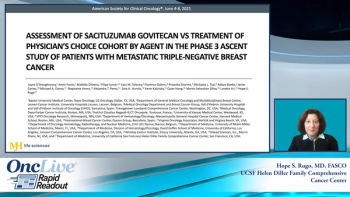
Hope S. Rugo, MD, FASCO, discusses data presented at the 2021 American Society of Clinical Oncology annual meeting from the phase 3 ASCENT study of patients with metastatic triple-negative breast cancer treated with sacituzumab govitecan.
Future Directions for the Management of HR+ Breast Cancer
ByAndrew D. Seidman, MD, Memorial Sloan Kettering Cancer Center,Aditya Bardia, MD, Massachusetts General Hospital Cancer Center,Dejan Juric, MD, Massachusetts General Hospital,Nicholas McAndrew, MD, MSCE, UCLA Health,Hope S. Rugo, MD, FASCO, UCSF Helen Diller Family Comprehensive Cancer Center Andrew D. Seidman, MD; Aditya Bardia, MD, MPH; Dejan Juric, MD; Nicholas McAndrew, MD, MSCE; and Hope S. Rugo, MD, share closing thoughts on the current and future treatment landscape for the management of HR+ breast cancer.
ES HR+ Breast Cancer: CDK4/6 Inhibitors in Clinical Practice
ByAndrew D. Seidman, MD, Memorial Sloan Kettering Cancer Center,Aditya Bardia, MD, Massachusetts General Hospital Cancer Center,Dejan Juric, MD, Massachusetts General Hospital,Nicholas McAndrew, MD, MSCE, UCLA Health,Hope S. Rugo, MD, FASCO, UCSF Helen Diller Family Comprehensive Cancer Center A discussion on the use of adjuvant CDK4/6 inhibitors in clinical practice for the treatment of early stage HR+ breast cancer.
Using CDK4/6 Inhibitors in Early Stage HR+ Breast Cancer
ByAndrew D. Seidman, MD, Memorial Sloan Kettering Cancer Center,Aditya Bardia, MD, Massachusetts General Hospital Cancer Center,Dejan Juric, MD, Massachusetts General Hospital,Nicholas McAndrew, MD, MSCE, UCLA Health,Hope S. Rugo, MD, FASCO, UCSF Helen Diller Family Comprehensive Cancer Center Experts in breast cancer share insights on the role of CDK4/6 inhibition in the adjuvant setting for early stage HR+ breast cancer.
Early Stage HR+ Breast Cancer: Optimizing Multigene Assays
ByAndrew D. Seidman, MD, Memorial Sloan Kettering Cancer Center,Aditya Bardia, MD, Massachusetts General Hospital Cancer Center,Dejan Juric, MD, Massachusetts General Hospital,Nicholas McAndrew, MD, MSCE, UCLA Health,Hope S. Rugo, MD, FASCO, UCSF Helen Diller Family Comprehensive Cancer Center Hope S. Rugo, MD, leads the discussion on the new data presented at the 2021 ASCO annual meeting for MammaPrint and Breast Cancer Index for early stage HR+ breast cancer.
Using Genomic Assays for Early Stage HR+ Breast Cancer
ByAndrew D. Seidman, MD, Memorial Sloan Kettering Cancer Center,Aditya Bardia, MD, Massachusetts General Hospital Cancer Center,Dejan Juric, MD, Massachusetts General Hospital,Nicholas McAndrew, MD, MSCE, UCLA Health,Hope S. Rugo, MD, FASCO, UCSF Helen Diller Family Comprehensive Cancer Center The role of genomic assays, including Oncotype DX as reported on in the RxPONDER trial, for the optimal management of early stage HR+ breast cancer is discussed.
Emerging Agents for the Management of HR+ mBC
ByAndrew D. Seidman, MD, Memorial Sloan Kettering Cancer Center,Aditya Bardia, MD, Massachusetts General Hospital Cancer Center,Dejan Juric, MD, Massachusetts General Hospital,Nicholas McAndrew, MD, MSCE, UCLA Health,Hope S. Rugo, MD, FASCO, UCSF Helen Diller Family Comprehensive Cancer Center Aditya Bardia, MD, MPH, leads the discussion on the use of novel CDK4/6 inhibitors, BCL2 inhibitors, and oral SERDS for the treatment of HR+ metastatic breast cancer.
PI3KCA Inhibition: Managing AEs in HR+ mBC
ByAndrew D. Seidman, MD, Memorial Sloan Kettering Cancer Center,Aditya Bardia, MD, Massachusetts General Hospital Cancer Center,Dejan Juric, MD, Massachusetts General Hospital,Nicholas McAndrew, MD, MSCE, UCLA Health,Hope S. Rugo, MD, FASCO, UCSF Helen Diller Family Comprehensive Cancer Center Andrew D. Seidman, MD; Aditya Bardia, MD, MPH; Dejan Juric, MD; Nicholas McAndrew, MD, MSCE; and Hope S. Rugo, MD, review the optimal management of adverse events associated with alpelisib in HR+ metastatic breast cancer.
Using CDK4/6 Inhibitors After HR+ mBC Disease Progression
ByAndrew D. Seidman, MD, Memorial Sloan Kettering Cancer Center,Aditya Bardia, MD, Massachusetts General Hospital Cancer Center,Dejan Juric, MD, Massachusetts General Hospital,Nicholas McAndrew, MD, MSCE, UCLA Health,Hope S. Rugo, MD, FASCO, UCSF Helen Diller Family Comprehensive Cancer Center Breast cancer experts comment on whether there is a benefit to switching to or continuing on CDK4/6 inhibitors with disease progression for HR+ metastatic breast cancer and discuss the use of tamoxifen for third-line endocrine therapy.
Case Discussion: Resistance to CDK4/6 Inhibitors in HR+ mBC
ByAndrew D. Seidman, MD, Memorial Sloan Kettering Cancer Center,Aditya Bardia, MD, Massachusetts General Hospital Cancer Center,Dejan Juric, MD, Massachusetts General Hospital,Nicholas McAndrew, MD, MSCE, UCLA Health,Hope S. Rugo, MD, FASCO, UCSF Helen Diller Family Comprehensive Cancer Center Andrew D. Seidman, MD, presents a case study of a 56-year-old postmenopausal woman diagnosed with stage IIB HR+ breast cancer and leads the discussion on approaching treatment for the given patient.
Implications of PIK3CA Mutations in HR+ mBC
ByAndrew D. Seidman, MD, Memorial Sloan Kettering Cancer Center,Aditya Bardia, MD, Massachusetts General Hospital Cancer Center,Dejan Juric, MD, Massachusetts General Hospital,Nicholas McAndrew, MD, MSCE, UCLA Health,Hope S. Rugo, MD, FASCO, UCSF Helen Diller Family Comprehensive Cancer Center Dejan Juric, MD, leads the discussion on the role of PIK3CA mutations in HR+ metastatic breast cancer.
Selecting a CDK4/6 Inhibitor for HR+ mBC
ByAndrew D. Seidman, MD, Memorial Sloan Kettering Cancer Center,Aditya Bardia, MD, Massachusetts General Hospital Cancer Center,Dejan Juric, MD, Massachusetts General Hospital,Nicholas McAndrew, MD, MSCE, UCLA Health,Hope S. Rugo, MD, FASCO, UCSF Helen Diller Family Comprehensive Cancer Center Experts in breast cancer comment on the appropriate patient selection of CDK4/6 inhibitors for the management of HR-positive metastatic breast cancer.
Using CDK4/6 Inhibitors in First-Line Treatment of HR+ mBC
ByAndrew D. Seidman, MD, Memorial Sloan Kettering Cancer Center,Aditya Bardia, MD, Massachusetts General Hospital Cancer Center,Dejan Juric, MD, Massachusetts General Hospital,Nicholas McAndrew, MD, MSCE, UCLA Health,Hope S. Rugo, MD, FASCO, UCSF Helen Diller Family Comprehensive Cancer Center A review of data from key phase 3 clinical trials, including ASCO 2021 updates, assessing the use of CDK4/6 inhibitors with endocrine therapy for the frontline treatment of HR-positive metastatic breast cancer.
Updated Data for Metastatic HER2+ Breast Cancer
ByRuth O'Regan, MD, University of Rochester Medical Center,Joyce O'Shaugnessy, MD, Texas Oncology,Hope S. Rugo, MD, FASCO, UCSF Helen Diller Family Comprehensive Cancer Center,Debu Tripathy, MD, MD Anderson Cancer Center 
Prognostic Tools for Early-Stage HER2+ Breast Cancer
ByRuth O'Regan, MD, University of Rochester Medical Center,Joyce O'Shaugnessy, MD, Texas Oncology,Hope S. Rugo, MD, FASCO, UCSF Helen Diller Family Comprehensive Cancer Center,Debu Tripathy, MD, MD Anderson Cancer Center 
Current Treatment Landscape for HER2+ Breast Cancer
ByRuth O'Regan, MD, University of Rochester Medical Center,Joyce O'Shaugnessy, MD, Texas Oncology,Hope S. Rugo, MD, FASCO, UCSF Helen Diller Family Comprehensive Cancer Center,Debu Tripathy, MD, MD Anderson Cancer Center 
Notable ASCO Trial Updates
ByJoyce A. O'Shaughnessy, MD, Baylor Charles A. Sammons Cancer Center,Dejan Juric, MD, Massachusetts General Hospital,Hope S. Rugo, MD, FASCO, UCSF Helen Diller Family Comprehensive Cancer Center,Tiffany A. Traina, MD, Memorial Sloan Kettering Cancer Center,Denise Yardley, MD, Tennessee Oncology 
HER2+ MBC Adverse-Event Management
ByJoyce A. O'Shaughnessy, MD, Baylor Charles A. Sammons Cancer Center,Dejan Juric, MD, Massachusetts General Hospital,Hope S. Rugo, MD, FASCO, UCSF Helen Diller Family Comprehensive Cancer Center,Tiffany A. Traina, MD, Memorial Sloan Kettering Cancer Center,Denise Yardley, MD, Tennessee Oncology