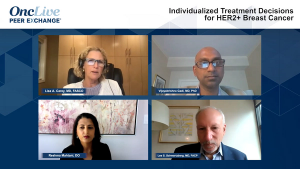
Closing thoughts from a discussion regarding the treatment landscape for HER2-positive breast cancer, with insight supporting the role of novel therapies to help personalize therapy.
Closing thoughts from a discussion regarding the treatment landscape for HER2-positive breast cancer, with insight supporting the role of novel therapies to help personalize therapy.
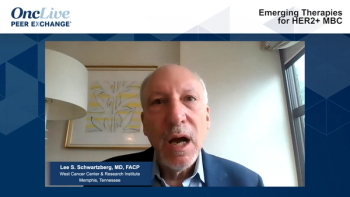
An overview of therapies under study in later-stage clinical trials to treat HER2-positive metastatic breast cancer.
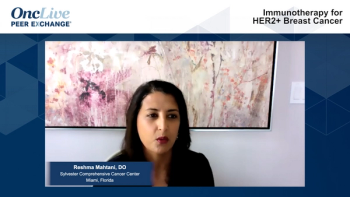
The rationale for incorporating checkpoint inhibitors into treatment regimens for HER2-positive breast cancer.
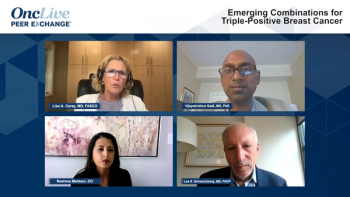
An overview of various trials investigating combination approaches as frontline therapy for triple-positive breast cancer and considerations for when to use chemotherapy and bring endocrine therapy into treatment.
Vijayakrishna Gadi, MD, PhD, defines triple-positive breast cancer and reacts to the potential use of trastuzumab combined with endocrine therapy as frontline therapy.

Lisa A. Carey, MD, FASCO, discusses the updated results of the phase 3 PALOMA-3 trial in hormone receptor–positive, HER2-positive breast cancer.
Considerations for addressing gaps in treatment for patients with HER2-positive metastatic breast cancer and brain metastasis, based on recent trial data.
A discussion regarding the preferred treatment approach for a 55-year-old woman with HR-/HER2+ metastatic breast cancer and 2 brain metastases.
Options available to treat patients with HER2-positive metastatic breast cancer and brain metastasis, and factors that impact choice of therapy based on CNS data demonstrated in several clinical trials of HER2-targeted agents.
Recommendations for screening patients with HER2-positive metastatic breast cancer for signs of brain metastasis as a consequence of current rates of prevalence.
Options available to treat patients with HER2-positive metastatic breast cancer following frontline therapy with T-DM1.
Variables that breast oncologists need to consider when selecting an appropriate systemic treatment approach for a patient with HER2-positive breast cancer.

Lisa A. Carey, MD, FASCO, discusses the phase 3 monarchE trial in hormone receptor–positive, HER2-negative breast cancer.
Breast oncologists discuss the pros and cons of treating patients with HER2-postive breast cancer with the fixed-dose subcutaneous formulation of pertuzumab plus trastuzumab compared with IV chemotherapy.
Best practices for preventing and managing treatment-related adverse events associated with systemic therapies used to treat HER2-positive metastatic breast cancer.
Dr Lee Schwartzberg, MD, FASCO, highlights the appropriateness for treating HER2-positive metastatic breast cancer with either neratinib plus capecitabine or margetuximab plus chemotherapy based on evidence revealed by the NALA and SOPHIA clinical trials.
Considerations for initiating trastuzumab deruxtecan in patients with HER2-positive metastatic breast cancer who received previous treatment with trastuzumab emtansine based on data demonstrated by the DESTINY-Breast01 study.

The significance of the HER2CLIMB study of tucatinib in combination with capecitabine and trastuzumab as treatment for patients with HER2-positive metastatic breast cancer.
Current treatment approaches available to treat HER2-positive metastatic breast cancer in the first- and second-line treatment settings.


August 10th 2021
July 20th 2021
July 13th 2021
July 27th 2021