Mark A. Socinski, MD, AdventHealth Cancer Institute
Articles by Mark A. Socinski, MD, AdventHealth Cancer Institute
Rare drivers such as EGFR exon 20 insertions and what they mean for treatment of patients with metastatic non–small cell lung cancer.
Mark A. Socinski, MD shares a brief overview of the biomarkers and FDA-approved targeted therapies for non–small cell lung cancers.
Clinical Endpoints and Neoadjuvant Therapy for Resectable NSCLC
ByMark A. Socinski, MD, AdventHealth Cancer Institute,Martin Dietrich, MD, PhD,Roy Herbst, MD, PhD, Yale Cancer Center,Chaitali Nangia, MD, Patty and George Hoag Cancer Center,Neal Edward Ready, MD, PhD, Duke Medical Center,Sandip P. Patel, MD, University of California San Diego The impact of endpoints used in clinical trials of neoadjuvant therapy for resectable non–small cell lung cancer as they relate to newer drug approvals and real-world practice.
Neoadjuvant Immunotherapy for Resectable NSCLC
ByMark A. Socinski, MD, AdventHealth Cancer Institute,Martin Dietrich, MD, PhD,Roy Herbst, MD, PhD, Yale Cancer Center,Chaitali Nangia, MD, Patty and George Hoag Cancer Center,Sandip P. Patel, MD, University of California San Diego,Neal Edward Ready, MD, PhD, Duke Medical Center Martin Dietrich, MD, PhD, describes his interpretations of the KEYNOTE-799 study of pembrolizumab plus chemoradiation therapy for unresectable stage III non–small cell lung cancer.
Role of Financial Toxicity on Treatment Decisions
ByMark A. Socinski, MD, AdventHealth Cancer Institute,Gilberto Lopes, MD, University of Miami Health System,Afsaneh Barzi, MD, PhD, City of Hope,Jack West, MD, City of Hope Experts in various specialties of oncology management share their insights on the role of financial toxicity on making treatment decisions for patients.
Definition of Financial Toxicity
ByMark A. Socinski, MD, AdventHealth Cancer Institute,Gilberto Lopes, MD, University of Miami Health System,Afsaneh Barzi, MD, PhD, City of Hope,Jack West, MD, City of Hope Jack West, MD, Gilberto Lopes, MD, and Afsaneh Barzi, MD, PhD, provide a definition for financial toxicity.
CRT and I-O for Unresectable Stage III NSCLC
ByMark A. Socinski, MD, AdventHealth Cancer Institute,Martin Dietrich, MD, PhD,Roy S. Herbst, MD, PhD, Yale Cancer Center,Chaitali Nangia, MD, Patty and George Hoag Cancer Center,Sandip P. Patel, MD, University of California San Diego,Neal Edward Ready, MD, PhD, Duke Medical Center Martin Dietrich, MD, PhD, describes his interpretations of the KEYNOTE-799 study of pembrolizumab plus chemoradiation therapy for unresectable stage III non–small cell lung cancer.
Appropriateness for Durvalumab in Unresectable Stage III NSCLC
ByMark A. Socinski, MD, AdventHealth Cancer Institute,Martin Dietrich, MD, PhD,Roy S. Herbst, MD, PhD, Yale Cancer Center,Chaitali Nangia, MD, Patty and George Hoag Cancer Center,Sandip P. Patel, MD, University of California San Diego,Neal Edward Ready, MD, PhD, Duke Medical Center Variables that influence patient selection for durvalumab consolidation after CRT as part of treatment for unresectable stage III non–small cell lung cancer.
Risks of Pneumonitis in Unresectable Stage III NSCLC
ByMark A. Socinski, MD, AdventHealth Cancer Institute,Martin Dietrich, MD, PhD,Roy S. Herbst, MD, PhD, Yale Cancer Center,Chaitali Nangia, MD, Patty and George Hoag Cancer Center,Sandip P. Patel, MD, University of California San Diego,Neal Edward Ready, MD, PhD, Duke Medical Center How to differentiate whether a patient with unresectable stage III non–small cell lung cancer develops pneumonitis from chemoradiation or durvalumab, and insight regarding techniques to help manage treatment toxicities.
Durvalumab for Unresectable Stage III NSCLC
ByMark A. Socinski, MD, AdventHealth Cancer Institute,Martin Dietrich, MD, PhD,Roy S. Herbst, MD, PhD, Yale Cancer Center,Chaitali Nangia, MD, Patty and George Hoag Cancer Center,Sandip P. Patel, MD, University of California San Diego,Neal Edward Ready, MD, PhD, Duke Medical Center Chaitali Nangia, MD, of the Patty and George Hoag Cancer Center, reacts to the significance of the 5-year overall survival data for the PACIFIC trial evaluating the use of durvalumab after chemoradiation as treatment for inoperable stage III non–small cell lung cancer.
Second-Line Therapy for Stage IV NSCLC
ByMark A. Socinski, MD, AdventHealth Cancer Institute,Martin Dietrich, MD, PhD,Roy S. Herbst, MD, PhD, Yale Cancer Center,Chaitali Nangia, MD, Patty and George Hoag Cancer Center,Sandip P. Patel, MD, University of California San Diego,Neal Edward Ready, MD, PhD, Duke Medical Center Second-line treatment recommendations for patients with stage IV non–small cell lung cancer who experience disease progression after immunotherapy.
Frontline Treatment of Stage IV NSCLC: What’s Next?
ByMark A. Socinski, MD, AdventHealth Cancer Institute,Martin Dietrich, MD, PhD,Roy S. Herbst, MD, PhD, Yale Cancer Center,Chaitali Nangia, MD, Patty and George Hoag Cancer Center,Sandip P. Patel, MD, University of California San Diego,Neal Edward Ready, MD, PhD, Duke Medical Center Future projections regarding the role of novel I-O therapies as frontline treatment for patients with metastatic non–small cell lung cancer.
Immune-Related Adverse Events in NSCLC
ByMark A. Socinski, MD, AdventHealth Cancer Institute,Martin Dietrich, MD, PhD,Roy S. Herbst, MD, PhD, Yale Cancer Center,Chaitali Nangia, MD, Patty and George Hoag Cancer Center,Sandip P. Patel, MD, University of California San Diego,Neal Edward Ready, MD, PhD, Duke Medical Center Recommendations for managing immune-related adverse events associated with checkpoint inhibitors used to treat stage IV non–small cell lung cancer.
Frontline Treatment of Stage IV NSCLC: Biomarkers
ByMark A. Socinski, MD, AdventHealth Cancer Institute,Martin Dietrich, MD, PhD,Roy S. Herbst, MD, PhD, Yale Cancer Center,Chaitali Nangia, MD, Patty and George Hoag Cancer Center,Sandip P. Patel, MD, University of California San Diego,Neal Edward Ready, MD, PhD, Duke Medical Center Martin Dietrich, MD, PhD, shares his thoughts on PD-L1 status, tumor mutational burden, and other predictive and prognostic biomarkers when making treatment decisions for patients with stage IV non–small cell lung cancer.
Frontline Treatment Decisions for Stage IV NSCLC
ByMark A. Socinski, MD, AdventHealth Cancer Institute,Martin Dietrich, MD, PhD,Roy S. Herbst, MD, PhD, Yale Cancer Center,Chaitali Nangia, MD, Patty and George Hoag Cancer Center,Sandip P. Patel, MD, University of California San Diego,Neal Edward Ready, MD, PhD, Duke Medical Center Considerations for selecting frontline therapy for metastatic non–small cell lung cancer based on various new data and treatment approvals in the field of immunotherapy.
Frontline Treatment of Stage IV NSCLC: IPI/NIVO
ByMark A. Socinski, MD, AdventHealth Cancer Institute,Martin Dietrich, MD, PhD,Roy S. Herbst, MD, PhD, Yale Cancer Center,Chaitali Nangia, MD, Patty and George Hoag Cancer Center,Sandip P. Patel, MD, University of California San Diego,Neal Edward Ready, MD, PhD, Duke Medical Center Neal Edward Ready, MD, PhD, describes which patients with stage IV non–small cell lung cancer may benefit from the combination of ipilimumab and nivolumab in the frontline treatment setting.
Frontline I-O Monotherapy Versus Combination Therapy for PD-L1+ Stage IV NSCLC
ByMark A. Socinski, MD, AdventHealth Cancer Institute,Martin Dietrich, MD, PhD,Roy S. Herbst, MD, PhD, Yale Cancer Center,Chaitali Nangia, MD, Patty and George Hoag Cancer Center,Sandip P. Patel, MD, University of California San Diego,Neal Edward Ready, MD, PhD, Duke Medical Center Drs Roy S. Herbst and Sandip P. Patel comment on patient candidacy for immunotherapy as monotherapy to treat PD-L1+ metastatic non–small cell lung cancer versus chemoimmunotherapy.
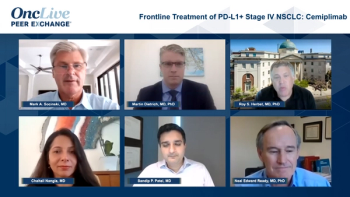
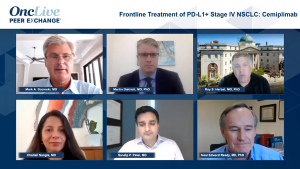
Frontline Treatment of PD-L1+ Stage IV NSCLC: Cemiplimab
ByMark A. Socinski, MD, AdventHealth Cancer Institute,Martin Dietrich, MD, PhD,Roy S. Herbst, MD, PhD, Yale Cancer Center,Chaitali Nangia, MD, Patty and George Hoag Cancer Center,Sandip P. Patel, MD, University of California San Diego,Neal Edward Ready, MD, PhD, Duke Medical Center Roy S. Herbst, MD, PhD, of Yale Cancer Center, highlights treatment advances in stage IV non–small cell lung cancer, including cemiplimab as frontline monotherapy based on EMPOWER-Lung 1.
Future Directions in Biomarker-Based Oncology
ByMark A. Socinski, MD, AdventHealth Cancer Institute,Jonathan Trent, MD, PhD, Sylvester Comprehensive Cancer Center,Lori J. Wirth, MD, Massachusetts General Hospital,Jyoti Patel, MD, FASCO, Lurie Cancer Center at Northwestern Medicine,Benjamin Levy, MD, Johns Hopkins Sidney Kimmel Cancer Center Experts in oncology discuss future directions in biomarker-driven therapy.
Tumor Agnostic RET Inhibition: The ARROW Trial
ByMark A. Socinski, MD, AdventHealth Cancer Institute,Jonathan Trent, MD, PhD, Sylvester Comprehensive Cancer Center,Lori J. Wirth, MD, Massachusetts General Hospital,Jyoti Patel, MD, FASCO, Lurie Cancer Center at Northwestern Medicine,Benjamin P. Levy, MD, Johns Hopkins Kimmel Cancer Center Dr Jyoti Patel presents data from the ARROW clinical trial.
RET as a Therapeutic Target for Solid Tumors
ByMark A. Socinski, MD, AdventHealth Cancer Institute,Jonathan Trent, MD, PhD, Sylvester Comprehensive Cancer Center,Lori J. Wirth, MD, Massachusetts General Hospital,Jyoti Patel, MD, FASCO, Lurie Cancer Center at Northwestern Medicine,Benjamin P. Levy, MD, John Hopkins Sidney Kimmel Cancer Center Expert oncologists discuss RET-driven therapy for select solid tumors.
TRK Fusion Inhibitors in Clinical Practice
ByMark A. Socinski, MD, AdventHealth Cancer Institute,Jonathan C. Trent, MD, Sylvester Comprehensive Cancer Center,Lori J. Wirth, MD, Massachusetts General Hospital,Jyoti Patel, MD, FASCO, Lurie Cancer Center at Northwestern Medicine,Benjamin P. Levy, MD, Johns Hopkins Kimmel Cancer Center Experts discuss their personal experiences when treating patients with NRTK fusions and solid tumors.
TRK Fusion Inhibitors in Tumor-Agnostic Clinical Trials
ByMark A. Socinski, MD, AdventHealth Cancer Institute,Jonathan Trent, MD, PhD, Sylvester Comprehensive Cancer Center,Lori J. Wirth, MD, Massachusetts General Hospital,Jyoti Patel, MD, FASCO, Lurie Cancer Center at Northwestern Medicine,Benjamin P. Levy, MD, Johns Hopkins Kimmel Cancer Center Jonathan Trent, MD, PhD, describes the safety and efficacy data from clinical trials of larotrectinib in patients with NRTK fusion–positive solid tumors.
Treatment Options for NRTK Fusion–Positive Solid Tumors
ByMark A. Socinski, MD, AdventHealth Cancer Institute,Jonathan Trent, MD, PhD, Sylvester Comprehensive Cancer Center,Lori J. Wirth, MD, Massachusetts General Hospital,Jyoti Patel, MD, FASCO, Lurie Cancer Center at Northwestern Medicine,Benjamin P. Levy, MD, Johns Hopkins Kimmel Cancer Center Benjamin Levy, MD, reviews the available treatment options for patients whose tumors harbor NRTK fusions.
NRTK Fusions in Oncology
ByMark A. Socinski, MD, AdventHealth Cancer Institute,Jonathan Trent, MD, PhD, Sylvester Comprehensive Cancer Center,Lori J. Wirth, MD, Massachusetts General Hospital,Jyoti Patel, MD, FASCO, Lurie Cancer Center at Northwestern Medicine,Benjamin P. Levy, MD, Johns Hopkins Kimmel Cancer Center Dr Lori Wirth describes the importance and implications of testing for NRTK fusions in patients with solid tumors.
Solid Tumors: Unmet Needs Related to Biomarker-Driven Therapy
ByMark A. Socinski, MD, AdventHealth Cancer Institute,Jonathan Trent, MD, PhD, Sylvester Comprehensive Cancer Center,Lori J. Wirth, MD, Massachusetts General Hospital,Jyoti Patel, MD, FASCO, Lurie Cancer Center at Northwestern Medicine,Benjamin P. Levy, MD, Johns Hopkins Kimmel Cancer Center Dr Mark Socinski and panel discuss the challenges and unmet meets of biomarker-driven therapy across solid tumor types.
Companion Diagnostics in Oncology for Solid Tumors
ByMark A. Socinski, MD, AdventHealth Cancer Institute,Jonathan Trent, MD, PhD, Sylvester Comprehensive Cancer Center,Lori J. Wirth, MD, Massachusetts General Hospital,Jyoti Patel, MD, FASCO, Lurie Cancer Center at Northwestern Medicine,Benjamin P. Levy, MD, Johns Hopkins Kimmel Cancer Center Experts in oncology provide their insights on the use of companion diagnostics in the treatment of solid tumors.
Pan-Tumor Biomarker Testing in Oncology
ByMark A. Socinski, MD, AdventHealth Cancer Institute,Jonathan Trent, MD, PhD, Sylvester Comprehensive Cancer Center,Lori J. Wirth, MD, Massachusetts General Hospital,Jyoti Patel, MD, FASCO, Lurie Cancer Center at Northwestern Medicine,Benjamin P. Levy, MD, Johns Hopkins Kimmel Cancer Center A panel of oncology experts in lung, thyroid, and sarcomatous tumors discuss the role and impact of pan-tumor biomarker testing.
Key Considerations for Biomarker Testing
ByMark A. Socinski, MD, AdventHealth Cancer Institute,Jonathan C. Trent, MD, Sylvester Comprehensive Cancer Center,Lori J. Wirth, MD, Massachusetts General Hospital,Jyoti Patel, MD, FASCO, Lurie Cancer Center at Northwestern Medicine,Benjamin P. Levy, MD, Johns Hopkins Kimmel Cancer Center Jyoti Patel, MD, FASCO, discusses the pros and cons of tissue versus blood for molecular testing of solid tumors.
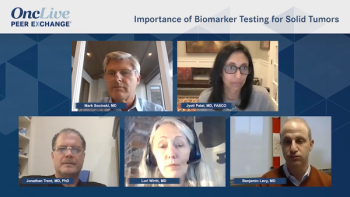
Importance of Biomarker Testing for Solid Tumors
ByMark A. Socinski, MD, AdventHealth Cancer Institute,Jonathan C. Trent, MD, Sylvester Comprehensive Cancer Center,Lori J. Wirth, MD, Massachusetts General Hospital,Jyoti Patel, MD, FASCO, Lurie Cancer Center at Northwestern Medicine,Benjamin P. Levy, MD, Johns Hopkins Kimmel Cancer Center Benjamin Levy, MD, and a multispecialty panel of experts discuss the importance of biomarker-directed therapy for appropriate solid tumors.