Martin F. Dietrich, MD, PhD, discusses the limitations of frontline chemotherapy in advanced/metastatic pancreatic cancer.
Martin Dietrich, MD, PhD, is a medical oncologist with The US Oncology Network Cancer Care Centers of Brevard and an assistant professor of internal medicine at the University of Central Florida College of Medicine in Orlando, Florida.
Martin F. Dietrich, MD, PhD, discusses the limitations of frontline chemotherapy in advanced/metastatic pancreatic cancer.
Panelists note that detecting low-level circulating tumor DNA (ctDNA) despite normal imaging presents a clinical challenge, requiring personalized management that balances early intervention with patient-centered communication, as this molecular signal offers a valuable window to detect and treat microscopic disease before overt recurrence.
Panelists highlight that advances in circulating tumor DNA (ctDNA) testing now enable detection of cancer at ultralow levels far earlier than traditional methods, offering new opportunities for timely intervention while emphasizing that negative results, though increasingly reliable, still require cautious interpretation to guide personalized treatment decisions.
Panelists emphasize that as circulating tumor DNA (ctDNA) testing becomes more integrated into clinical practice, careful interpretation, tailored testing schedules, and ongoing provider education are key to its effective use in personalized breast cancer care.
Panelists discuss the real-world challenges of managing patients with positive circulating tumor DNA (ctDNA) but no radiographic evidence of disease, emphasizing treatment intensification, genomic profiling for resistance mutations, dynamic monitoring, and the integration of ctDNA with imaging and biopsy to guide personalized breast cancer care.
Panelists discuss ongoing studies exploring circulating tumor DNA (ctDNA) use in the adjuvant breast cancer setting to detect recurrence earlier and guide therapy, highlighting advances in assay sensitivity, the choice between tumor-informed and tumor-agnostic tests, and the challenge of turning ctDNA’s strong prognostic value into actionable, outcome-improving interventions.
Panelists discuss how circulating tumor DNA (ctDNA) serves as a highly predictive prognostic biomarker in breast cancer, guiding personalized treatment intensification and informing important patient decisions while enhancing risk stratification and motivating proactive care despite ongoing research into its impact on long-term outcomes.
Panelists discuss how circulating tumor DNA (ctDNA) is becoming a vital biomarker in breast cancer, with its dynamic changes guiding personalized treatment decisions, serving as a surrogate end point in trials, enabling earlier detection of progression, and offering a less-invasive monitoring tool that complements imaging—especially benefiting patients with hard-to-monitor disease or those who are frail.
Panelists discuss how emerging data from studies like E-BLIS and I-SPY 2 validate circulating tumor DNA (ctDNA) as a powerful prognostic tool in early breast cancer, showing it can detect recurrence months before imaging and potentially refine risk stratification beyond traditional markers, though its role in guiding treatment decisions remains under active investigation.
Panelists discuss how circulating tumor DNA (ctDNA) monitoring provides a valuable lead time for detecting recurrence in early-stage breast cancer—especially hormone receptor–positive cases—yet requires careful patient counseling and integration with traditional prognostic tools, as its use for guiding treatment decisions remains nuanced and dependent on evolving clinical evidence.
Panelists discuss how circulating tumor DNA (ctDNA) testing for molecular residual disease (MRD) offers a sensitive tool for detecting early breast cancer recurrence before clinical symptoms appear while emphasizing the importance of shared decision-making, patient education, and clinical trial referral in the absence of standardized guidelines for managing ctDNA-positive results.
Panelists discuss how current breast cancer surveillance remains largely symptom-driven and reactive, often missing early metastatic recurrence, and how circulating tumor DNA (ctDNA) testing offers a promising shift toward proactive, personalized monitoring by enabling earlier detection of molecular residual disease (MRD) and guiding timely therapeutic interventions.
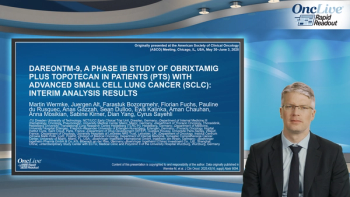
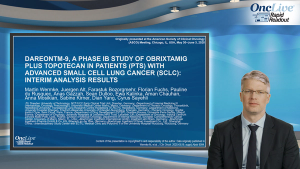
Martin Dietrich, MD, live from the 2025 ASCO Annual Meeting, presents interim results from the phase 1b DAREONTM-9 study, showing that obrixtamig combined with topotecan is well tolerated and demonstrates promising preliminary efficacy in patients with relapsed or refractory small cell lung cancer, with a confirmed overall response rate of 69%.
Experts reflect on the evolving landscape of biomarker testing in lung cancer, examining its crucial role in treatment decisions and advancements in perioperative and adjuvant therapies.
Closing out their panel on immunotherapy in non–small cell lung cancer, expert oncologists share key takeaways on the selection of novel therapy in this setting.
A brief review of the POSEIDON trial, which analyzed durvalumab with or without tremelimumab in combination with chemotherapy in advanced NSCLC.
Key opinion leaders in the field of non–small cell lung cancer management discuss the role of immunotherapy in patients with concomitant KRAS and KEAP1/STK11 mutations.
A comprehensive discussion on combination chemotherapy + immunotherapy regimens available to patients with advanced non–small cell lung cancer.

Shared insight on the value that molecular testing and PD-L1 testing, respectively, have on determining optimal therapy for patients with advanced non–small cell lung cancer.
Switching their focus to advanced non–small cell lung cancer, panelists identify parameters that may influence the use of immune checkpoint inhibitors in this setting.
Before closing out their review of resectable NSCLC treatment strategies, key opinion leaders consider nuances in utilizing perioperative therapy in the current paradigm.
Switching their focus to the adjuvant setting of resectable NSCLC, expert panelists identify treatment options in this setting and review the clinical data behind them.
Shared insight from key opinion leaders on the value of molecular testing in patients with resectable non–small cell lung cancer and how it can be applied.
Closing out their discussion on the management of cutaneous squamous cell carcinoma, expert panelists share clinical pearls and excitement for the future.
Focused discussion on the selection of neoadjuvant therapy in patients with resectable NSCLC in light of recent clinical trials.
Expert oncologists reflect on key factors that aid in the selection of therapy for patients diagnosed with resectable non–small cell lung cancer (NSCLC).
Dr Vishal Patel shares a surgeon’s perspective on MDC, followed by a discussion on how intensifying treatment after surgery may improve outcomes for higher-risk patients with CSCC.
Experts in the field of CSCC revisit the concept of multidisciplinary care and consider best communication strategies.
Shared insight on novel treatment modalities in the setting of cutaneous squamous cell carcinoma and how they may be triaged moving forward.
Following their review of recent clinical data, expert panelists consider how neoadjuvant cemiplimab will fit into the real-world treatment paradigm of resectable CSCC, including the possibility of delaying or avoiding surgery in patients who have an adequate response to cemiplimab.
Published: June 23rd 2025 | Updated: September 10th 2025
August 25th 2021
December 23rd 2022
March 15th 2023