
Nitin Jain, MD
Advertisement

Nitin Jain, MD, is a professor of medicine in the Department of Leukemia of the Division of Cancer Medicine at The University of Texas MD Anderson Cancer Center.
Articles by Nitin Jain, MD

Panelists discuss how their institutions organize multidisciplinary teams for chronic lymphocytic leukemia care, detailing the specific roles of various specialists including oncologists, nurses, pharmacists, and cardiologists in coordinating comprehensive patient care, managing adverse events, and addressing treatment-related complications throughout the course of therapy.
Panelists discuss how emerging resistance patterns in chronic lymphocytic leukemia influence their approach to treatment sequencing, considering the mechanisms of resistance to different drug classes and how this knowledge informs the selection and order of therapies to maximize long-term disease control and patient outcomes.
Panelists discuss how they balance the potential benefits of aggressive first-line treatment in chronic lymphocytic leukemia against the importance of preserving effective options for subsequent lines of therapy, considering factors such as patient prognosis, treatment goals, and the evolving landscape of available therapies.
Panelists discuss how they approach treatment sequencing in relapsed/refractory chronic lymphocytic leukemia (CLL), considering primary factors such as prior therapies, mechanisms of resistance, patient characteristics, and treatment goals to optimize the order and selection of subsequent therapies for improved long-term outcomes.
Panelists discuss how they approach treatment selection for multi-refractory chronic lymphocytic leukemia (CLL) patients, considering factors such as prior therapy responses, patient fitness, and disease characteristics to guide choices among available options, including CAR T-cell therapy, while also addressing the limitations and challenges associated with each treatment modality in their decision-making process.
Panelists discuss how various additional treatment options for relapsed/refractory chronic lymphocytic leukemia (CLL) are considered, including CAR-T cell therapy, immunomodulatory drugs like lenalidomide, chemoimmunotherapy regimens, and other emerging therapies, highlighting their potential roles in the evolving treatment landscape.
Panelists discuss how they evaluate patients for tumor lysis syndrome (TLS) risk, considering factors such as tumor burden, renal function, and prior therapies, and how this assessment influences their decision between prescribing a non-covalent BTK inhibitor or a venetoclax-based regimen for chronic lymphocytic leukemia treatment.
Panelists discuss how utilizing pirtobrutinib in clinical practice, focusing on its application in patients who have developed resistance or intolerance to prior BTK inhibitors, as well as in those who have shown resistance to both BTK and BCL-2 inhibitors in chronic lymphocytic leukemia treatment.
Panelists discuss how the non-covalent BTK inhibitor pirtobrutinib has shown promising results in the BRUIN clinical trials for both BTK inhibitor-naive and previously treated chronic lymphocytic leukemia patients, reviewing key efficacy and safety data presented at recent hematology conferences.
Panelists discuss how they assess patients for resistance to first-line BTK inhibitor therapy in chronic lymphocytic leukemia, emphasizing the importance of clinical evaluation, laboratory testing, and genetic analysis in determining the presence and mechanisms of resistance to guide subsequent treatment decisions.
Panelists discuss how treatment approaches are tailored differently for patients with rapid, aggressive chronic lymphocytic leukemia progression versus those with slower, less aggressive disease, considering factors such as urgency of intervention, choice of therapy intensity, and long-term management strategies.
Panelists discuss how various patient-specific factors, including age, comorbidities, performance status, disease aggressiveness, symptoms, and biomarkers, are carefully considered to guide the selection of optimal treatment strategies for individuals with chronic lymphocytic leukemia (CLL).
Panelists discuss how the choice of prior therapy between BTK inhibitors and BCL2 inhibitors influences subsequent treatment decisions in chronic lymphocytic leukemia (CLL), considering factors such as resistance mechanisms, toxicity profiles, and patient-specific characteristics.
Panelists discuss the current standard of care and treatment landscape for patients with chronic lymphocytic leukemia.
Nitin Jain, MD, discusses current treatment options and considerations for the frontline management of CLL.
Nitin Jain, MD, discusses the preliminary results from the phase 1 BALLI-01 study, which investigated UCART22, a genetically modified allogeneic T-cell therapy, in patients with relapsed or refractory B-cell acute lymphoblastic leukemia.
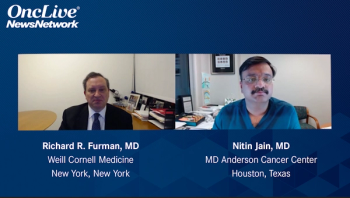
Richard R. Furman, MD, and Nitin Jain, MD, share insight on the evolving treatment landscape of CLL, particularly for treatment in early line settings.
Nitin Jain, MD, and Richard R. Furman, MD, discuss the standard treatment criteria for CLL and answer audience questions on the appropriate circumstances to adjust, switch, and discontinue therapy.
Nitin Jain, MD, comments on the use of novel treatment strategies, including CAR T-cell therapy, being evaluated to treat patients with CLL.
Nitin Jain, MD, shares factors to consider when selecting the optimal therapy for patients with CLL.
Nitin Jain, MD, provides insight on approaching treatment with noncovalent BTK inhibitors for patients with CLL who have acquired resistance to covalent inhibitors.
Richard R. Furman, MD, reviews resistance mechanisms to BTK inhibitors and how they affect treatment selection for patients with CLL.
Nitin Jain, MD, leads the discussion on the use of fixed-dose regimens for the treatment of CLL as seen in the phase 2 CAPTIVATE and phase 3 GLOW trials.
Richard R. Furman, MD, leads the discussion on clinical implications from head-to-head trials of BTK inhibitors in the relapsed setting for patients with CLL.
Nitin Jain, MD, and Richard R. Furman, MD, review available treatment options for the treatment of CLL and discuss the safety and tolerability of these therapies.
Nitin Jain, MD, assistant professor, Department of Leukemia, The University of Texas MD Anderson Cancer Center, discusses the combination of venetoclax (Venclexta) and ibrutinib (Imbruvica) in chronic lymphocytic leukemia (CLL).
Nitin Jain, MD, assistant professor, Department of Leukemia, The University of Texas MD Anderson Cancer Center, discusses the treatment of patients with chronic lymphocytic leukemia who have developed Richter’s transformation.
Nitin Jain, MD, assistant professor, Department of Leukemia, The University of Texas MD Anderson Cancer Center, discusses PD-1 expression in patients with chronic lymphocytic leukemia (CLL) who were treated with the combination of nivolumab (Opdivo) and ibrutinib (Imbruvica).
Nitin Jain, MD, assistant professor, Department of Leukemia, The University of Texas MD Anderson Cancer Center, discusses the efficacy and safety of the combination of idelalisib and rituximab for older patients with chronic lymphocytic leukemia.
Advertisement
Latest Updated Articles
 Q&A: Modifying and Switching Therapies in CLL
January 5th 2022
- Q&A: Early Treatment of CLL
January 5th 2022
- Novel Treatments for the Management of CLL
January 5th 2022
- Role of Fixed-Dose Regimens in CLL
December 15th 2021
- Choosing the Appropriate Treatment Strategy in CLL
December 22nd 2021
- Using Noncovalent BTK Inhibitors for the Management of CLL
December 22nd 2021
Advertisement
Advertisement
Trending on OncLive
1
FDA Approves Pirtobrutinib for Previously Untreated CLL/SLL
2
Oral Azacitidine and Cedazuridine Meets Primary Pharmacokinetic End Point in MDS and CMML
3
Revisit Every OncLive On Air Episode From September 2026
4
UTRxMYCN M1-14 Nets FDA Dual Designations in Soft Tissue Sarcoma
5