Rachna T. Shroff, MD, MS, FASCO, discusses how bringing a diversity of perspectives to clinical trial design has moved the needle in pancreatic cancer.

Rachna Shroff, MD, MS, FASCO, is interim clinical affairs director, associate director of Clinical Investigations, and co-lead of Gastrointestinal Clinical Research Team at The University of Arizona Cancer Center. She is also a professor in the Department of Medicine, chief of the Division of Hematology/Oncology, medical director of the Oncology Service Line, and associate dean of Clinical and Translational Research at The University of Arizona College of Medicine.
Rachna T. Shroff, MD, MS, FASCO, discusses how bringing a diversity of perspectives to clinical trial design has moved the needle in pancreatic cancer.
Rachna T. Shroff, MD, MS, FASCO, and Kristen Spencer, DO, discuss factors weighed when navigating first-line chemotherapy selection in pancreatic cancer.
Despite recent breakthroughs, a major unmet need in pancreatic cancer remains extending effective therapies to patients without targetable mutations—requiring more precise molecular stratification, strategic combinations (including immunotherapy), and a continued focus on durable responses through clinical trial participation to truly transform outcomes in this heterogeneous and historically resistant disease.
After decades of limited progress, a new wave of RAS-targeted therapies—backed by stronger early-phase data and smarter trial design—is driving renewed optimism in pancreatic cancer, offering the real possibility of more effective, better-tolerated, and personalized treatment options for a disease long defined by therapeutic scarcity.
A new phase 3 trial evaluating an oral RAS-ON inhibitor in patients with advanced pancreatic cancer after frontline chemotherapy marks a major step toward potentially redefining second-line treatment, offering a targeted, patient-friendly alternative to standard chemotherapy with the hope of improving both outcomes and quality of life.
Recent breakthroughs in pancreatic cancer treatment focus on novel inhibitors that target the active, GTP-bound “RAS-ON” state—previously considered undruggable—showing promising early trial results with meaningful response rates, reduced circulating tumor DNA, and extended progression-free survival, signaling a potential paradigm shift in managing this historically difficult-to-treat disease.
Panelists discussed second-line treatment for RAS-mutant pancreatic cancer, emphasizing that sequencing regimens like FOLFIRINOX and gemcitabine-based therapies should be tailored to prior treatment and performance status, while also integrating holistic care—including pain management, nutrition, and early use of molecularly targeted agents—to maximize quality of life and capitalize on critical therapeutic windows.
Panelists emphasized that early, comprehensive molecular testing at diagnosis—including for RAS mutations—is essential in pancreatic cancer to uncover rare but actionable targets, facilitate timely clinical trial enrollment, and build a foundation for future treatment decisions, even if no immediate therapies are available.
Panelists highlighted how recent breakthroughs in KRAS-specific inhibitors—such as those targeting G12C, G12D, and G12V mutations—are transforming the management of pancreatic cancer, underscoring the importance of precise molecular profiling through tumor-based next-generation sequencing or, when necessary, circulating tumor DNA to guide emerging personalized therapies in this historically challenging disease.
Panelists discuss how advancements in molecular oncology are transforming RAS mutations—especially KRAS, but also NRAS and HRAS—from historically “undruggable” targets into promising avenues for personalized therapy in pancreatic and other solid tumors.
Panelists discuss how KRAS mutations, long considered “undruggable” in pancreatic cancer, are now emerging as actionable targets thanks to allele-specific inhibitors, marking a turning point in precision oncology and offering new hope for improving outcomes in a historically treatment-resistant disease.
Rachna Shroff, MD, MS, FASCO, discusses the efficacy of nab-paclitaxel plus gemcitabine and cisplatin in newly diagnosed, advanced biliary tract cancer.
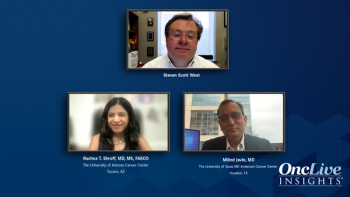
Milind Javle, MD; Rachna Shroff, MD, MS, FASCO; and a patient discuss ongoing research efforts in advanced biliary tract cancer.
Milind Javle, MD; Rachna Shroff, MD, MS, FASCO; and a patient discuss how to factor in trastuzumab deruxtecan in advanced biliary tract cancer.
Milind Javle, MD; Rachna Shroff, MD, MS, FASCO; and a patient discuss considering factors for immunotherapy agents in advanced biliary tract cancer.
Milind Javle, MD; Rachna Shroff, MD, MS, FASCO; and a patient discuss the clinical implications of 3-year survival data from TOPAZ-1 in advanced biliary tract cancer.
Milind Javle, MD; Rachna Shroff, MD, MS, FASCO; and a patient put the TOPAZ-1 data into context for patients with advanced biliary tract cancer.
Milind Javle, MD; Rachna Shroff, MD, MS, FASCO; and a patient discuss the phase 3 TOPAZ-1 trial in advanced biliary tract cancer.
Milind Javle, MD, and Rachna Shroff, MD, MS, FASCO, discuss a case of advanced biliary tract cancer with a patient.
Milind Javle, MD, and Rachna Shroff, MD, MS, FASCO, and a patient discuss prognosis and standard-of-care treatment for patients with advanced biliary tract cancer.
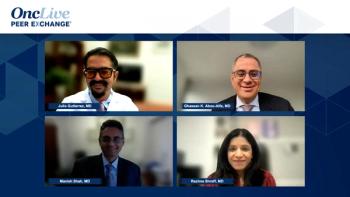
The panel closes their discussion by highlighting exciting developments on the horizon for the treatment of HCC.
Dr Ghassan K. Abou-Alfa explains the safety profiles of the discussed frontline therapy options for advanced HCC.
Key opinion leaders discuss the sequencing of systemic therapy options for patients with advanced HCC.
Dr Manish Shah reviews data from the HIMALAYA study on front-line systemic therapy in advanced HCC with tremelimumab plus durvalumab.
Julio Gutierrez, MD, and Ghassan K. Abou-Alfa, MD, discuss the results of the IMbrave150 study investigating atezolizumab plus bevacizumab in the first-line setting for advanced HCC.
Experts review data from IMbrave050 on the potential role of atezolizumab plus bevacizumab in the adjuvant setting for HCC.
Manish Shah, MD, details the role of locoregional therapy in HCC, and Julio Gutierrez, MD, comments on transplant as a curative option.
The panel explains the Child-Pugh scoring system and how staging and liver function impact treatment decisions for patients with HCC.
Key opinion leaders review the process of diagnosing HCC, the role of molecular testing, and associated challenges.
Experts provide an overview of hepatocellular carcinoma, including the risk factors and prognosis.
March 15th 2023

August 9th 2023
February 15th 2023