






Breast Cancer
Latest News
Advertisement
Latest Videos



































































Advertisement
More News

Datopotamab deruxtecan resulted in a statistically significant and clinically meaningful improvement in progression-free survival compared with chemotherapy among patients with previously treated, hormone receptor-positive/HER2-negative inoperable or metastatic breast cancer.

The addition of inavolisib to palbociclib and fulvestrant improved progression-free survival vs palbociclib and fulvestrant alone in select patients with PIK3CA-mutated, hormone receptor–positive, HER2-negative, locally advanced or metastatic breast cancer.

Precise stratification of hormone receptor–positive, HER2-negative breast cancer using BluePrint and MammaPrint assays revealed comparable 3-year recurrence-free survival rates between Black and White patients despite observed racial differences in the distribution of molecular subtypes.

Jason Jincong Freeman, discusses mortality differences across various racial groups in male patients with stage I, II, or III breast cancer.
Heather A. Parsons, MD, MPH, discusses the correlation between liquid biopsy and HER2 status in breast cancer, according to data from a novel epigenomic platform.

Maintenance Pembrolizumab/Olaparib Misses Survival End Points in Locally Advanced or Metastatic TNBC
Pembrolizumab plus olaparib did not improve progression-free or overall survival vs pembrolizumab plus chemotherapy in patients with locally recurrent inoperable or metastatic triple-negative breast cancer who received induction pembrolizumab plus chemotherapy.

The addition of pembrolizumab to neoadjuvant chemotherapy followed by adjuvant pembrolizumab plus endocrine therapy improved pathologic complete responses in key subsets of patients with early-stage, high-risk, estrogen receptor–positive/HER2-negative breast cancer enrolled in the phase 3 KEYNOTE-756 trial.

Capivasertib plus fulvestrant did not negatively affect quality of life compared with placebo plus fulvestrant in patients with aromatase inhibitor–resistant, hormone receptor–positive, HER2-negative advanced breast cancer.

Utilizing an artificial intelligence–assisted workflow to detect sentinel lymph node metastases in patients with breast cancer was deemed safe according to current diagnostic standards and reduced the need for immunohistochemistry and its associated financial burden.

The combination of ribociclib and endocrine therapy led to an improvement in progression-free survival and overall survival vs placebo plus endocrine therapy in patients with hormone receptor-positive/HER2-negative advanced breast cancer across all age groups.

In this final episode of OncChats: Reviewing Best Practices in the Surgical Management of Breast Cancer, Gladys Giron, MD, FACS, and Cristina Lopez-Peñalver, MD, shed light on clinical outcomes following surgery of the primary tumor in patients with stage IV breast cancer.

Paolo Tarantino, MD, discusses ongoing investigations into the use of antibody-drug conjugates targeting B7-H4 vedotin, highlighting their potential significance for the treatment paradigm in breast cancer.

Erica L. Mayer, MD, MPH, discusses findings from research investigating CDK4/6 inhibitors in patients with hormone receptor (HR)–positive, HER2-negative breast cancer.

The expert panel concludes the program with key takeaways and closing thoughts on the evolving antibody-drug conjugate space.

Joseph A. Sparano, MD, FACP, discusses developments in breast cancer diagnosis and treatment.

The FDA has granted fast track designation to zotatifin for use in combination with fulvestrant and abemaciclib as second- or third-line therapy for the treatment of patients with estrogen receptor-positive, HER2-negative advanced or metastatic breast cancer with disease progression following treatment with endocrine therapy and a CDK4/6 inhibitor.

With multiple antibody drug conjugate options now available for patients with HER2-negative metastatic breast cancer, clinicians must consider a variety of factors when selecting and sequencing therapies.

In this fourth episode of OncChats: Reviewing Best Practices in the Surgical Management of Breast Cancer, Gladys Giron, MD, FACS, and Cristina Lopez-Peñalver, MD, discuss how to appropriately manage patients with stage IV breast cancer and outline when surgical approaches may be appropriate for this population.
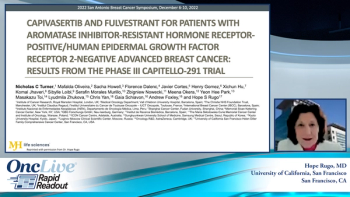
Hope Rugo, MD reviews key data from the CAPItello-291 phase 3 trial recently presented at the San Antonio Breast Cancer Symposium in December 2022.

Mylin A. Torres, MD, discusses using antibody-drug conjugates (ADCs) to treat patients with breast cancer.

Cynthia Ma, MD, PhD, discusses the use of AKT inhibitors vs PI3K inhibitors in breast cancer.
Experts in breast, lung, and gastric malignancies provide insights on multidisciplinary care in oncology and educating community specialists.
Medical oncologists discuss prospects and challenges in the breast and lung cancer treatment landscapes.

Joseph Gligorov, MD, emphasizes the impact of trastuzumab deruxtecan in HER2-positive breast cancer and explores its potential in HER2-low populations, and envisions a future where ADCs and immunotherapy will have a vital role in treatment, particularly in triple-negative breast cancer.

In this third episode of OncChats: Reviewing Best Practices in the Surgical Management of Breast Cancer, Gladys Giron, MD, FACS, and Cristina Lopez-Peñalver, MD, discuss key advancements made in the surgical treatment of patients with breast cancer.
Advertisement
Advertisement
Trending on OncLive
1
FDA Approves Tucatinib Plus Trastuzumab/Pertuzumab as First-Line Maintenance in Advanced HER2+ Breast Cancer
2
Iberdomide Plus Daratumumab/Dexamethasone Yields Significant PFS Benefit in R/R Myeloma
3
FDA Approves Atezolizumab Plus Chemo for Stage III dMMR Colon Cancer
4
VIR-5500 Receives FDA Fast Track Designation in mCRPC
5