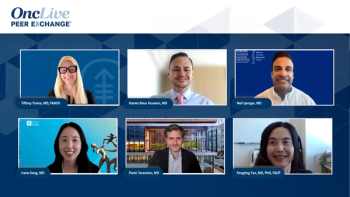
In the program's closing segment, the panel shares practical pearls and reflections for clinicians.

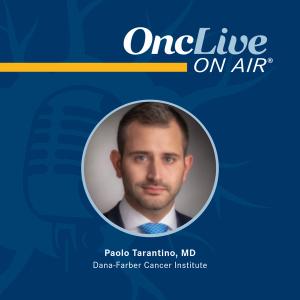
Paolo Tarantino, MD is an Advanced Research Fellow in the Breast Oncology Program at Dana-Farber Cancer Institute and Harvard Medical School.
In the program's closing segment, the panel shares practical pearls and reflections for clinicians.
The panel explores the rationale and emerging data for combining ADCs with immunotherapy and other targeted agents.
The panel discusses the notably low treatment discontinuation rates seen with ADCs in both pivotal trials compared with chemotherapy, and whether these reassuring numbers translate to real-world practice.
The panel reviews the distinct adverse event profile associated with datopotamab deruxtecan, moving from least to most common.
The panel takes a deeper look at neutropenia, one of the adverse events of special interest with sacituzumab govitecan.
Paolo Tarantino, MD, PhD, notes the emergence of TROP2-directed ADCs in first-line TNBC management and the sequencing questions their arrival raises.
Paolo Tarantino, MD, PhD, notes the implications of updated safety data with post-neoadjuvant T-DXd in high-risk, HER2-positive early breast cancer.
The panel addresses one of the field's most pressing practical questions: what to offer after a first-line ADC, acknowledging that no prospective data yet exist to guide the decision.
The panel explores how to assign value to different trial endpoints in an aggressive disease, discussing overall survival as the gold standard while considering how crossover and confounding factors complicate its interpretation, and where PFS2 fits as a measure that reflects benefit across lines of therapy.
Dr Tarantino discusses practice-informing data regarding antibody-drug conjugates in breast cancer that were presented at the 2026 ASCO Annual Meeting.
With both pivotal trials reviewed, the panel discusses how to reconcile the data when counseling an individual patient.
The panel reviews the TROPION-Breast02 findings, offering equipoise alongside the prior discussion of ASCENT-03.
The panel takes a closer look at ASCENT-03, framing it as a study designed to test whether a TROP2-directed ADC could serve as a first-line alternative to chemotherapy.
The panel turns to the design of two pivotal first-line trials, framing the discussion not as a head-to-head comparison but as a way to inform patient selection in clinic.
The panel addresses one of the more difficult challenges in metastatic TNBC: central nervous system involvement.
The panel discusses the rationale for using effective agents in the first-line metastatic setting rather than reserving them for later lines, considering the disease's aggressive course and limited expected survival alongside the trajectories seen in other breast cancer subtypes.
The panel reviews how the metastatic TNBC treatment paradigm has evolved, tracing TROP2-directed ADCs from later-line use into the first-line setting.
The panel grounds the discussion in the biology and natural history of metastatic triple-negative breast cancer, framing it as a high-proliferation subtype prone to rapid resistance, in which the first-line setting offers an important opportunity to influence outcomes. Panelists outline a biomarker-driven treatment algorithm stratified by PD-L1 status, germline BRCA status, and prior early-stage therapy, touching on immune checkpoint inhibition, PARP inhibitors, platinum-based chemotherapy, and the role of antibody-drug conjugates across lines of therapy.
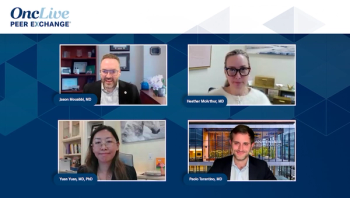
Experts discuss the potential of antibody-drug conjugates in treating triple-negative breast cancer, highlighting ongoing trials and emerging therapies.
Experts discuss the critical unmet needs in triple-negative breast cancer, highlighting innovative treatments and the importance of developing effective biomarkers.
Explore effective strategies for managing side effects of ADC therapy in triple-negative breast cancer, focusing on toxicity and patient care.
Experts discuss the sequencing of antibody-drug conjugates in breast cancer treatment, exploring optimal strategies and emerging clinical data.
Explore the promising role of trastuzumab deruxtecan in treating HER2-low triple-negative breast cancer, highlighting key trial findings and expert insights.
It seems there is no text provided for summarization. Please share the content you'd like summarized, and I'll be happy to help!
Dr. Tarantino discusses the promising results of the Trodelvy breast cancer study, highlighting its impact on treatment for high-risk patients.
Dr. Yuan discusses the ASCENT-03 trial's efficacy, crossover implications, and safety data for sacituzumab govitecan in cancer treatment.
It seems there is no text provided for summarization. Please provide the text you'd like summarized, and I'll be happy to help!
It seems there is no text provided for summarization. Please provide the text you'd like summarized, and I'll be happy to help!
Explore the latest advancements in clinical trials for early-stage triple-negative breast cancer, focusing on promising antibody-drug conjugates (ADCs).
Discover the promising advancements in TROP2-targeted antibody-drug conjugates for treating triple-negative and hormone-positive breast cancer.
September 11th 2024