



Lung Cancer
Latest News
Advertisement
Latest Videos




































































Advertisement
More News

Sotorasib provided consistent benefit over docetaxel in the majority of key prespecified molecularly defined subsets of patients with pretreated KRAS G12C–mutated non–small cell lung cancer enrolled to the phase 3 CodeBreaK 200 trial.
The addition of tumor treating fields to standard-of-care immunotherapy or chemotherapy regimens elicited an improvement in overall survival vs SOC therapies alone in patients with metastatic non-small cell lung cancer following progression on or after platinum-based chemotherapy, according to data from the phase 3 LUNAR trial.

The novel irreversible EGFR exon 20 insertion inhibitor sunvozertinib demonstrated significant clinical activity and similar safety to prior reports in Chinese patients with non–small cell lung cancer harboring EGFR exon 20 insertion mutations who progressed on prior platinum-based chemotherapy, according to results from the phase 2 WO-KONH6 study.

The addition of pembrolizumab to pemetrexed and platinum-based chemotherapy resulted in a numerical, but not statistically significant, improvement in progression-free survival or overall survival vs chemotherapy plus placebo in patients with TKI-resistant, EGFR-mutated, metastatic nonsquamous non–small cell lung cancer.

The SEZ6-targeted antibody-drug conjugate ABBV-011, when administered at 1 mg/kg every 3 weeks, was found to be well tolerated and to demonstrate early efficacy in patients with relapsed or refractory small cell lung cancer.
Nivolumab plus ipilimumab and chemotherapy continued to show durable benefit at 4 years compared with chemotherapy alone as first-line therapy in patients with advanced non–small cell lung cancer, particularly in the PD-L1–negative and squamous populations.

Roy S. Herbst, MD, PhD, discusses findings from the overall survival analysis of the phase 3 ADAURA trial of adjuvant osimertinib in patients with stage IB to IIIA resected non–small cell lung cancer harboring EGFR mutations.

Neoadjuvant nivolumab plus chemotherapy improved clinical outcomes vs chemotherapy alone in patients with resectable non–small cell lung cancer who received definitive surgery with numerical but not statistical improvements seen even when definitive surgery was not achieved.

The PD-1 and TIGIT bispecific rilvegostomig demonstrated promising early signs of tolerability and efficacy in patients with advanced or metastatic PD-L1–positive non–small cell lung cancer following progression on at least 1 prior checkpoint inhibitor. according to initial findings from the phase 1/2 ARTEMIDE-01 study.

Treatment with adjuvant osimertinib produced a statistically significant and clinically meaningful improvement in overall survival compared with placebo in patients with resected, EGFR-mutated, stage IB to IIIA non–small cell lung cancer.

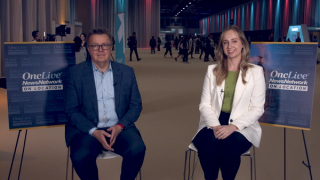
OncLive® will be LIVE with OncLive® News Network: On Location at the 2023 ASCO Annual Meeting. Each day, we will broadcast a series of interviews with top thought leaders, to learn their thoughts and reactions to data presented across oncology during the conference.

When administered at doses of 90 μg/kg or higher, the novel DLL3-targeting T-cell engager, BI 764532, was found to have an acceptable toxicity profile and to elicit encouraging responses in patients with DLL3-positive small cell lung cancer and neuroendocrine carcinoma.

The addition of pembrolizumab to neoadjuvant platinum-based chemotherapy followed by resection and adjuvant pembrolizumab alone resulted in a significant improvement in event-free survival and pathological response for patients with early-stage non–small cell lung cancer.

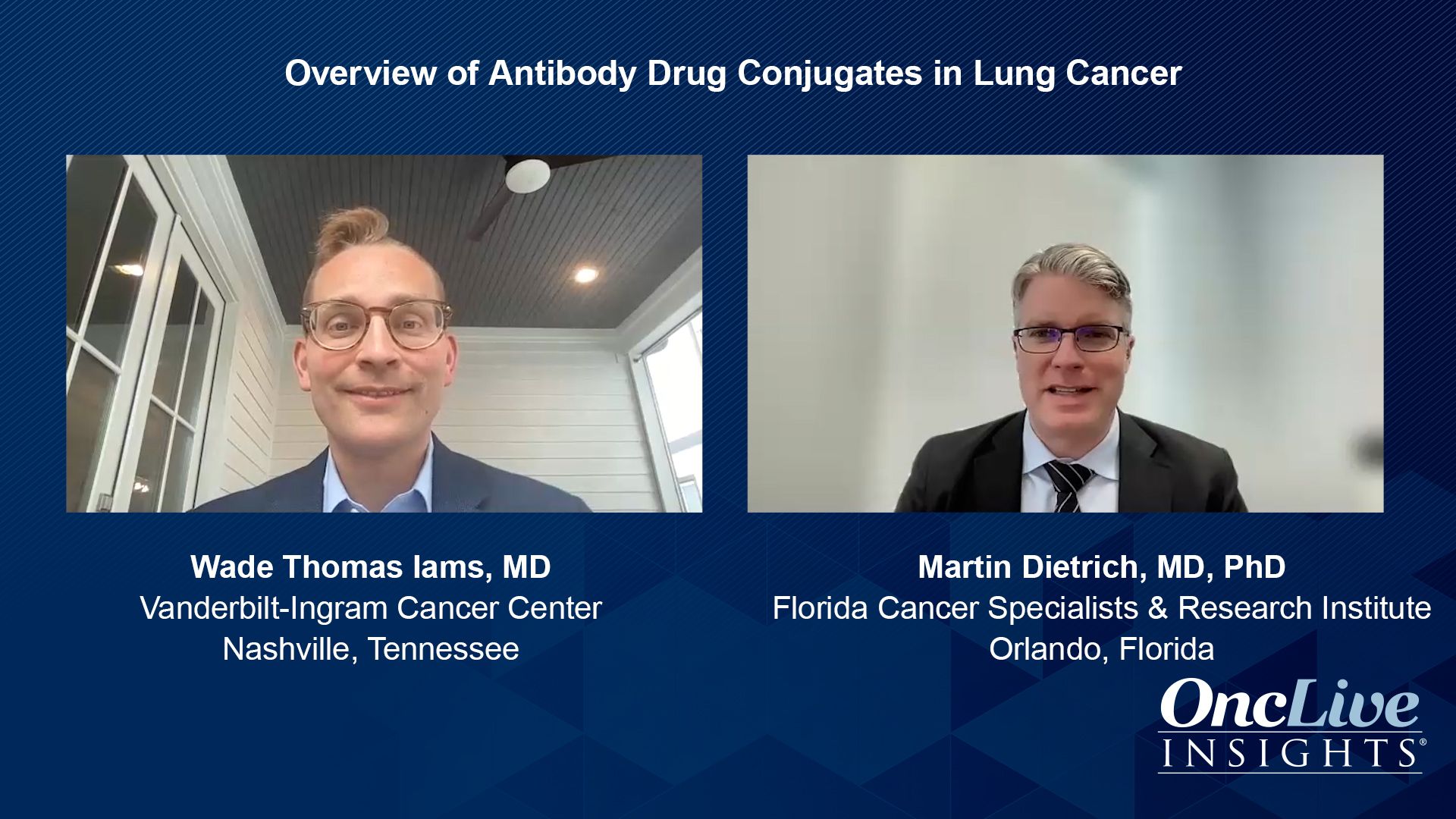
Drs Martin Dietrich and Wade Thomas Iams discuss the differences between the targets, payloads, and linker technologies of the antibody drug conjugates in development for lung cancer.
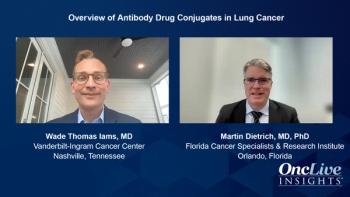
Wade Thomas Iams, MD, provides an overview of antibody drug conjugates in the treatment of patients with lung cancer, including challenges and impact on clinical practice.
Closing out their panel on immunotherapy in non–small cell lung cancer, expert oncologists share key takeaways on the selection of novel therapy in this setting.

Stephen V. Liu, MD, discusses the importance of next-generation sequencing in non–small cell lung cancer, and details trials that have continued to move this treatment arena forward.

Edgardo S. Santos, MD, FACP, discusses the evolution of osimertinib in the treatment of patients with EGFR-mutated non–small cell lung cancer and the updated data that reaffirmed its role in the adjuvant setting for this patient population.

Experts in the field share the abstracts they found to be the most practice changing at this year’s ASCO Annual meeting.
Edgardo S. Santos, MD, FACP, discusses the impact of treatment with cemiplimab plus chemotherapy in patients with squamous non–small cell lung cancer.

The safety review committee for the phase 1/2 Acclaim-1 trial has ruled that the study evaluating quaratusugene ozeplasmid in combination with osimertinib in patients with advanced non–small cell lung cancer can proceed to the phase 2 expansion portion.

The FDA has granted priority review to repotrectinib for the treatment of patients with ROS1-positive locally advanced or metastatic non–small cell lung cancer.

Henry S. Park, MD, MPH, discusses the importance of considering radiation therapy in patients with non–small cell lung cancer and how this therapeutic approach can work in concert with targeted therapy and other systemic therapies.

The European Medicines Agency’s Committee for Medicinal Products for Human Use has recommended the approval of nivolumab as neoadjuvant therapy in combination with platinum-based chemotherapy for patients with resectable non–small cell lung cancer at high risk of recurrence and tumor cell PD-L1 expression of at least 1%.

A brief review of the POSEIDON trial, which analyzed durvalumab with or without tremelimumab in combination with chemotherapy in advanced NSCLC.
Advertisement
Advertisement
Trending on OncLive
1
FDA Approves Tucatinib Plus Trastuzumab/Pertuzumab as First-Line Maintenance in Advanced HER2+ Breast Cancer
2
Five Under 5: Top Oncology Videos for the Week of 10/5/2026
3
GI Cancer Monthly Rewind: Key News and Expert Insights You May Have Missed in September 2026
4
FDA Grants Fast Track Designation to PSV359 for Advanced FAP-Positive Solitary Fibrous Tumors
5