






Lung Cancer
Latest News
Advertisement
Latest Videos
































































Advertisement
More News
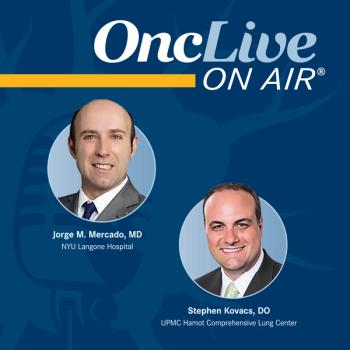
Drs Mercado and Kovacs discuss the importance of multidisciplinary approaches to lung cancer screening and management, barriers to lung cancer screening that affect how early certain patients are diagnosed with this disease, and where the future of lung cancer detection and treatment is headed.
The FDA has granted a fast track designation to SynKIR-110 for the treatment of patients with mesothelioma.

Single-agent liposomal irinotecan resulted in a similar median overall survival and progression-free survival to that achieved with topotecan in patients with small cell lung cancer that had progressed on or following frontline platinum-based chemotherapy.

First-line cemiplimab monotherapy or in combination with platinum-based chemotherapy conferred long-term clinical benefit to patients with unresectable, locally advanced non–small cell lung cancer who were ineligible for concurrent chemoradiation.

Janeesh Sekkath Veedu, MBBS, discusses the survival advantage conferred by surgical-based treatment compared with definitive chemoradiation in patients with stage IIIA non–small cell lung cancer.

Adagrasib induced high overall response rates in patients with KRAS G12C–mutated non–small cell lung cancer who achieved at least 90% mutation allele frequency clearance.

Data for adjuvant atezolizumab following neoadjuvant atezolizumab and resection demonstrated an improvement in disease-free survival and a trend toward improved overall survival in patients with resectable stage IB to IIIB non–small cell lung cancer compared with those who did not receive adjuvant atezolizumab.

The FDA has accepted for review supplemental new drug applications for the combination of encorafenib and binimetinib for the treatment of patients with metastatic non–small cell lung cancer harboring a BRAF V600E mutation, as detected by an FDA-approved test.

Treatment with eftilagimod alpha plus pembrolizumab resulted in tumor shrinkage and a tolerable safety profile in patients with anti–PD-1/PD-L1–resistant non–small cell lung cancer.
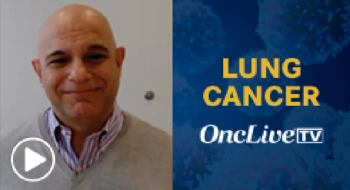
Khaled Hassan, MD, discusses key results from the phase 1 CHRYSALIS trial of the bispecific antibody amivantamab-vmjw in non–small cell lung cancer expressing EGFR exon 20 insertion mutations.

Second-line atezolizumab plus cabozantinib did not generate a clinical benefit over standard-of-care docetaxel in patients with metastatic non–small cell lung cancer previously treated with immune checkpoint inhibitors and chemotherapy.

The combination of tusamitamab ravtansine and pembrolizumab with or without chemotherapy generated responses and was well tolerated when used as first-line treatment for patients with CEACAM5-positive nonsquamous non–small cell lung cancer.

Frontline cemiplimab plus chemotherapy improved overall survival and progression-free survival compared with investigator’s choice of chemotherapy for patients with PD-L1–positive non–small cell lung cancer that has metastasized to the brain.

The use of 4 cycles of chemotherapy plus durvalumab with or without tremelimumab-actl was associated with improved or sustained response and similar toxicity compared with chemotherapy alone as frontline therapy in patients with metastatic non–small cell lung cancer, according to post hoc exploratory findings from the phase 3 POSEIDON trial.

Taletrectinib continued to demonstrate meaningful efficacy in the form of a durable objective response rate and a high intracranial ORR with acceptable tolerability in both TKI-naïve and crizotinib-pretreated patients with ROS1-positive non–small cell lung cancer.

Brian Mitzman, MD, FACS, FCCP, discusses the use of adjuvant atezolizumab following platinum-based chemotherapy in patients with resectable non–small cell lung cancer.

The addition of cemiplimab to platinum-doublet chemotherapy continued to provide a clinically meaningful and statistically significant improvement in clinical benefit over chemotherapy alone in patients with advanced non–small cell lung cancer, irrespective of histology or PD-L1 expression level.

Neoadjuvant nivolumab plus chemotherapy produced a long-term event-free survival benefit vs chemotherapy alone in patients with resectable non–small cell lung cancer, independent of whether patients underwent minimally invasive surgery or thoracotomy or complete or partial resection of the lung.

Amivantamab continued to be tolerable and efficacious in patients with non–small cell lung cancer harboring EGFR exon 20 insertion mutations whose disease progressed on platinum-based chemotherapy.

Up-front treatment with osimertinib reduced the risk of brain progression-free survival but provided a comparable overall survival benefit compared with sequential treatment with gefitinib followed by osimertinib in patients with advanced non–small cell lung cancer harboring EGFR mutations.

The European Commission has approved cemiplimab-rwlc plus platinum-based chemotherapy for the frontline treatment of patients with locally advanced or metastatic PD-L1–positive non–small cell lung cancer without EGFR, ALK, or ROS1 alterations and who are not eligible for chemoradiation.

Maya Khalil, MD, discusses key clinical trial updates on the use of nivolumab and ipilimumab with or without chemotherapy in non–small cell lung cancer.
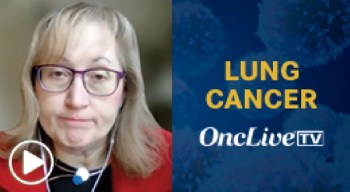
Julie Renee Brahmer, MD, discusses the use of tremelimumab plus durvalumab and platinum-based chemotherapy for the first-line treatment of patients with non–small cell lung cancer, and how decisions can be made between this regimen and nivolumab plus ipilimumab and chemotherapy.
Brian Mitzman, MD, FACS, FCCP, discusses the emergence of immunotherapy as a treatment option for patients with early-stage non–small cell lung cancer.

Anne Chiang, MD, PhD, discusses recent advancements in the biological understanding and treatment of small cell lung cancer.
Advertisement
Advertisement
Trending on OncLive
1
FDA Approves Tucatinib Plus Trastuzumab/Pertuzumab as First-Line Maintenance in Advanced HER2+ Breast Cancer
2
FDA Grants Breakthrough Device Designation to Natera’s Multi-Cancer Early Detection Assay
3
Five Under 5: Top Oncology Videos for the Week of 10/5/2026
4
GI Cancer Monthly Rewind: Key News and Expert Insights You May Have Missed in September 2026
5