




Lung Cancer
Latest News

January 5th 2023
By Chris Ryan
Tumor treating fields plus standard-of-care therapies led to a statistically significant and clinically meaningful improvement in overall survival vs SOC alone in patients with stage IV NSCLC who progressed while on or after platinum chemotherapy, meeting the primary end point of the LUNAR trial.

EMA Validates Type II Application for Trastuzumab Deruxtecan in Advanced HER2-Mutated NSCLC
By Jason Harris
Advertisement
Latest Videos




































































Advertisement
More News

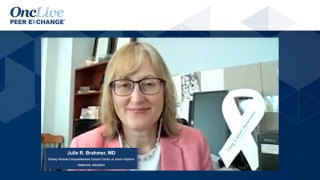
Centering discussion on KRAS inhibitors and associated clinical trials, Martin Dietrich, MD, PhD, and Joshua Sabari, MD, detail the second-line management of KRAS G12C–mutated non–small cell lung cancer.

Konstantinos Leventakos, MD, PhD, discusses the emergence of immunotherapy and lurbinectedin as beneficial treatments in small cell lung cancer, where osimertinib fits into the non–small cell lung cancer treatment paradigm, and more.

Key opinion leaders identify the first-line treatment armamentarium for patients with KRAS G12C–mutated non–small cell lung cancer.
A brief review of how results from adequate molecular testing may help to inform the first-line management of non–small cell lung cancer.

Before closing out their discussion on IO therapy in non–small cell lung cancer, Melissa Johnson, MD, and Joshua Sabari, MD, identify treatment strategies in the setting of concomitant KRAS/p53 mutation.

The combination of domvanalimab plus zimberelimab with or without etrumadenant generated an improvement in overall response rate and progression-free survival compared with zimberelimab alone in patients with PD-L1–high metastatic non–small cell lung cancer, according to findings from the phase 2 ARC-7 trial.
The FDA’s accelerated approval of adagrasib for adult patients with KRAS G12C–mutated locally advanced or metastatic non–small cell lung cancer who have received at least 1 prior systemic therapy has provided a second KRAS G12C inhibitor option for patients.
The FDA has approved the FoundationOne® Liquid CDx as a companion diagnostic to identify patients with non–small cell lung cancer whose tumors have EGFR exon 19 deletions or exon 21 L858R substitutions.
The FDA has approved an additional indication for pemetrexed by injection, an alternative to standard pemetrexed, in combination with pembrolizumab and platinum-based chemotherapy for the initial treatment of patients with metastatic, nonsquamous non–small cell lung cancer without EGFR or ALK genomic tumor aberrations.

Durvalumab monotherapy failed to elicit a statistically significant improvement in overall survival vs platinum-based chemotherapy as frontline treatment in patients with stage IV non–small cell lung cancer with at least 25% positivity of PD-L1 on tumor cells, or in a subgroup of patients at low risk of early mortality.
The United Kingdom’s Medicines and Healthcare Products Regulatory Agency has accepted a marketing authorization application seeking approval for sugemalimab plus chemotherapy as first-line treatment for patients with metastatic non–small cell lung cancer.
The FDA has approved a new indication for pafolacianine to aid surgeons in detecting lung cancer lesions in adult patients with known or suspected lung cancer.

Stephen V. Liu, MD, discusses the effect of the FDA approval of atezolizumab on the development of other chemoimmunotherapy regimens and ongoing efforts to expand and individualize treatment options in small cell lung cancer.

Shared perspectives on the emerging strategies for the management of non–small cell lung cancer following the identification of KRAS/STK11, or KRAS/KEAP1 mutations.
A comprehensive discussion on how to overcome barriers that may inhibit access to adequate molecular testing in patients with non–small cell lung cancer.

Contextualizing treatment selection with the POSEIDEN and CheckMate 9LA clinical trials, experts consider how to select the optimal treatment for patients with concomitant KRAS/STK11, or KRAS/KEAP1–mutated NSCLC.
Expert perspectives on course-correcting the management of patients with NSCLC who may not have received adequate molecular profiling in the past.

Dr Johnson discusses the FDA approval of tremelimumab plus durvalumab and chemotherapy in non–small cell lung cancer, key data from the POSEIDON trial, and the combination’s efficacy and tolerability in various patient populations.

Daiichi Sankyo has filed a supplemental new drug application with Japan’s Ministry of Health, Labor, and Welfare for the use of fam-trastuzumab deruxtecan-nxki in adults with previously treated HER2-mutant unresectable advanced or recurrent non–small cell lung cancer.

Jorge M. Mercado, MD, discusses the effect of the COVID-19 pandemic on lung cancer screening.
The FDA has issued an accelerated approval for the Agilent Resolution ctDx FIRST assay for plasma as a companion diagnostic for adagrasib.

Alexander I. Spira, MD, PhD, FACP, discusses the FDA approval of adagrasib in patients with KRAS G12C–mutated non–small cell lung cancer.
The FDA has granted accelerated approval to adagrasib (Krazati) for the treatment of adult patients with KRAS G12C–mutated locally advanced or metastatic non–small cell lung cancer, as determined by an FDA-approved test, who have received at least 1 prior systemic therapy.

Manish Patel, DO, discusses updates in treatment with a PD1 and CTLA-4 inhibitor in non–small cell lung cancer.
Shared insight on best practices in non–small cell lung cancer management to utilize molecular testing and identify patients harboring KRAS G12C mutations.
Advertisement
Advertisement
Trending on OncLive
1
FDA Approves Tucatinib Plus Trastuzumab/Pertuzumab as First-Line Maintenance in Advanced HER2+ Breast Cancer
2
GI Cancer Monthly Rewind: Key News and Expert Insights You May Have Missed in September 2026
3
Five Under 5: Top Oncology Videos for the Week of 10/5/2026
4
FDA Grants Breakthrough Device Designation to Natera’s Multi-Cancer Early Detection Assay
5