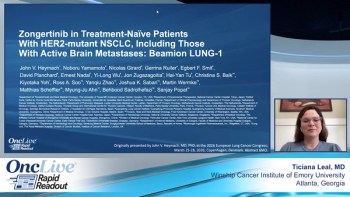
Ticiana Leal, MD, discusses clinical considerations surrounding the diagnosis of LEMS in patients with lung cancer.

Your AI-Trained Oncology Knowledge Connection!


Ticiana A. Leal, MD, is an associate professor and director of the Thoracic Medical Oncology Program in the Department of Hematology and Medical Oncology at Emory University School of Medicine in Atlanta, Georgia; as well as medical director of the Clinical Trials Office and leader of the Lung Cancer Disease Team at the Winship Cancer Institute of Emory University

Ticiana Leal, MD, discusses clinical considerations surrounding the diagnosis of LEMS in patients with lung cancer.

Experts discuss the persistent challenges in EGFR-mutated non–small cell lung cancer , including central nervous system (CNS) progression and treatment sequencing, emphasizing the urgent need for more transformative strategies beyond current combination regimens, greater inclusion of complex patient populations in trials, and the critical role of comprehensive biomarker testing and shared decision-making in delivering personalized, future-forward care.

Experts discuss the expanding treatment landscape for EGFR-mutated non–small cell lung cancer (NSCLC), highlighting emerging strategies beyond tyrosine kinase inhibitors (TKIs)—including novel immunotherapy combinations and antibody-drug conjugates (ADCs)—with particular interest in bispecific antibodies and TROP2-directed ADCs that may offer new options for patients progressing on targeted therapy, despite ongoing challenges in translating immune-based approaches into consistent survival gains.

Experts discussed how, despite several new third-generation EGFR tyrosine kinase inhibitors (TKIs) in development, the real progress in treating EGFR-mutant lung cancer is likely to come from combination therapies rather than new monotherapies, emphasizing the need for treatments that deliver meaningful improvements over current standards rather than just incremental changes.

Resistance management in EGFR-mutant lung cancer relies on both liquid and tissue biopsies to guide therapy, with careful interpretation of molecular findings and multidisciplinary collaboration essential to balancing precision medicine advances against patient safety and evidence-based care.

Panelists discuss how the next 3 to 5 years will likely see T-cell engagers moving into earlier treatment lines, potential ADCs replacing chemotherapy in first-line therapy, and the critical need for better biomarker testing to optimize treatment sequencing and patient selection in an increasingly complex therapeutic landscape.

Panelists discuss novel and investigational therapies under study for small cell lung cancer, including immunotherapy combinations and targeted approaches.

Panelists discuss real-world experiences with novel agents for relapsed small cell lung cancer, focusing on efficacy, safety, and patient selection.

Panelists discuss treatment decision-making in second-line small cell lung cancer, balancing efficacy, toxicity, and patient-specific factors.

Panelists discuss the importance of shared decision-making, patient communication, and adherence strategies in small cell lung cancer treatment.

Panelists discuss therapeutic strategies for recurrent small cell lung cancer with central nervous system involvement, emphasizing adverse event (AE) management and patient support.

Panelists discuss the clinical relevance of emerging trial data evaluating combination maintenance strategies and their potential role in practice.

Panelists discuss practical considerations in selecting first-line regimens and managing maintenance therapy in patients responding to initial treatment.

Panelists review key clinical trial data demonstrating the efficacy and safety of chemo-immunotherapy regimens in extensive-stage small cell lung cancer.

Panelists discuss the diagnostic evaluation and staging process for extensive-stage small cell lung cancer, emphasizing comprehensive imaging and laboratory workup to guide initial treatment planning.

Panelists discuss how patient and disease factors, such as performance status, comorbidities, and extent of metastases, influence first-line treatment selection in small cell lung cancer.

Experts shared that while amivantamab combined with chemotherapy in MARIPOSA- 2 can cause challenging toxicities, careful dose adjustments, premedication, and vigilant monitoring help manage adverse effects and support continued treatment.

Experts highlight evolving evidence that continuing EGFR tyrosine kinase inhibitors (TKIs) with chemotherapy after progression may improve outcomes, but emphasize that treatment sequencing decisions must be personalized based on emerging data, patient factors, and drug availability.

Panelists discuss how emerging therapies including DLL3-targeted ADCs, trispecific T-cell engagers, CAR T cells, and radioligand therapies represent promising approaches that may offer single-dose treatments or enhanced efficacy, though more data on durability and optimal sequencing are needed.

Panelists discuss how antibody-drug conjugates targeting B7-H3 show impressive response rates compared to historical controls, while T-cell engagers remain the priority for second-line therapy due to their demonstrated durability, though patient preferences and contraindications may influence individual treatment decisions.

Experts discuss the promise of subcutaneous (SubQ) amivantamab in improving logistical efficiency and reducing infusion-related reactions in the MARIPOSA regimen, while emphasizing that chronic toxicities persist regardless of administration route, underscoring the ongoing need for proactive monitoring, supportive care, and close clinical oversight.

Experts discuss the cumulative toxicities of pemetrexed in the FLAURA2 regimen, emphasizing the need for personalized, flexible approaches to maintenance therapy duration that balance ongoing efficacy with tolerability, guided by patient-specific factors and real-world clinical experience.

Panelists discuss how tarlatamab implementation requires careful infrastructure planning, including 24-hour monitoring capabilities, staff education about cytokine release syndrome management, patient counseling, and coordination with community partners to ensure all eligible patients have access to this standard-of-care therapy.

Panelists discuss how neutropenia management varies widely across institutions, with some using primary prophylaxis with G-CSF or trilaciclib, while others tailor supportive care based on individual patient risk factors including age, comorbidities, and prior treatment tolerance.

Experts discuss the critical role of toxicity management in deciding whether to use amivantamab/lazertinib up-front or in later lines, highlighting the need for intensive supportive care, coordinated care teams, and structured patient education to navigate the regimen’s unique and often burdensome adverse effect profile.

Experts discuss the comparative merits of FLAURA2 and MARIPOSA frontline regimens for EGFR-mutant non–small cell lung cancer, noting similar survival benefits but highlighting key differences in toxicity profiles, supportive care demands, and real-world practicality that make individualized patient counseling essential to treatment selection.

Panelists discuss how monitoring for long-term immunotherapy toxicities requires regular imaging and symptom assessment, with early recognition and treatment of pneumonitis, hypothyroidism, and adrenal insufficiency being critical for maintaining patients on therapy and preventing chronic complications.

Panelists discuss how managing toxicities during chemoradiation requires proactive counseling about esophagitis and fatigue, while immunotherapy consolidation typically doesn’t enhance these acute toxicities, making it feasible to start within the recommended timeframe after completion of chemoradiation.

Experts discuss the vital role of shared decision-making in lung cancer treatment, emphasizing personalized, ongoing conversations that align therapy choices with patients’ values, quality-of-life considerations, and life circumstances to support informed and compassionate care.

Experts discuss a key finding from FLAURA2 showing that many patients never reach second-line therapy, reinforcing the importance of delivering the most effective treatment—such as combination therapy—up-front, particularly when patients are fit, as real-world barriers and rapid progression may limit later opportunities for intervention.

Published: July 9th 2024 | Updated:

Published: May 11th 2022 | Updated:

Published: May 11th 2022 | Updated:

Published: November 9th 2023 | Updated:

Published: October 19th 2023 | Updated:

Published: February 21st 2022 | Updated: