




Lung Cancer
Latest News

Advertisement
Latest Videos



































































Advertisement
More News
Logan Roof, MD, discusses the importance of investigating demographic disparities that exist in lung cancer mortality, expands on the results of the population-based CDC database analysis, and discusses potential next steps to address these disparities in the future.
A supplemental biologics license application seeking the expanded approval of amivantamab-vmjw in combination with carboplatin plus pemetrexed for use in the frontline treatment of patients with locally advanced or metastatic non–small cell lung cancer harboring EGFR exon 20 insertion mutations has been submitted to the FDA.

Pasi A. Jänne, MD, PhD, discusses the advantages of bispecific ADCs that target both HER3 and EGFR; preliminary efficacy and safety data seen with BL-B01D1 in patients with non–small cell lung cancer; and the activity of this agent in patients with head and neck squamous cell carcinoma, small cell lung cancer, and nasopharynx cancer.

Gregory Peter Kalemkerian, MD, discusses the unmet needs associated with the investigation of combination chemoimmunotherapy in the frontline treatment of patients with extensive-stage small cell lung cancer.
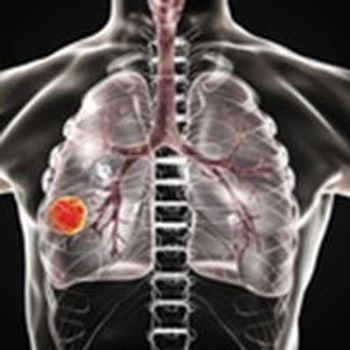
The National Medical Products Administration of China has approved sunvozertinib for use in adult patients with locally advanced or metastatic non–small cell lung cancer harboring EGFR exon 20 insertion mutations whose disease has progressed on or following platinum-based chemotherapy.

Japan’s Ministry of Health, Labour, and Welfare has approved fam-trastuzumab deruxtecan-nxki for use in adult patients with unresectable advanced or recurrent, HER2-mutant non–small cell lung cancer that has progressed following chemotherapy.

The addition of the investigational anti-TIGIT immunotherapy tiragolumab to atezolizumab demonstrated a numerical but not statistically significant improvement in overall survival vs atezolizumab alone as frontline therapy for patients with PD-L1–high, locally advanced or metastatic non–small cell lung cancer.
Antonia Sepulveda, MD, PhD, an expert on NSCLC, outlines discrepancies in molecular testing between academic and community settings.
Focused discussion on tissue testing and the effect of turnaround time on NSCLC treatment and molecular testing strategies.

Furmonertinib had efficacy and an acceptable toxicity profile when utilized as adjuvant treatment in EGFR-mutated, stage IA2-IIIA non–small cell lung cancer with high-risk pathological factors who have undergone radical surgery

Ahmed Megahed, MBBCh, discusses the rationale for investigating the effects of next-generation sequencing on first-line treatment decisions for patients with stage IV non–small cell lung cancer.

Edgardo S. Santos, MD, FACP, discusses key survival data from the pivotal phase 3 ADAURA trial in early-stage non–small cell lung cancer.

Erminia Massarelli, MD, PhD, MS, discusses unmet needs in the treatment of patients with small cell lung cancer that were discussed at the 2023 Bridging the Gaps in Lung Cancer meeting, as well as how further research may help mitigate these needs.

The natural killer T-cell agonist IMM60 may overcome resistance to PD-1 inhibitors when combined with immunotherapy in patients with melanoma and non–small cell lung cancer.

Treatment with repotrectinib continued to produce high and durable responses with a manageable safety profile in patients with ROS1-positive locally advanced or metastatic non–small cell lung cancer who were naïve to a TKI or previously treated with 1 TKI and no chemotherapy.

Alexander I. Spira, MD, PhD, FACP, discusses a phase 1 study of the antibody-drug conjugate MYTX-011 in patients with non–small cell lung cancer.
Expert oncologists compare the logistics and sensitivities of liquid and tissue biopsies in the treatment of non–small cell lung cancer.
A panel of experts on the treatment of non–small cell lung cancer (NSCLC) discuss the role of biomarker testing and review testing strategies.

Angel Qin, MD, discusses her process when choosing between targetable agents for patients with EGFR exon 20–mutated lung cancer.
The FDA has granted an orphan drug designation to quratusugene ozeplasmid (Reqorsa) for the treatment of patients with small cell lung cancer.

Treatment with the folate receptor–α antibody-drug conjugate BAT8006 led to responses with a manageable safety profile in patients with advanced solid tumors, including ovarian cancer, breast cancer, and cervical cancer.

Before closing out their first module, expert oncologists consider novel treatment strategies and agents in the frontline setting of stage small cell lung cancer.
A panel of expert oncologists offer closing thoughts on the future treatment landscape and unmet needs in small-cell lung cancer.

Laurent Greiller, MD, and Christian Grohé, MD, consider real-world data and adverse events observed with frontline chemoimmunotherapy in small cell lung cancer.

Helena A. Yu, MD, discusses the investigation of BL-B01D1 in patients with advanced solid tumors, the potential significance of this research for those with EGFR-mutant and wild-type disease, and the expanding body of evidence supporting continued antibody-drug conjugate development in non–small cell lung cancer.
Advertisement
Advertisement
Trending on OncLive
1
FDA Approves Tucatinib Plus Trastuzumab/Pertuzumab as First-Line Maintenance in Advanced HER2+ Breast Cancer
2
GI Cancer Monthly Rewind: Key News and Expert Insights You May Have Missed in September 2026
3
Five Under 5: Top Oncology Videos for the Week of 10/5/2026
4
FDA Grants Fast Track Designation to PSV359 for Advanced FAP-Positive Solitary Fibrous Tumors
5