




Lung Cancer
Latest News

October 10th 2023
By Kristi Rosa
Pembrolizumab plus chemotherapy prior to surgery, followed by resection and single-agent pembrolizumab in the adjuvant setting, significantly improved overall survival vs neoadjuvant placebo plus chemotherapy followed by adjuvant placebo in patients with resectable stage II, IIIA, or IIIB (T3-4N2) non–small cell lung cancer, meeting the dual primary end point of the phase 3 KEYNOTE-671 trial.
Advertisement
Latest Videos
































































Advertisement
More News
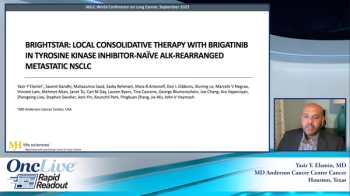
Expert oncologist Yasir Elamin, MD, shares data from the BRIGHTSTAR trial and considers how it may inform real-world use of brigatinib in patient with ALK-rearranged metastatic non–small cell lung cancer.
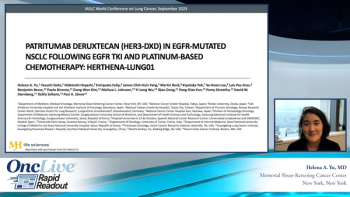
Expert oncologist Helena Yu, MD, reviews data from HERTHENA-Lung01 following the IASLC 2023 World Conference on Lung Cancer and considers how patritumab deruxtecan will fit into clinical practice.
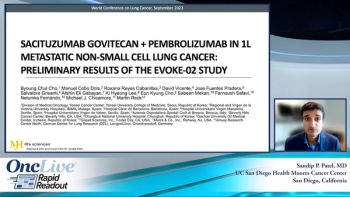
Sandip P. Patel, MD, reviews data from the preliminary results of the EVOKE-02 study investigating sacituzumab govitecan plus pembrolizumab in first-line metastatic non–small cell lung cancer.

The FDA has granted a fast track designation to BI 764532 for the treatment of patients with extensive-stage small cell lung cancer that has progressed following at least 2 prior lines of treatment, and for patients with advanced or metastatic extrapulmonary neuroendocrine carcinoma that has progressed following at least 1 prior line of treatment.

The focus turns to therapeutic strategies for treating MET exon 14 non–small cell lung cancer.
Experts on non–small cell lung cancer share their approaches to treating patients who have RET fusions and review updates on selpercatinib and pralsetinib.

Takeda has announced plans to voluntarily withdraw mobocertinib in the United States for adult patients with EGFR exon 20 insertion mutation–positive, locally advanced or metastatic non–small cell lung cancer whose disease has progressed on or following platinum-based chemotherapy.

The FDA has granted an orphan drug designation to alisertib (MLN8237) for the treatment of patients with extensive-stage small cell lung cancer.
Mitchell Machtay, MD, discusses the association between the levels of circulating immune biomarkers prior to immunotherapy and survival outcomes in patients with stage III non-small cell lung cancer.

Biagio Ricciuti, MD, discusses the association between PD-L1 expression levels and long-term survival with anti–PD-L1 monotherapy in patients with advanced non–small cell lung cancer.

The expert panel discusses the history of antibody-drug conjugates and explores their mechanisms of action.
A panel of cancer-treating specialists introduce the discussion with a broad overview of antibody-drug conjugates (ADCs).

J. Nicholas Bodor, MD, PhD, MPH, discusses the results of prior research supporting the inception of a study that profiled reactive estrogen species in women with EGFR-positive non–small cell lung cancer, as well as the findings from this study.

Jacqueline Aredo, MD, MS, discusses findings from a study assessing the molecular distribution of driver mutations and tumor suppressor gene mutations in patients with non–small cell lung cancer who are eligible for lung cancer screening.

First-line treatment with the combination of amivantamab and lazertinib resulted in a statistically significant and clinically meaningful improvement in progression-free survival compared with osimertinib in patients with locally advanced or metastatic non–small cell lung cancer harboring EGFR mutations.

Treatment with the combination of sotorasib carboplatin, and pemetrexed produced responses and demonstrated safety in patients with KRAS G12C–mutated, advanced non–small cell lung cancer, according to data from the phase 1/2 CodeBreaK 101 trial.

Arutha Kulasinghe, PhD, discusses findings from a study profiling the tumor microenvironment of non–small cell lung cancer, as well as future directions planned with this research and the implications of these findings.
Andrea Billè, MD, discusses findings from a propensity-matched comparison of minimally invasive surgery vs stereotactic ablative radiotherapy in patients with clinical stage I non–small cell lung cancer.

The FDA has granted fast track designation to MYTX-011 for use as a potential therapeutic option in patients with non–small cell lung cancer and cMET overexpression.

Emerging data in the neoadjuvant setting and the expansion of testing in standard practice have presented questions surrounding screening for and developing strategies from variant information in EGFR-mutated resectable non–small cell lung cancer.
Julie R. Brahmer, MD, and Joshua K. Sabari, MD, review recent data on entrectinib and larotrectinib for the treatment of patients with NSCLC with NTRK fusions.
The expert panel discusses factors that influence treatment decisions when choosing appropriate therapy for patients with ALK-rearranged NSCLC.

Jonathan W. Riess, MD, MS, discusses preliminary results from a phase 2 trial of the IO102-IO103 immuno-modulating cancer vaccine plus pembrolizumab in patients with metastatic non–small cell lung cancer adenocarcinoma.

Joachim G. J. V. Aerts, MD, PhD, discusses findings from the phase 3 DENIM trial in patients with mesothelioma, which was presented at the International Association for the Study of Lung Cancer 2023 World Conference on Lung Cancer.

The 18th Annual New York Lung Cancers Symposium, scheduled for November 11, 2023, as a live meeting in New York, New York, boasts an agenda that covers a broad range of modern clinical topics.
Advertisement
Advertisement
Trending on OncLive
1
FDA Approves Tucatinib Plus Trastuzumab/Pertuzumab as First-Line Maintenance in Advanced HER2+ Breast Cancer
2
FDA Grants Breakthrough Device Designation to Natera’s Multi-Cancer Early Detection Assay
3
Five Under 5: Top Oncology Videos for the Week of 10/5/2026
4
GI Cancer Monthly Rewind: Key News and Expert Insights You May Have Missed in September 2026
5